ragnar digital collection · 作品展 exhibit of works

computer technique group コンピュータ・テクニック・グループ

tokyo 1966–1969
exemplary works and materials from the pioneering group of computer art
3D walkthrough →

Collection Ephemera

CTG in Print
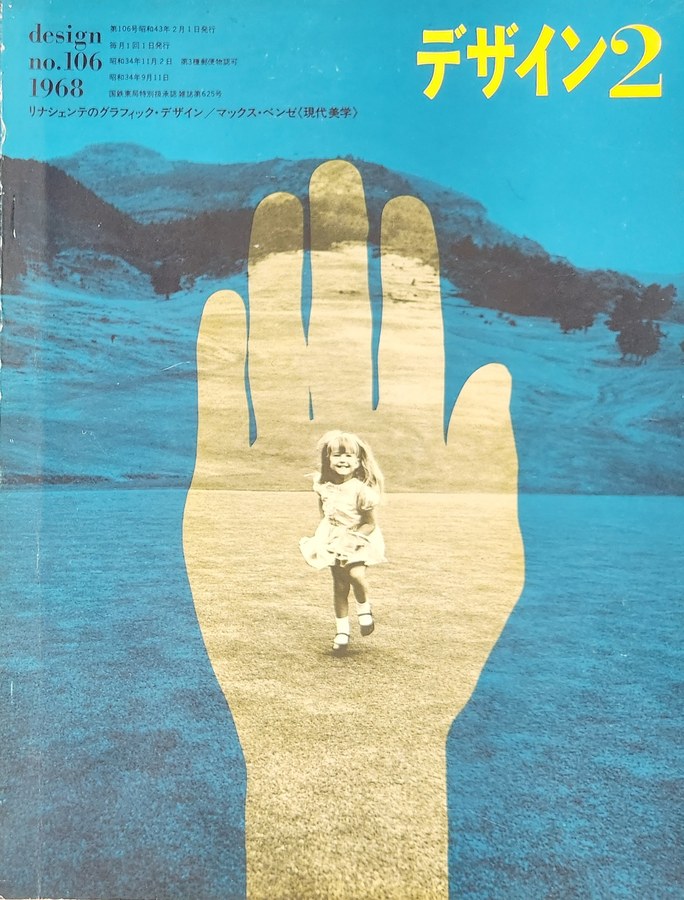
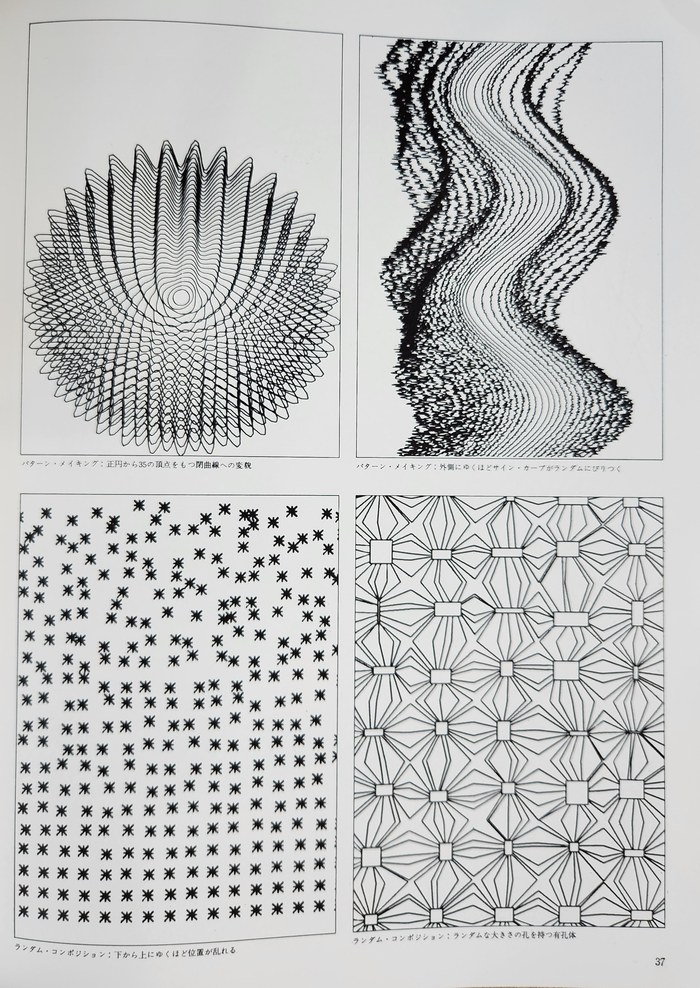
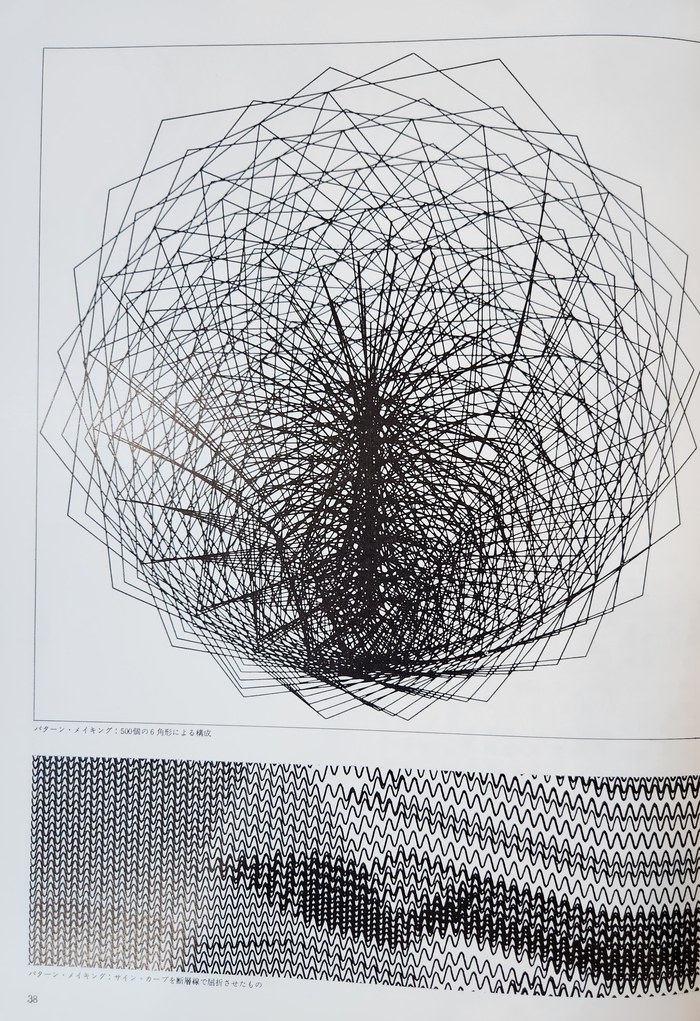
Design magazine no. 106, February 1968

Design デザイン, no. 106

February 1968 · Magazine · Bijutsu Shuppan-sha

First installment of CTG’s three-part serial on computer graphic design in the Tokyo design monthly, written months before Cybernetic Serendipity made CTG internationally known. Includes an essay by Max Bense, “Contemporary Aesthetics.”
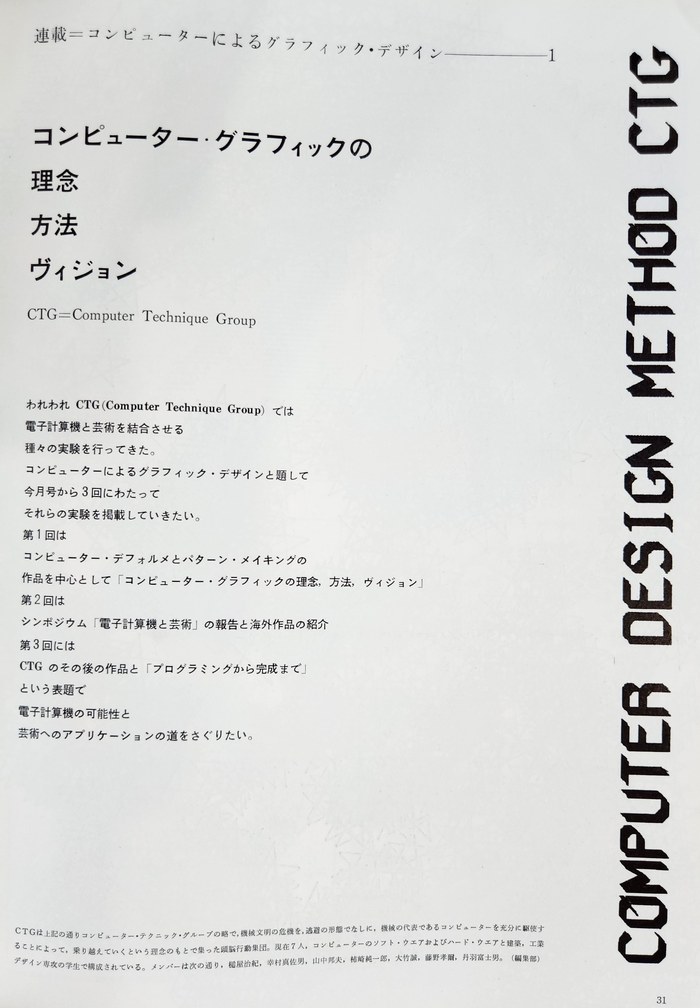
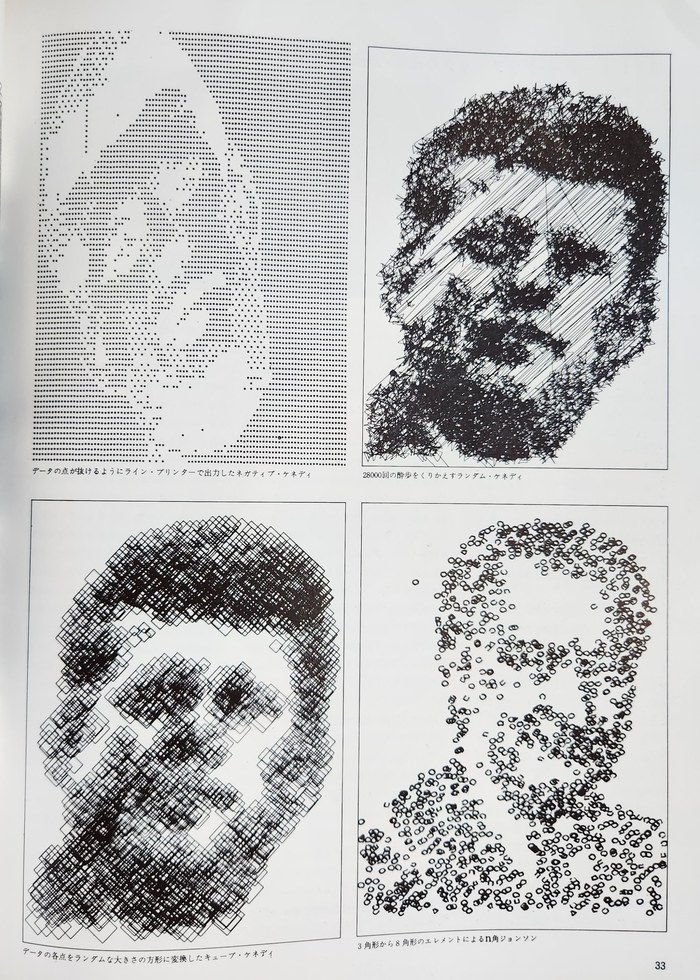
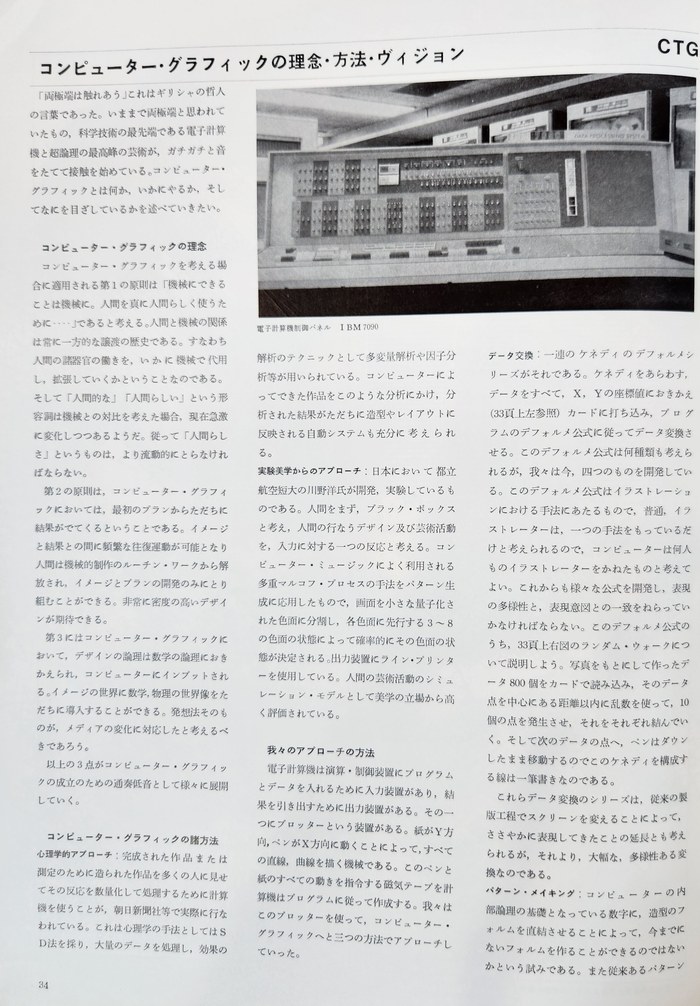
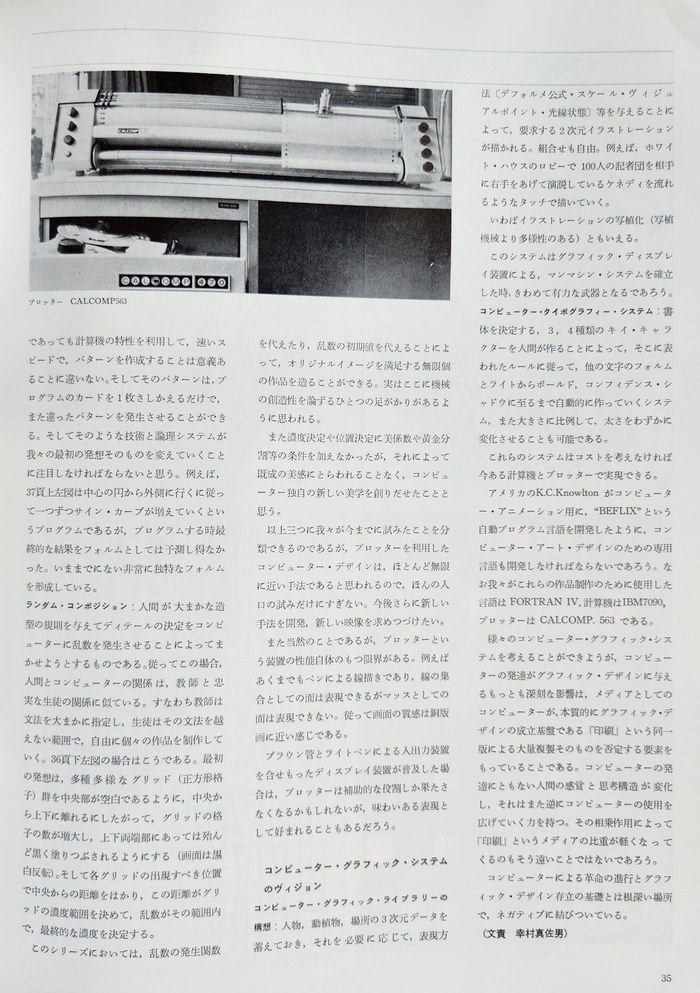
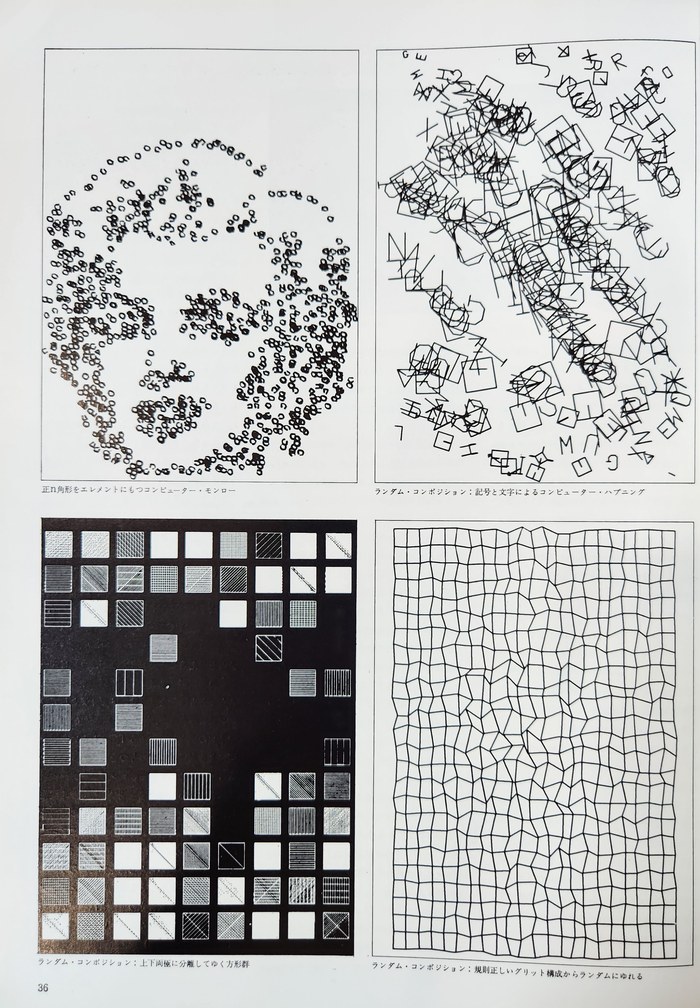
Design no. 106 page 31: the serial's opening page, with the editors' note on CTG and its seven members Design no. 106 page 33: Negative Kennedy, Random Kennedy, Cube Kennedy and n-gon Johnson Design no. 106 page 34: the essay's opening, with a photograph of the IBM 7090 control panel Design no. 106 page 35: the CalComp 563 plotter, and the closing section on a vision for computer graphic systems Design no. 106 page 36: Computer Monroe and three random compositions Design no. 106 page 37: four pattern-making and random-composition plates Design no. 106 page 38: a composition of 500 hexagons, and sine curves refracted along fault lines
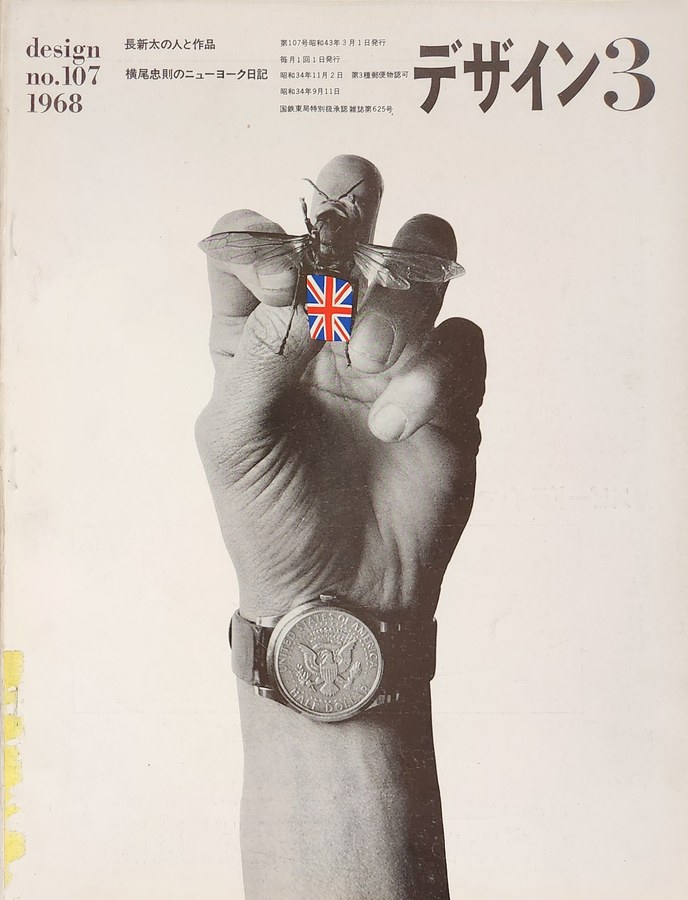
Design magazine no. 107, March 1968

Design デザイン, no. 107

March 1968 · Magazine · Bijutsu Shuppan-sha

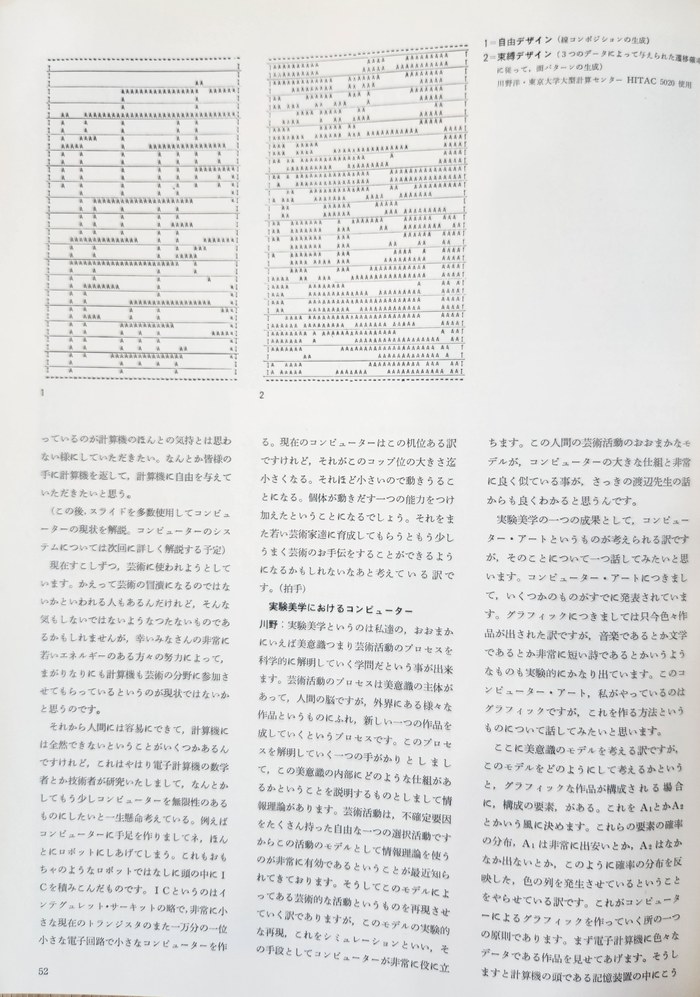
Second installment of the serial: CTG’s report on the symposium “Electronic Computers and Art.”
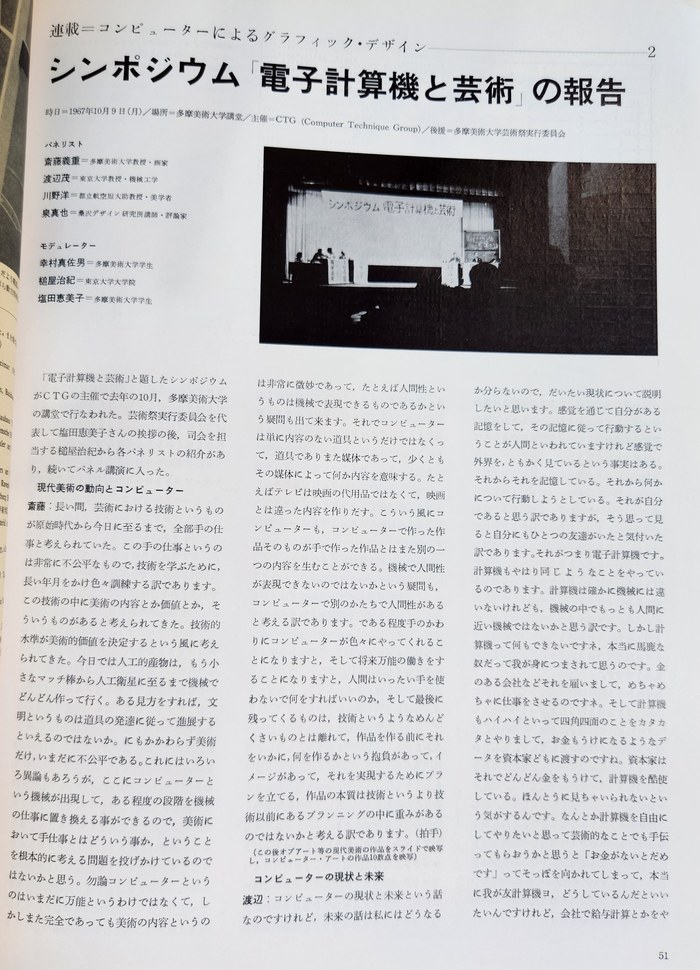
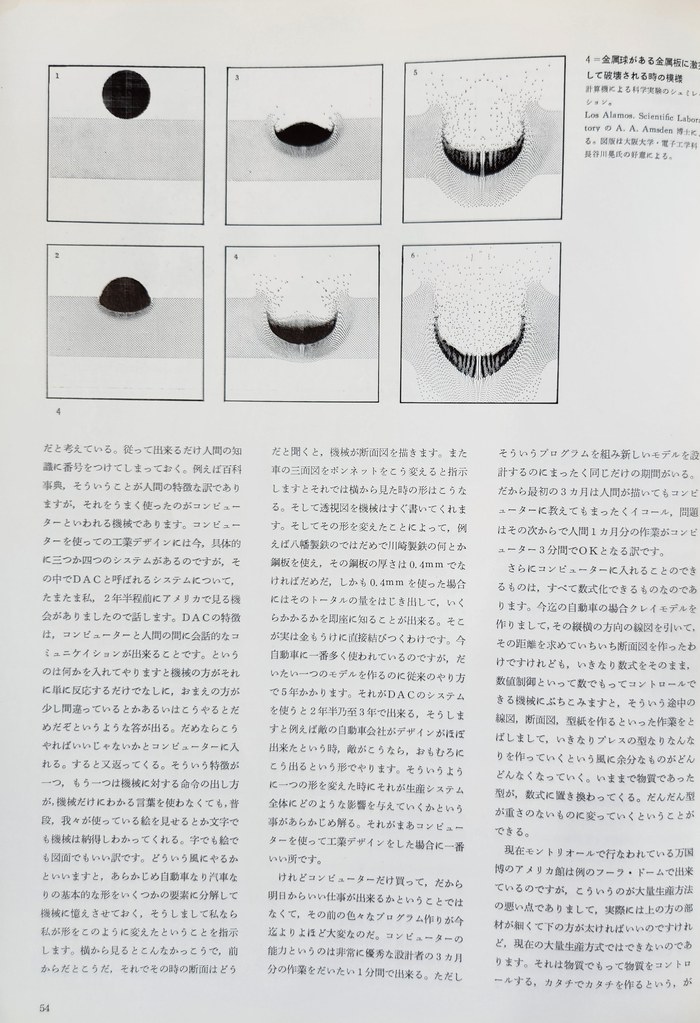
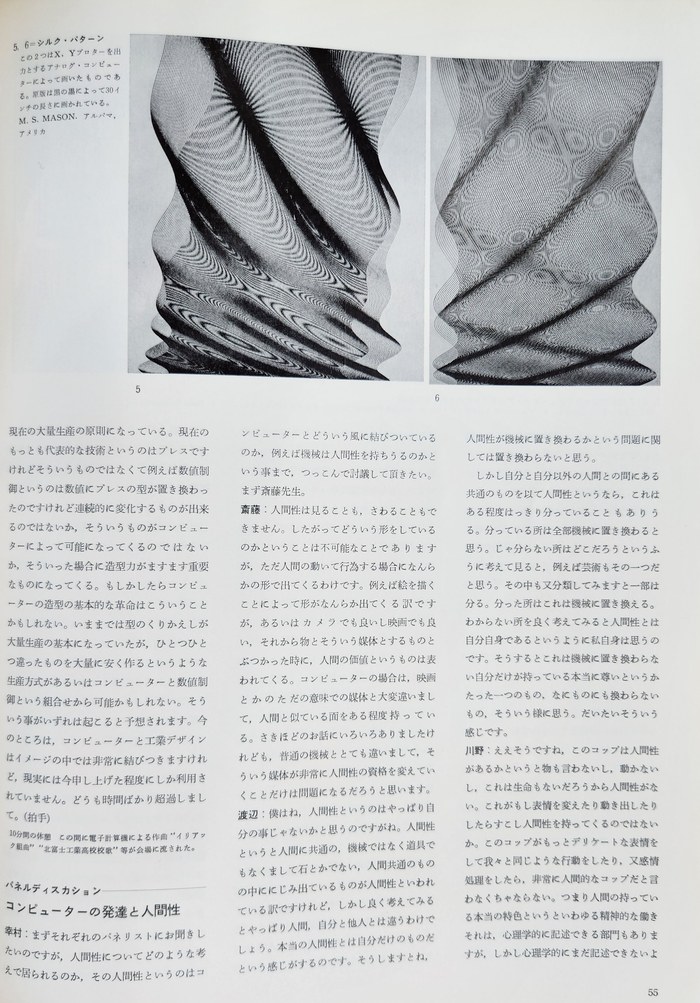
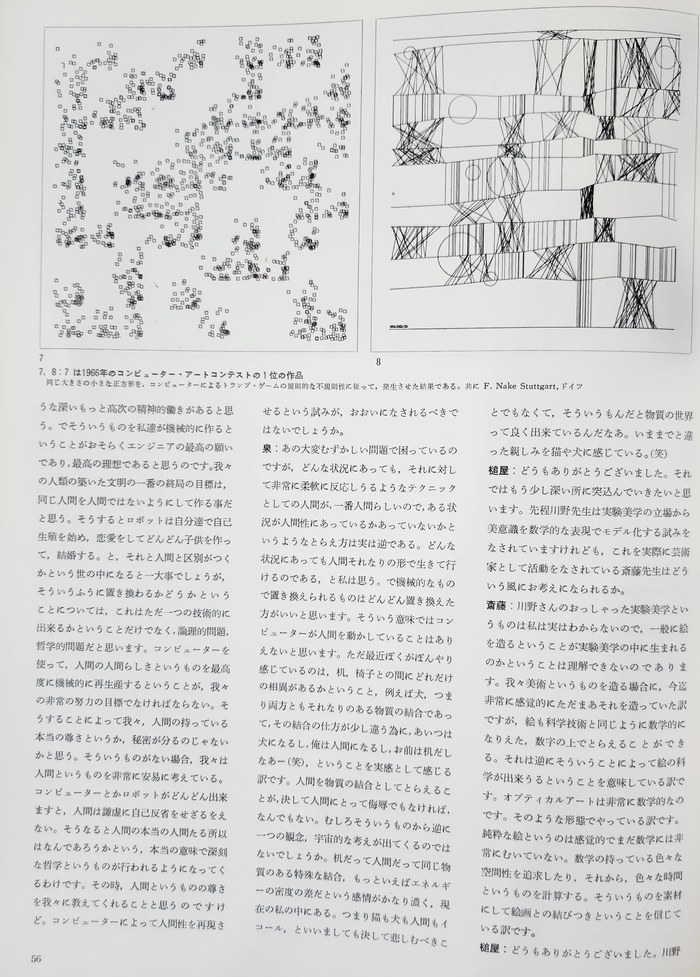
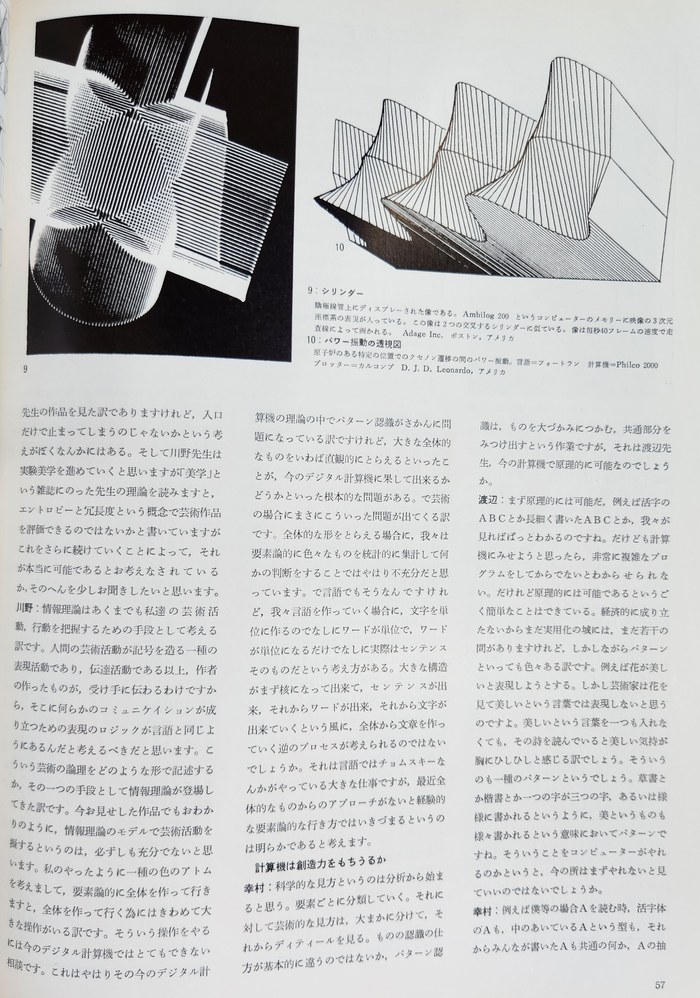
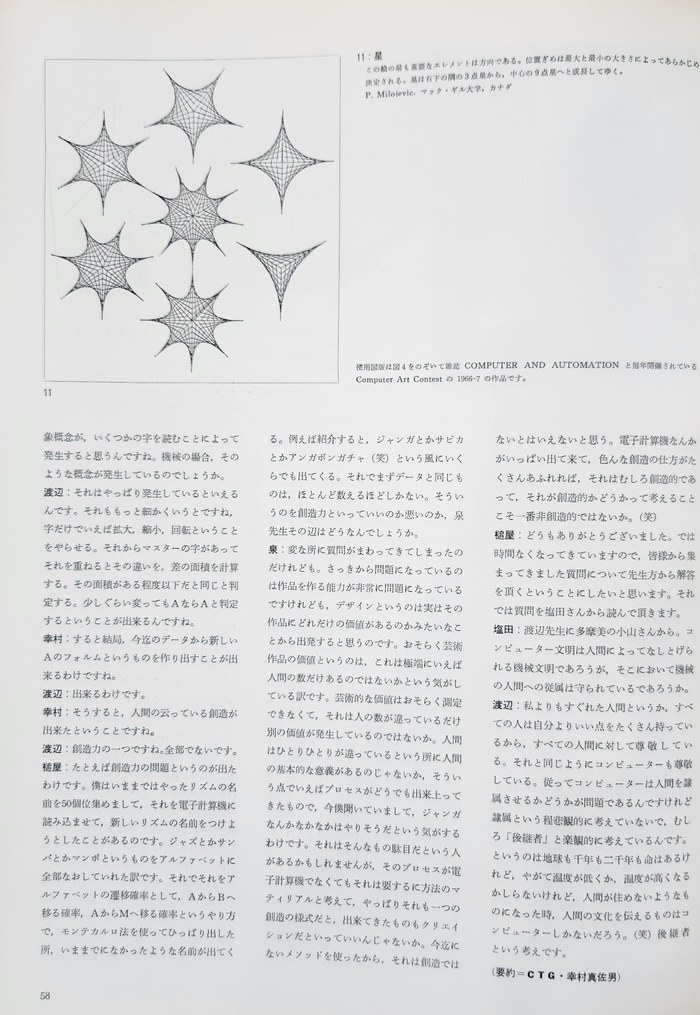
Design no. 107 page 51: the symposium report's opening, with the panel and moderators listed and a photograph of the hall Design no. 107 page 52: Hiroshi Kawano's free and constrained designs, made on the University of Tokyo's HITAC 5020 Design no. 107 page 54: a Los Alamos simulation of a metal sphere striking a plate, in six frames Design no. 107 page 55: Silk Pattern by M. S. Mason, drawn by analog computer on an X-Y plotter Design no. 107 page 56: two works by Frieder Nake, the upper one first prize in the 1966 Computer Art Contest Design no. 107 page 57: a cylinder on a cathode-ray display, and a perspective plot of power oscillation Design no. 107 page 58: Stars by P. Milojevic, and the close of the discussion
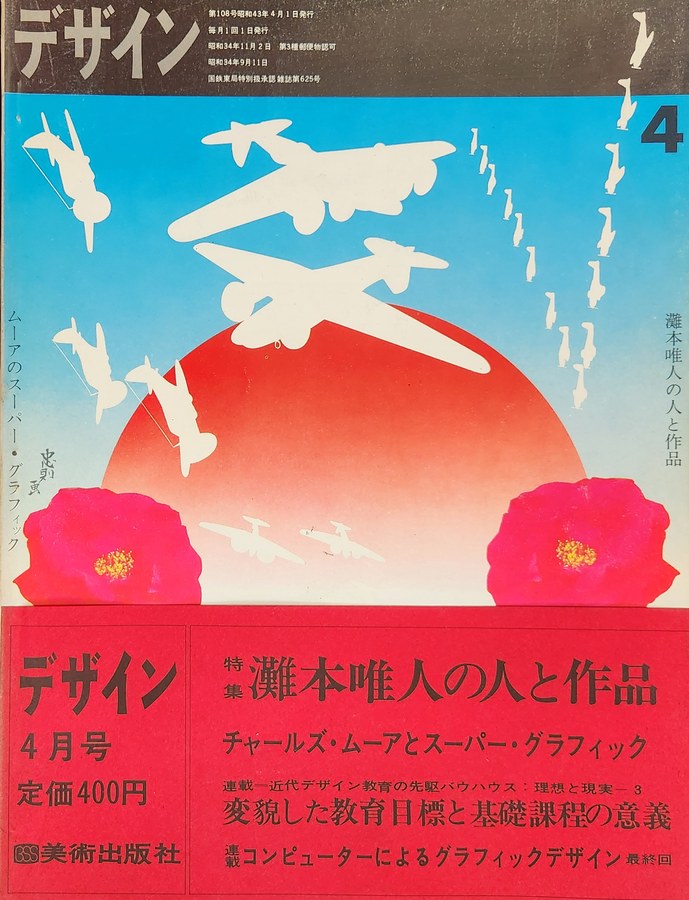
Design magazine no. 108, April 1968, cover by Tadanori Yokoo

Design デザイン, no. 108

April 1968 · Magazine · Bijutsu Shuppan-sha

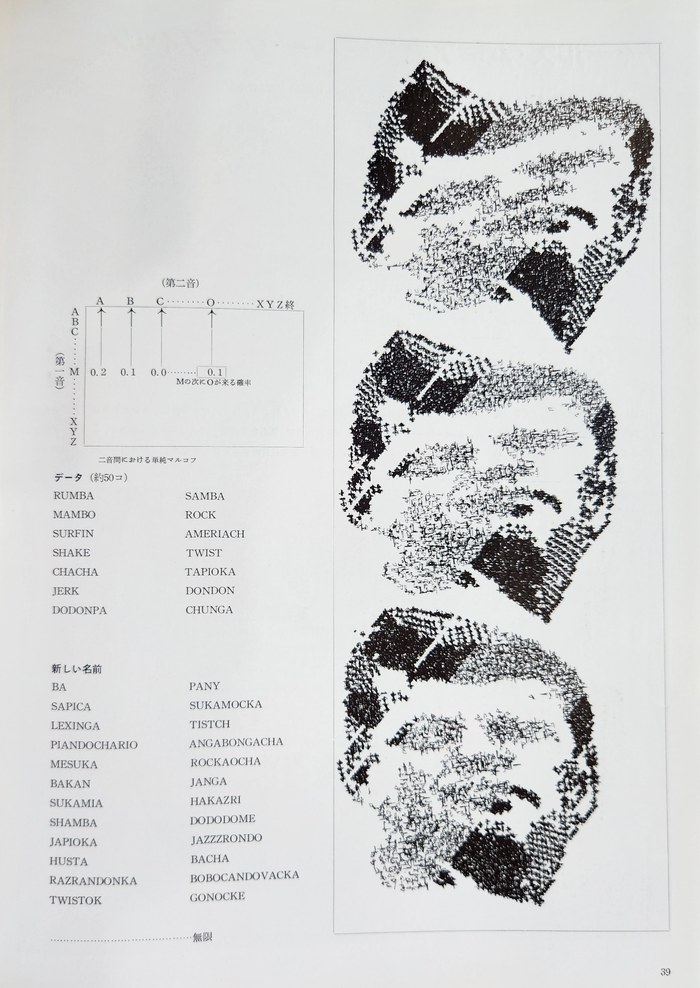
Final installment, “From Programming to Completion”: CTG walks the reader through the making of a work from program to finished graphic.
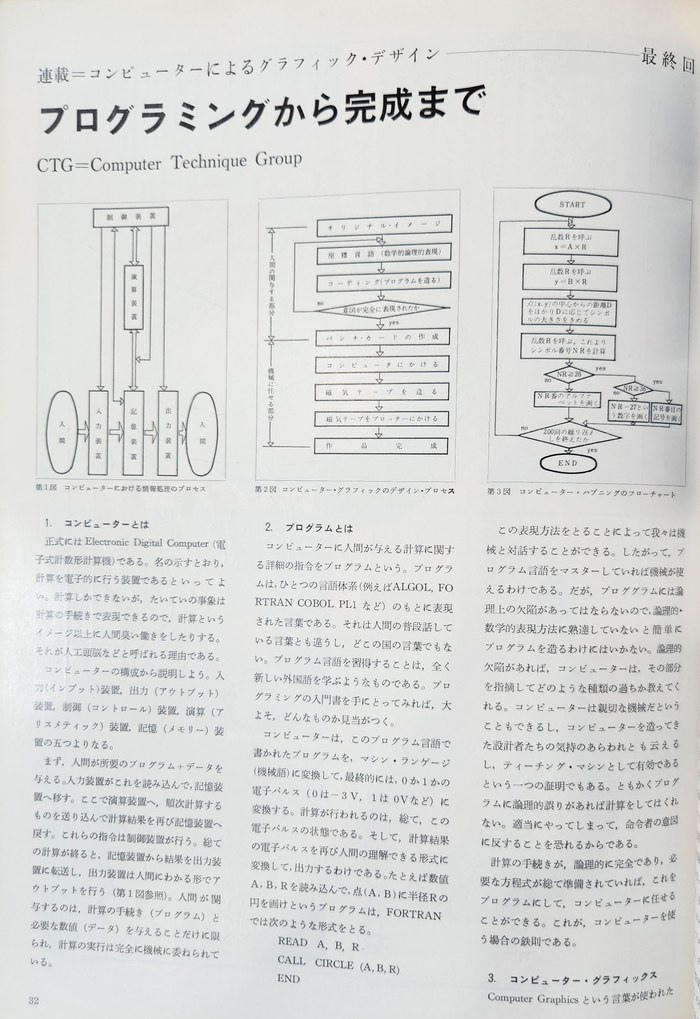
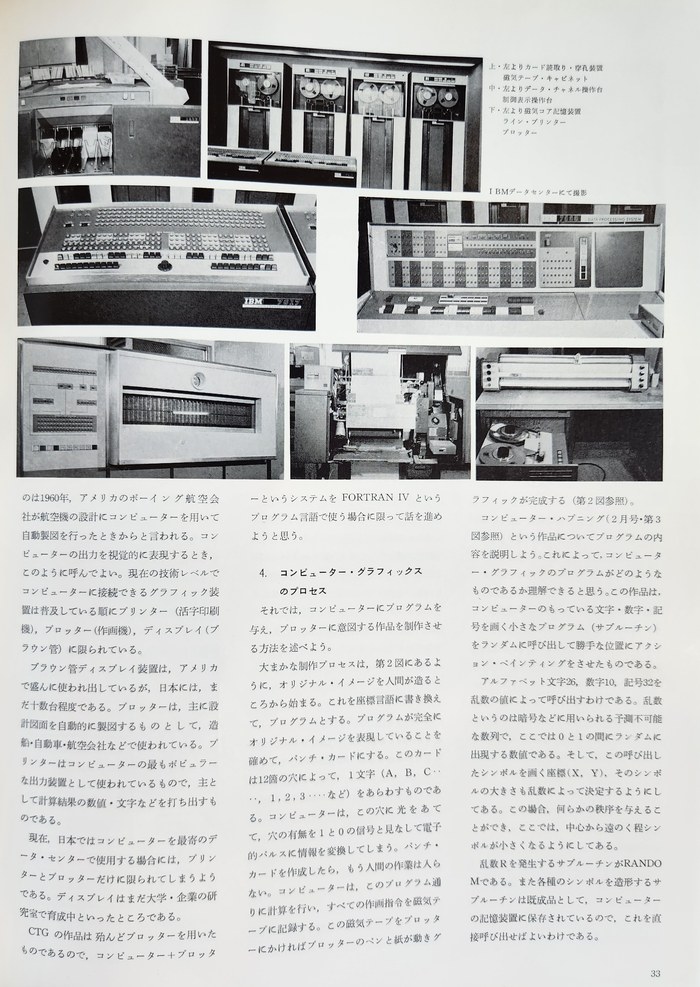
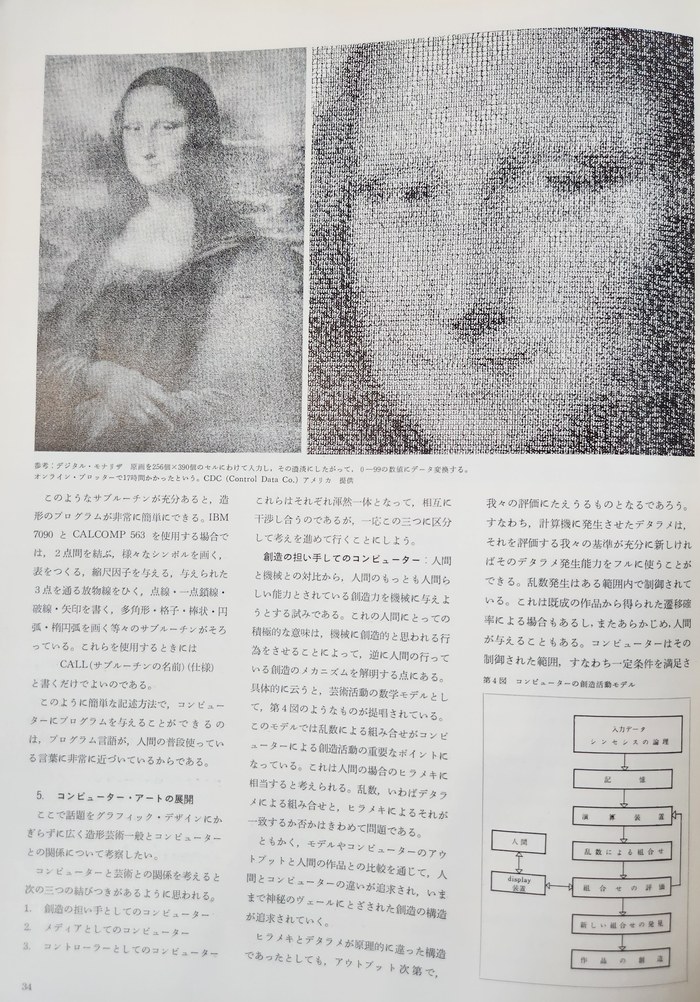
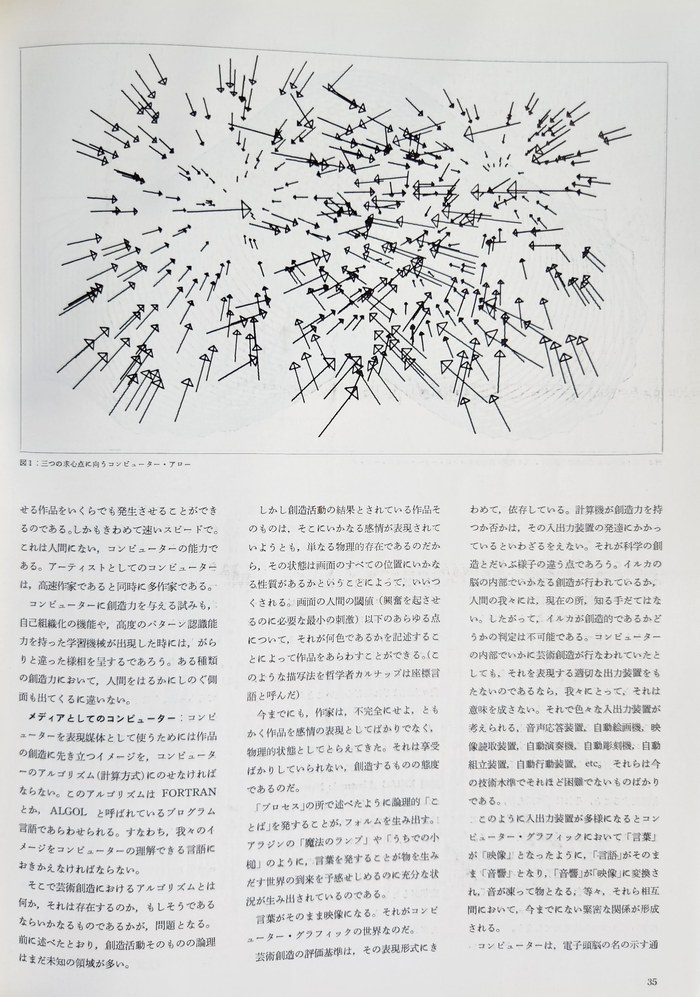
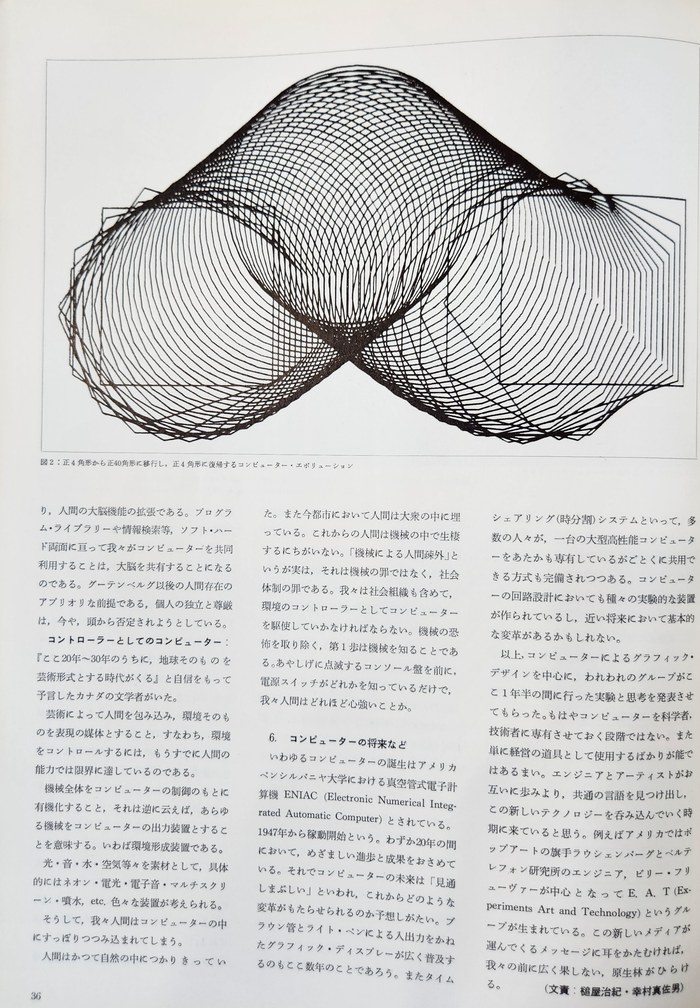
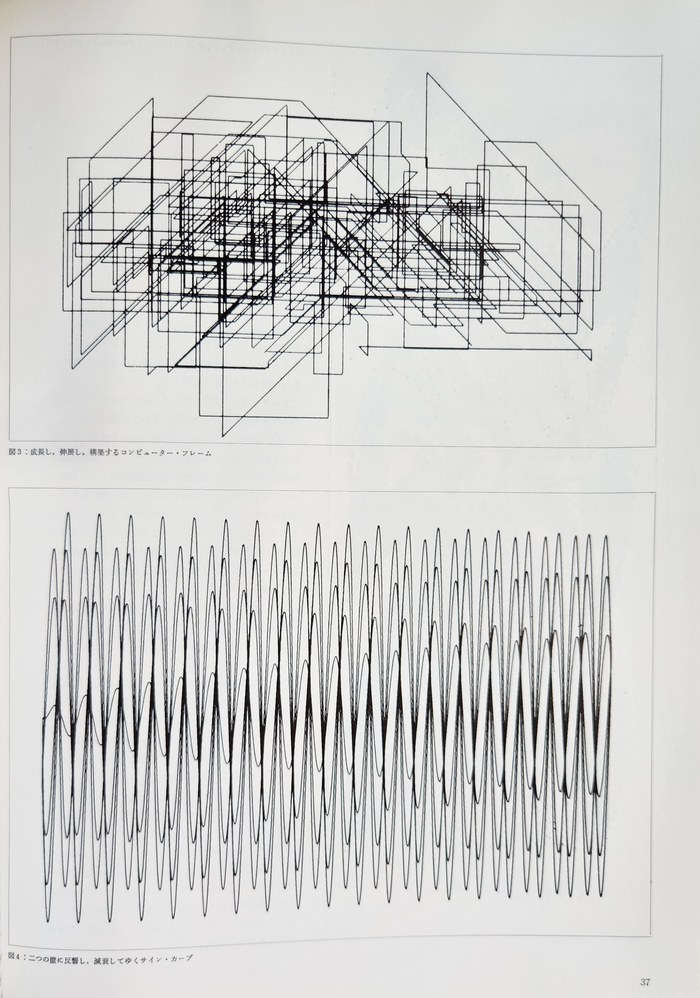
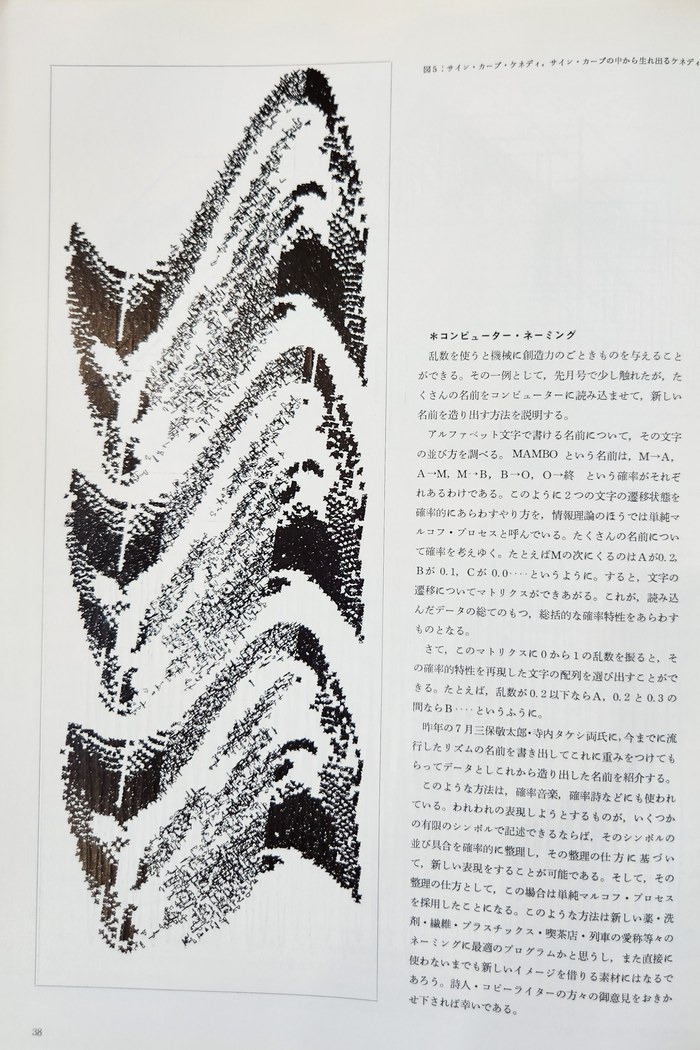
Design no. 108 page 32: the final installment's opening, with three flowcharts including the program for Computer Happening Design no. 108 page 33: seven photographs of the IBM data center, from card punch to plotter Design no. 108 page 34: the Digital Mona Lisa supplied by Control Data, and a model of the computer's creative activity Design no. 108 page 35: Computer Arrows toward three centripetal points Design no. 108 page 36: Computer Evolution, a square passing through a forty-sided figure and back Design no. 108 page 37: Computer Frame, and sine curves echoing between two walls Design no. 108 page 38: Sine Curve Kennedy, with the section on Computer Naming Design no. 108 page 39: the Markov matrix, the rhythm-name data set and the names the program generated
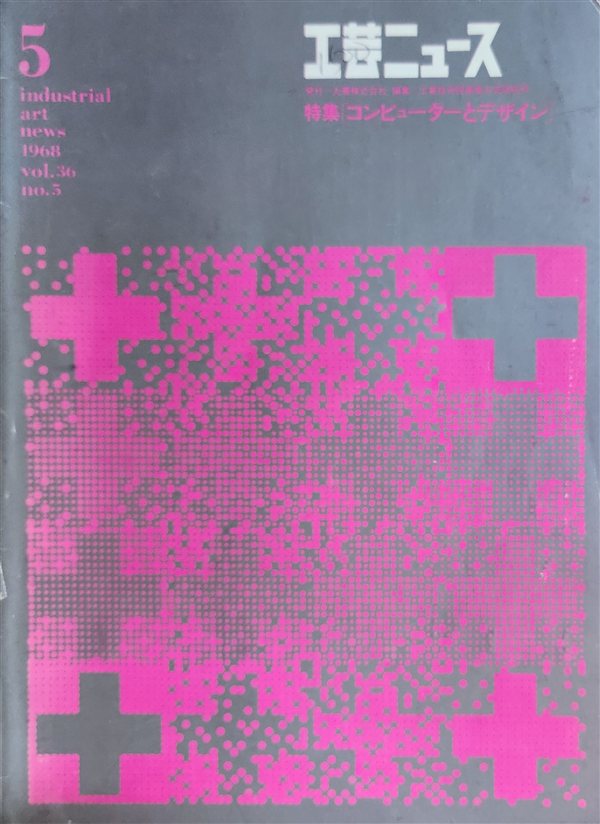
Kōgei News vol. 36 no. 5, 1968, Computers and Design special issue, cover noise-pattern study by Kōhei Sugiura

Kōgei News 工芸ニュース (Industrial Art News), vol. 36, no. 5

1968 · Journal of the Industrial Arts Institute, special issue “Computers and Design” · Maruzen · cover: Kōhei Sugiura

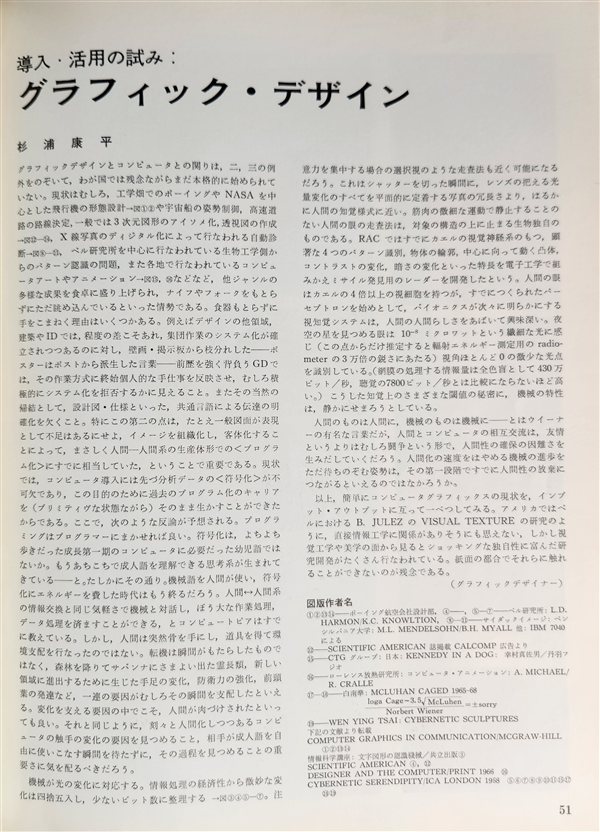
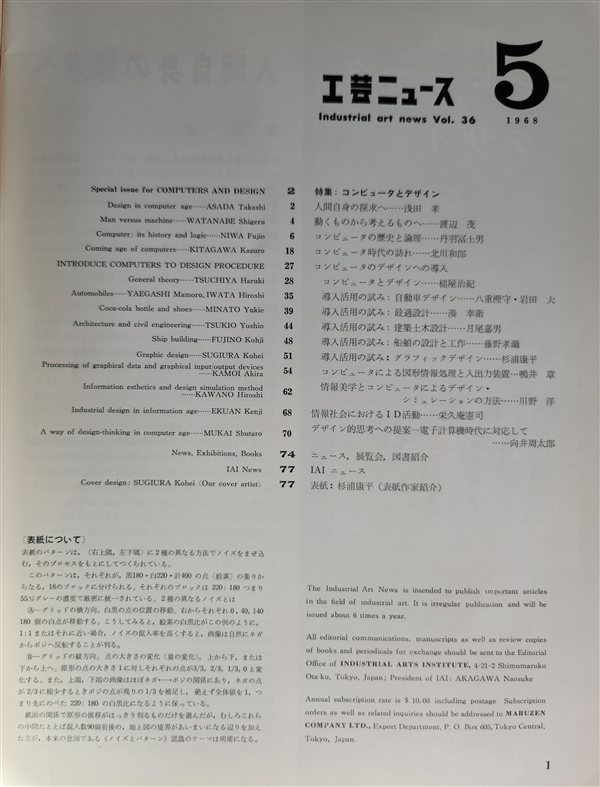
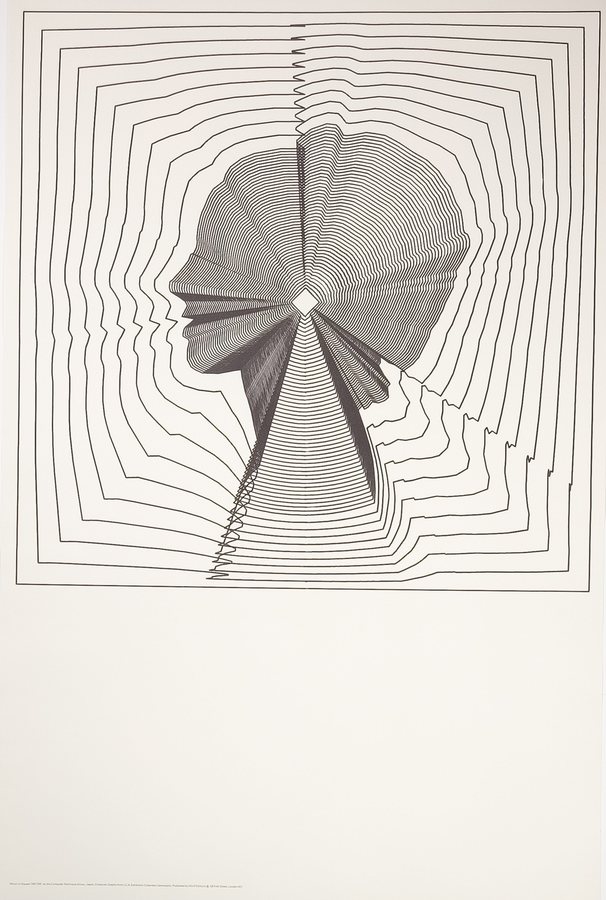
Special issue of the state industrial-design research institute’s journal. The section opens with Return to a Square as a full-page frontispiece, captioned “a square and a woman’s profile given to the computer as data and topology-transformed—production: CTG.” Three members wrote for the issue: Tsuchiya on bringing computers into design practice, Fujino on ship design, and Niwa on the computer’s history and logic (also included are Shigeru Watanabe, “Man versus Machine,” and Hiroshi Kawano on information aesthetics). Kōhei Sugiura’s graphic-design survey reproduces Kennedy in a Dog.
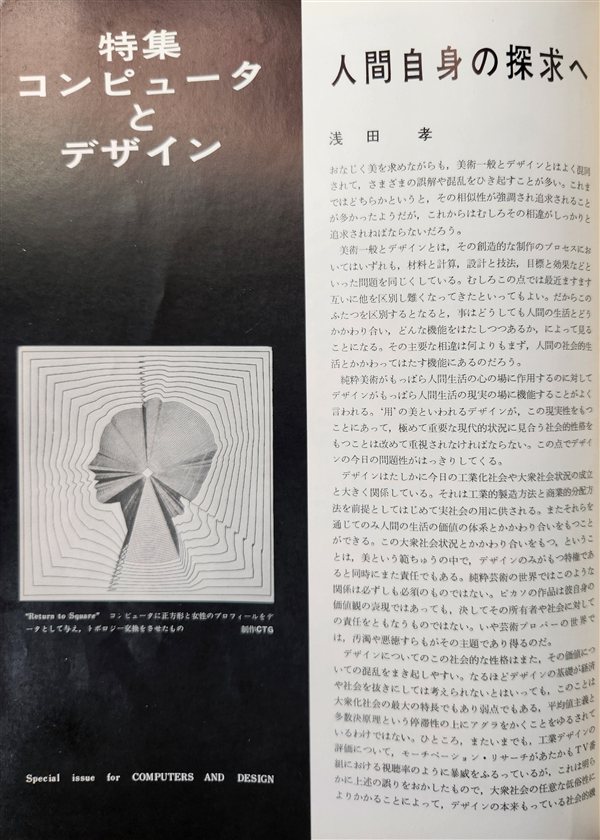
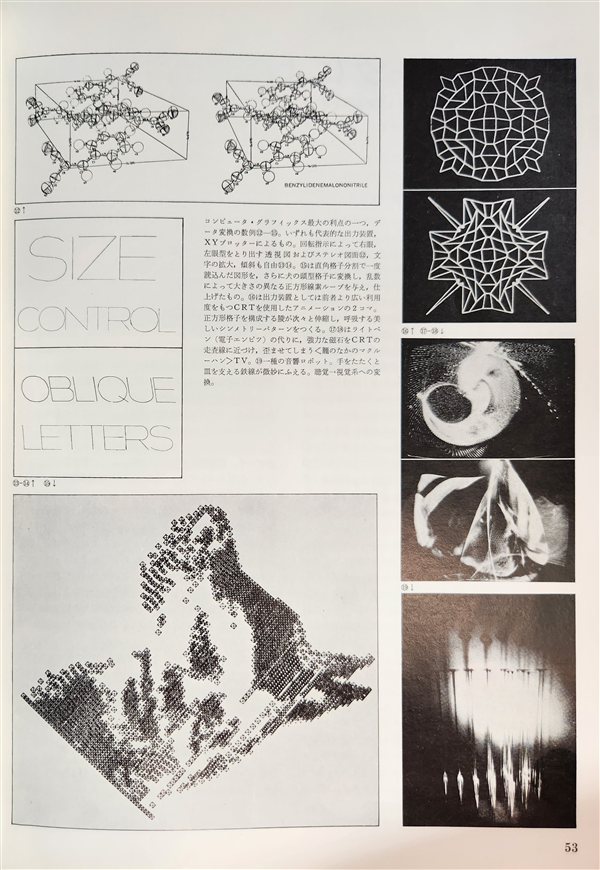
Kōgei News no. 5 1968, special-section title page: Return to a Square as frontispiece, production credit CTG, facing Takashi Asada's essay Kōgei News no. 5 1968, page 53: Kennedy in a Dog plate in Kōhei Sugiura's graphic-design survey Kōgei News no. 5 1968, page 51: Sugiura's graphic-design article with plate credits naming CTG, Kohmura and Niwa for Kennedy in a Dog Kōgei News no. 5 1968 contents page: articles by Tsuchiya, Fujino and Niwa, with the note on Sugiura's cover pattern
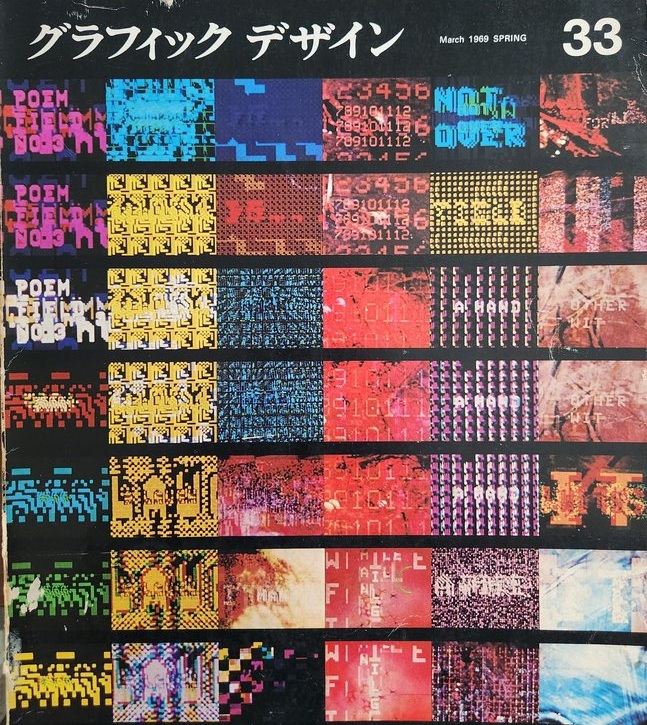
Graphic Design magazine issue 33

Graphic Design, no. 33

Spring (March) 1969 · Magazine · Kōdansha

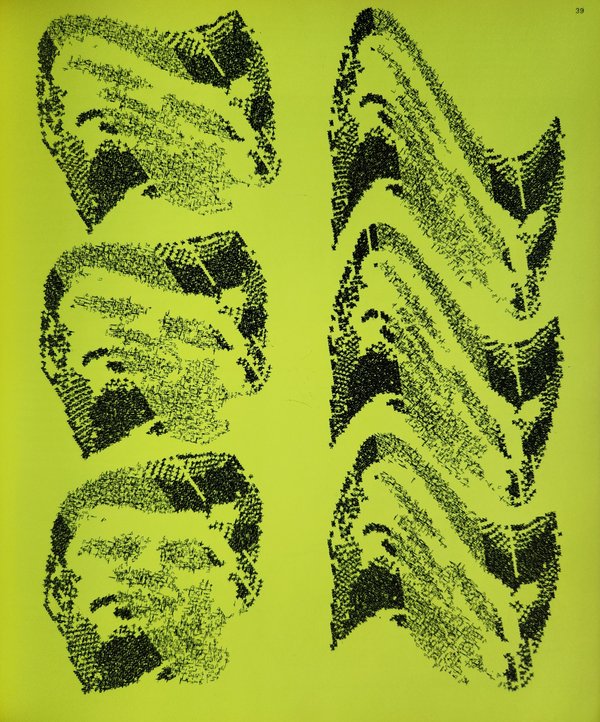
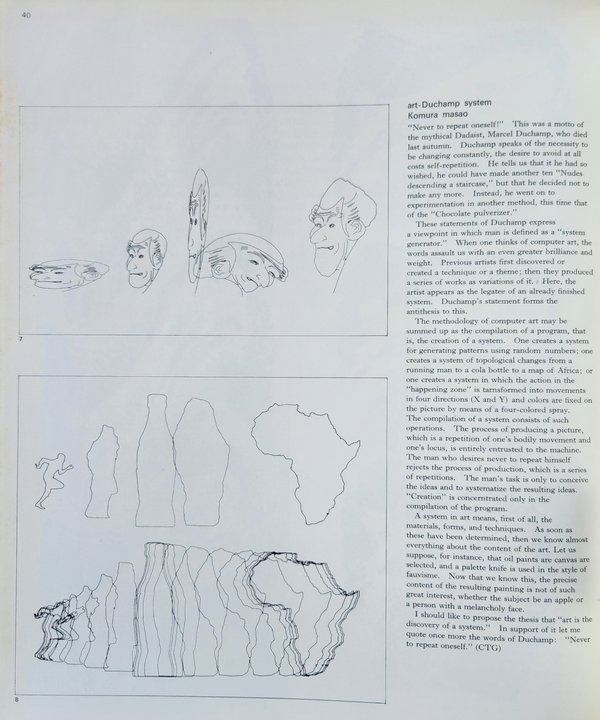
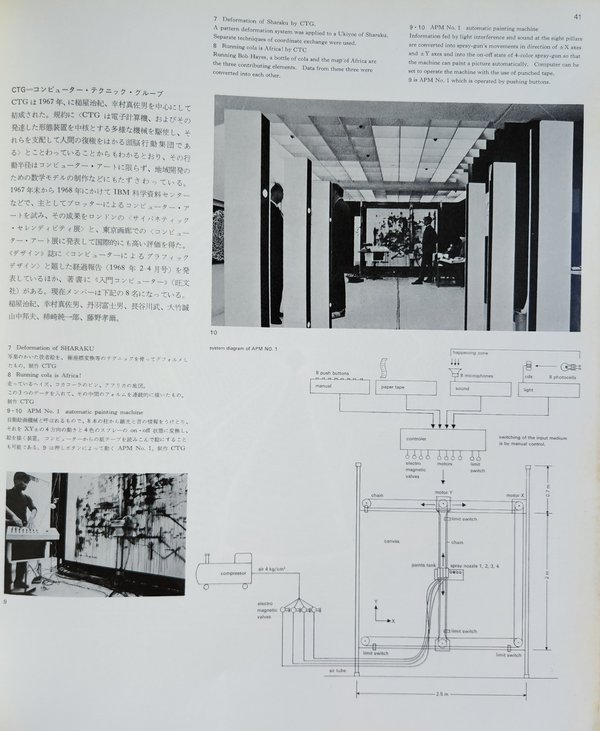
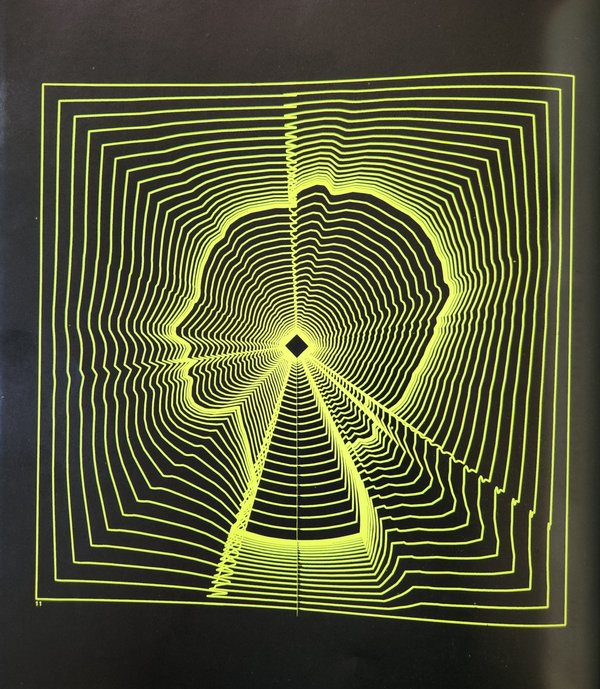
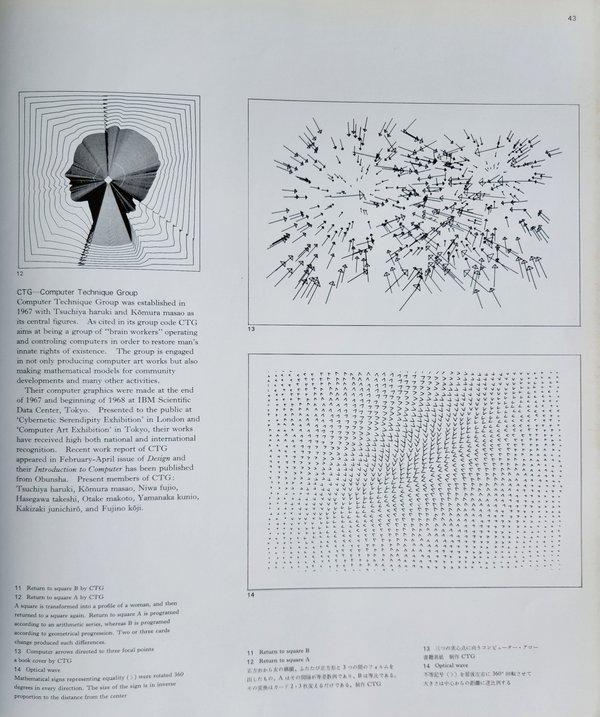
Computer-art special issue whose “computer graphics” feature includes Hiroshi Kawano and CTG. Built around the two 1968 exhibitions Cybernetic Serendipity and Tokyo Gallery. Seven pages of CTG: the Kennedy/Monroe suite (Monroe in the net, Shot Kennedy No. 1, the line-printer Negative Kennedy data check, Sinwave Kennedy); Kohmura’s art-Duchamp essay in Japanese and English, the first printing of his thesis “art is the discovery of a system”; the APM No. 1 system diagram with operator and installation photographs; Return to a Square (a) and (b); an overprint plate of March of Polygons with Tragedy of 7; and the group profile: a group of “brain workers” aiming “to restore man’s innate rights of existence.”
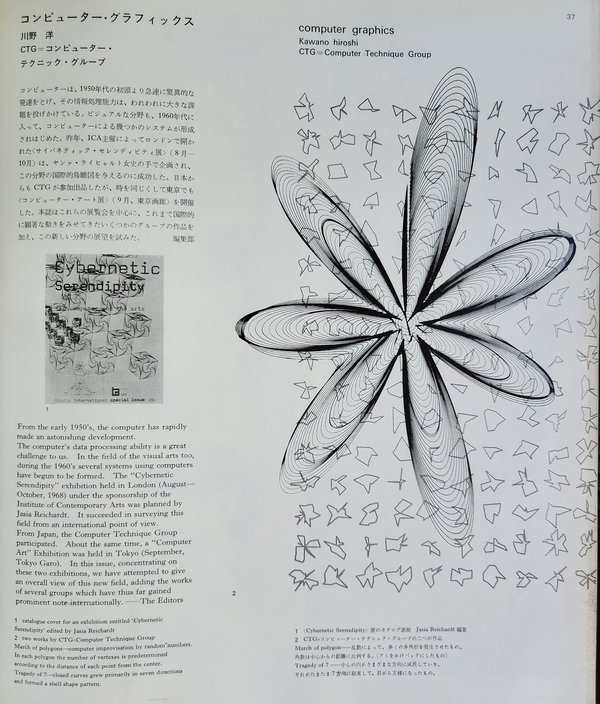
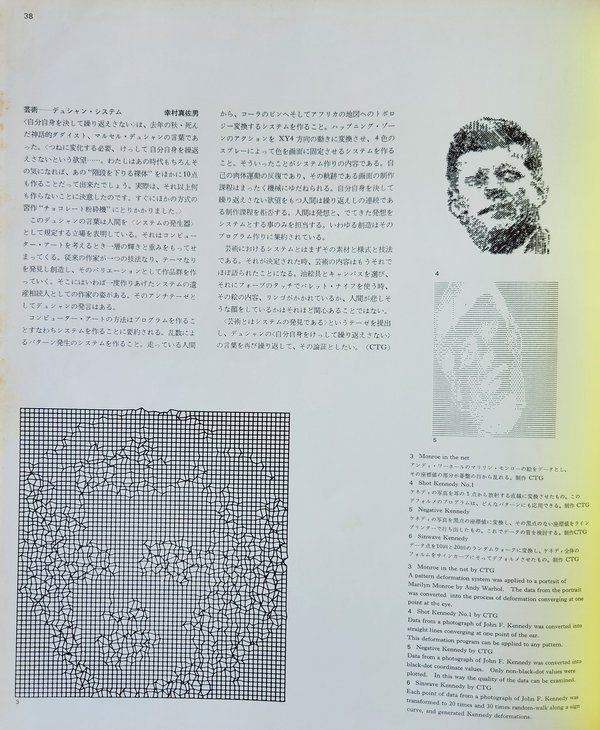
Graphic Design no. 33 page 37: computer graphics feature opener by Hiroshi Kawano and CTG, with March of Polygons overprinted with Tragedy of 7 Page 38: Kohmura's art-Duchamp system essay in Japanese, with Monroe in the net, Shot Kennedy No. 1 and Negative Kennedy Page 39: full-page plate of the random-walk Sinwave Kennedy deformations in yellow Page 40: the art-Duchamp system essay in English—"art is the discovery of a system"—with Deformation of Sharaku and Running cola is Africa! Page 41: APM No. 1 system diagram, operator photograph and Tokyo Gallery installation view, with the group profile in Japanese Page 42: full-page plate of Return to a Square (b), yellow on black Page 43: CTG profile in English with Return to a Square (a), the Computer arrows book cover for Obunsha, and Optical wave
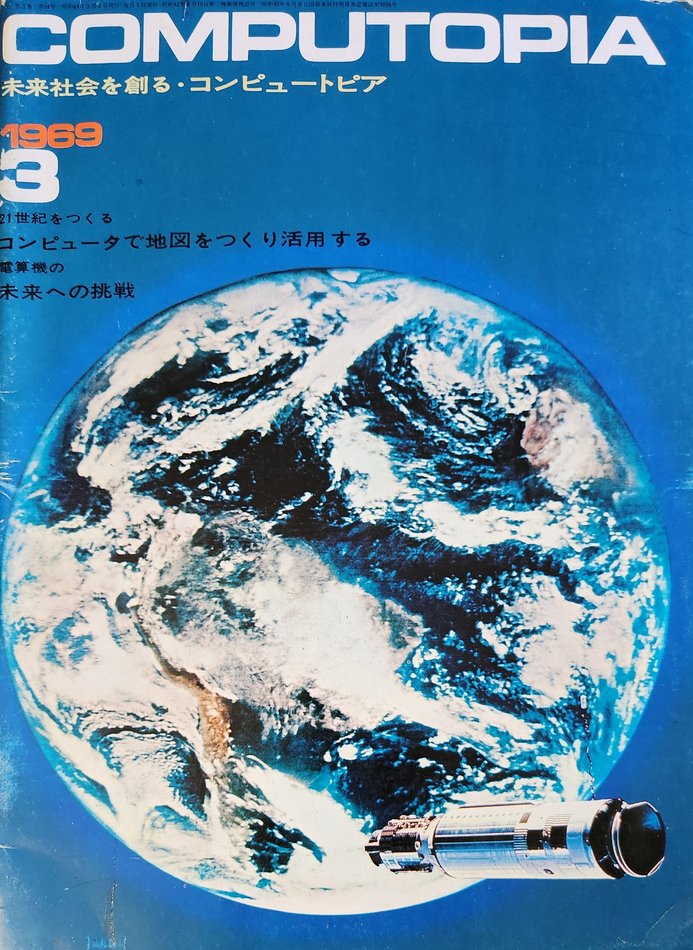
Computopia, March 1969, Earth-from-space cover

Computopia コンピュートピア, March 1969

March 1, 1969 · Magazine · Computer Age-sha

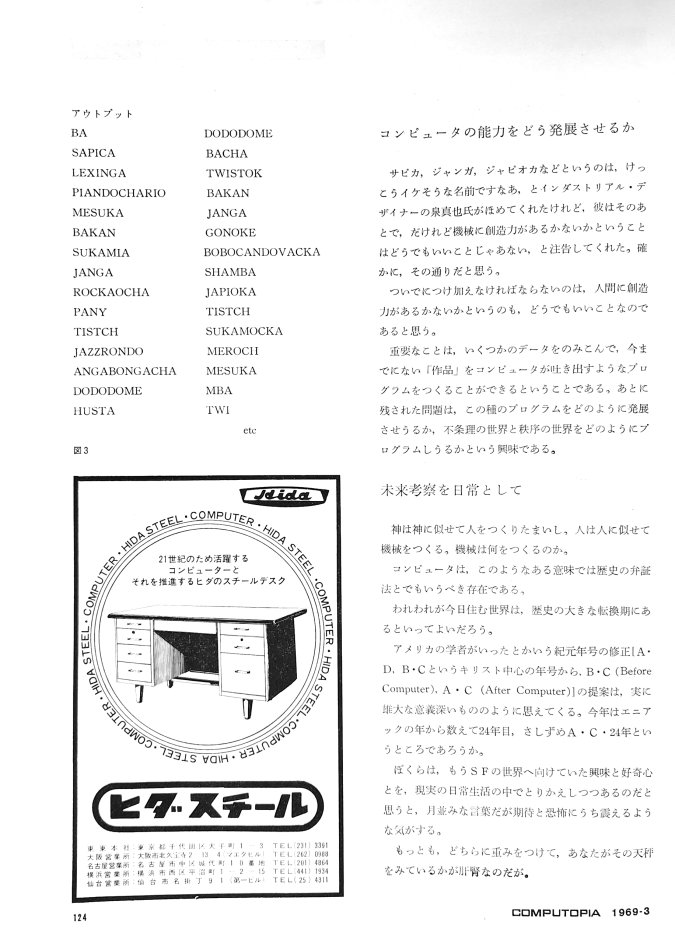
Tsuchiya’s essay “On the Creative Power of Machines,” signed Computer Technique Group. Tsuchiya describes the group as eight men who call themselves electronic hippies and who took up computer art as “the most useless way of using a computer.” He recounts the imaginary machines he keeps in an old notebook and argues that if creativity means “the power to make something new,” a machine can have it. Also includes the rhythm-name program made with the jazz pianist Keitarō Miho around 1967.
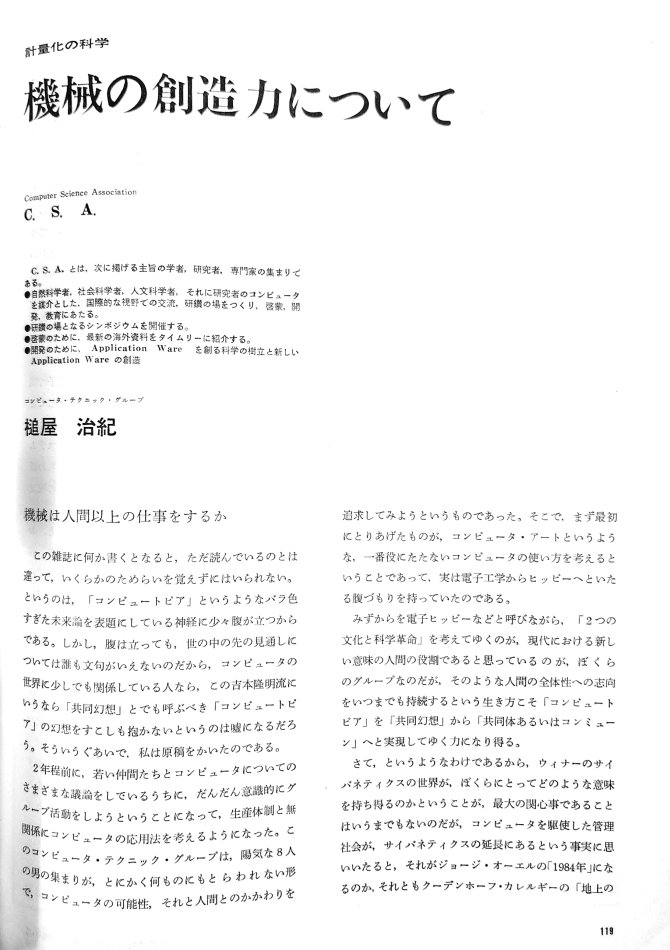
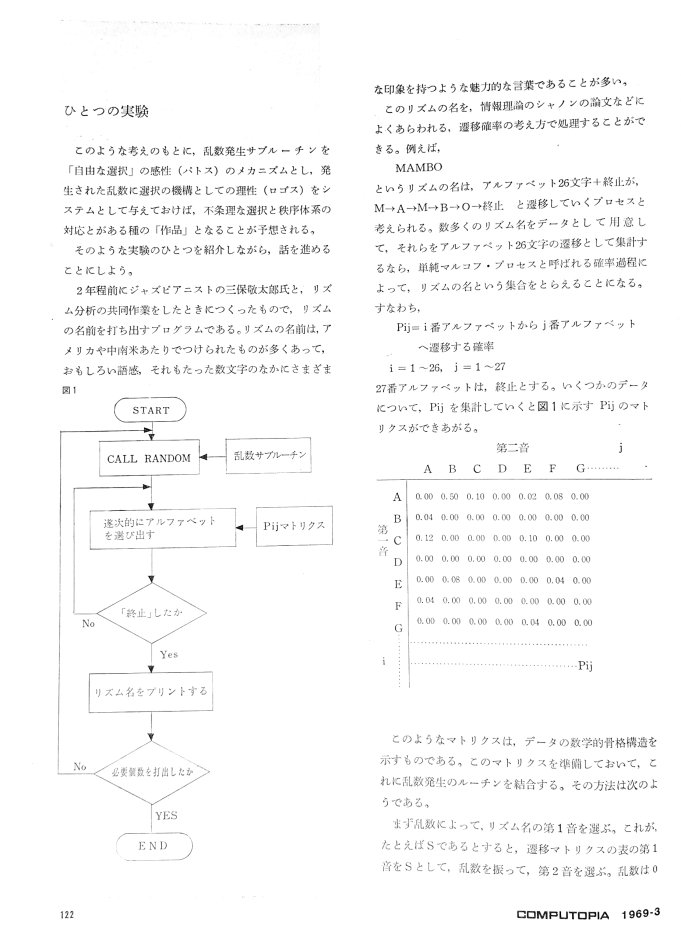
Computopia March 1969 page 119: the essay's opening, byline Computer Technique Group, Haruki Tsuchiya Computopia March 1969 page 122: flowchart of the rhythm-name program and the Markov transition matrix Computopia March 1969 page 124: the computer's invented rhythm names, SAPICA to HUSTA
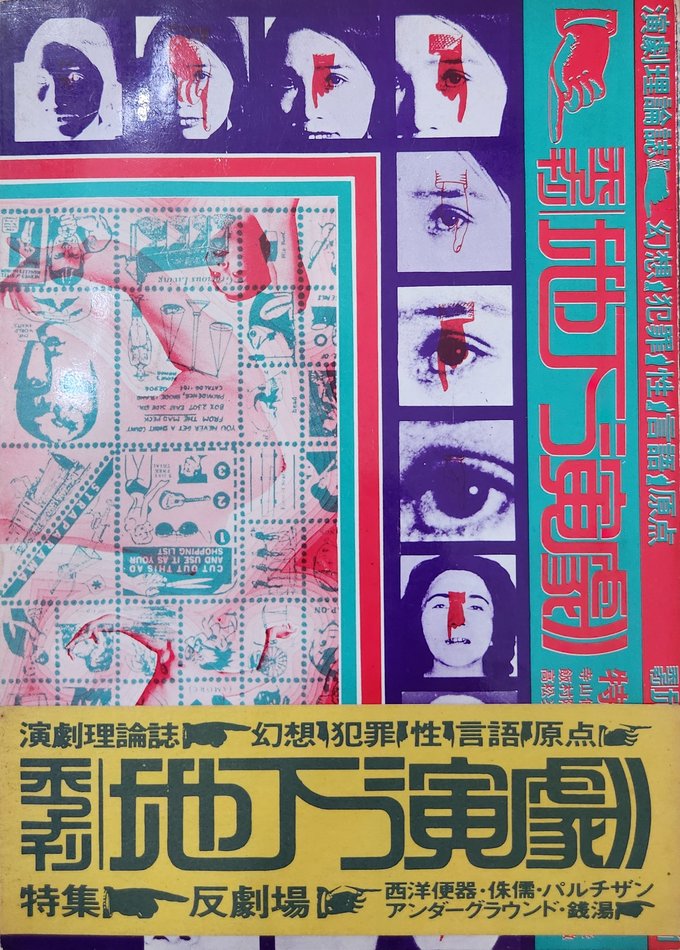
Kikan Chika Engeki inaugural issue, May 1969, cover with the Anti-Theater special-feature band

Kikan Chika Engeki 季刊地下演劇, inaugural issue

May 1969 · Magazine · special feature “Anti-Theater”

The first issue of the theater-theory quarterly of Shūji Terayama’s Tenjō Sajiki. Includes Tsuchiya’s seven-page essay on Heartbreak Hotel, his stochastic melodrama written in 1967.
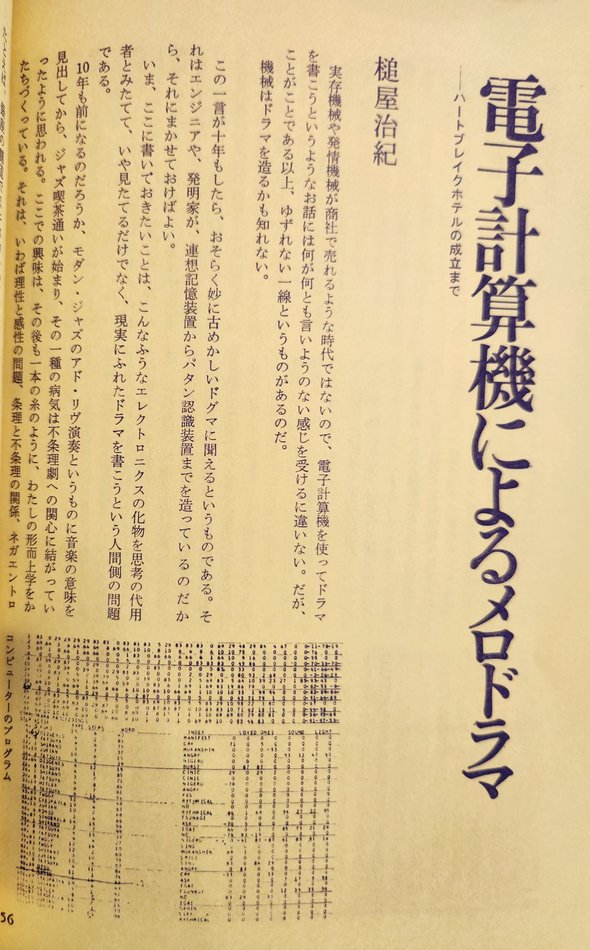
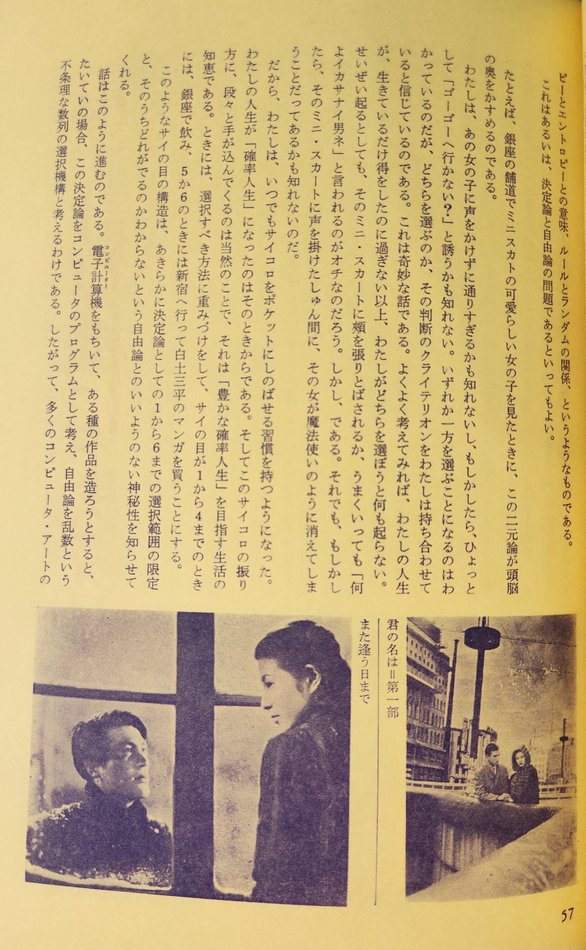
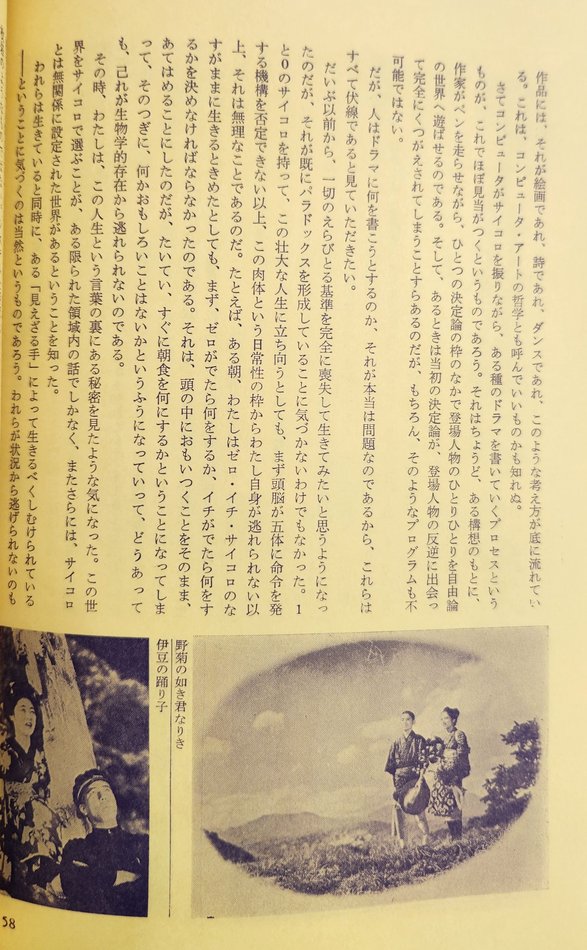
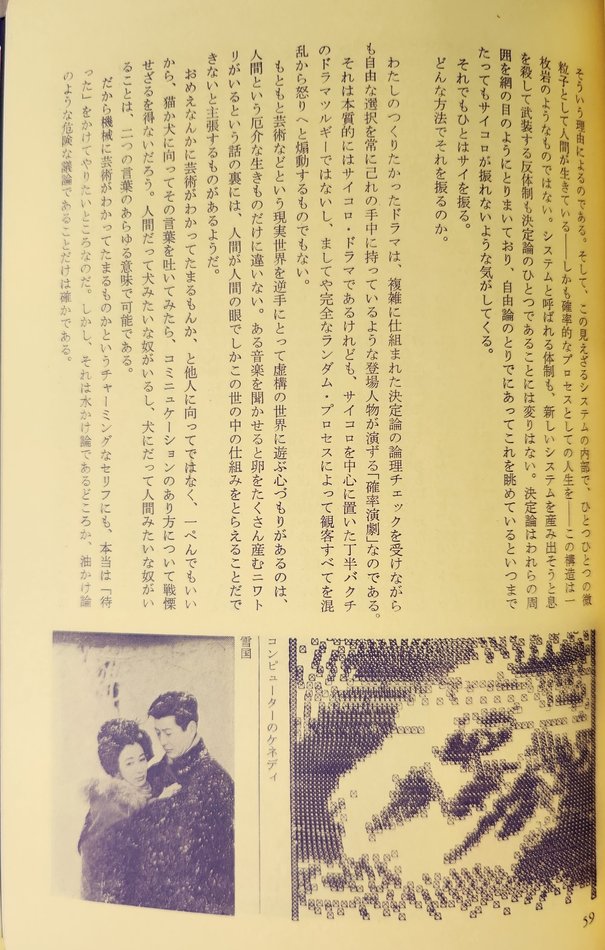
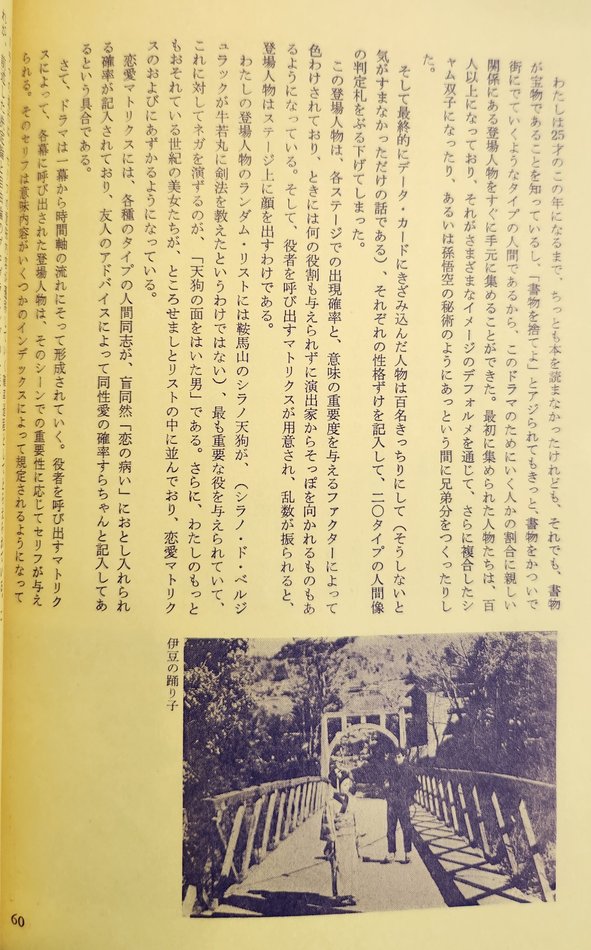
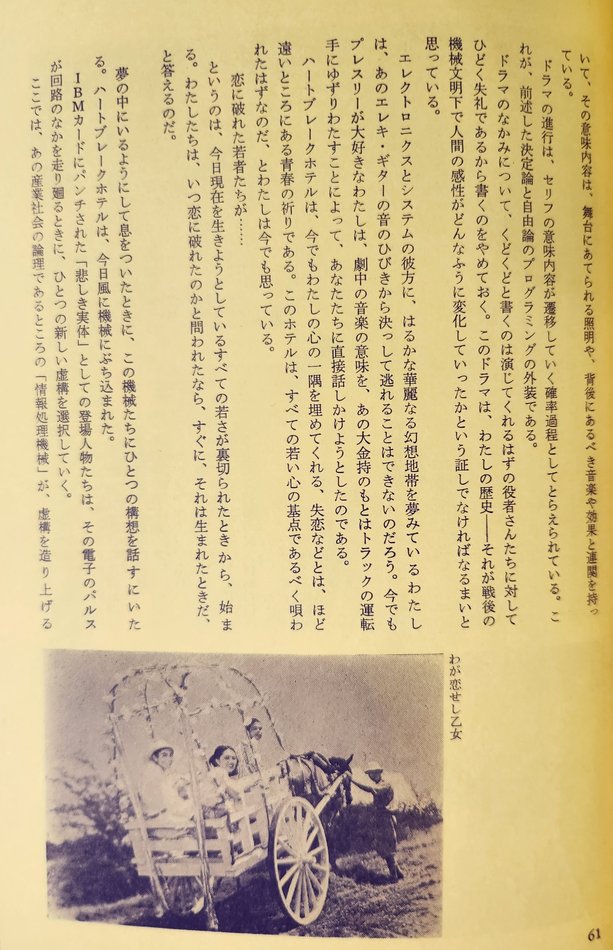
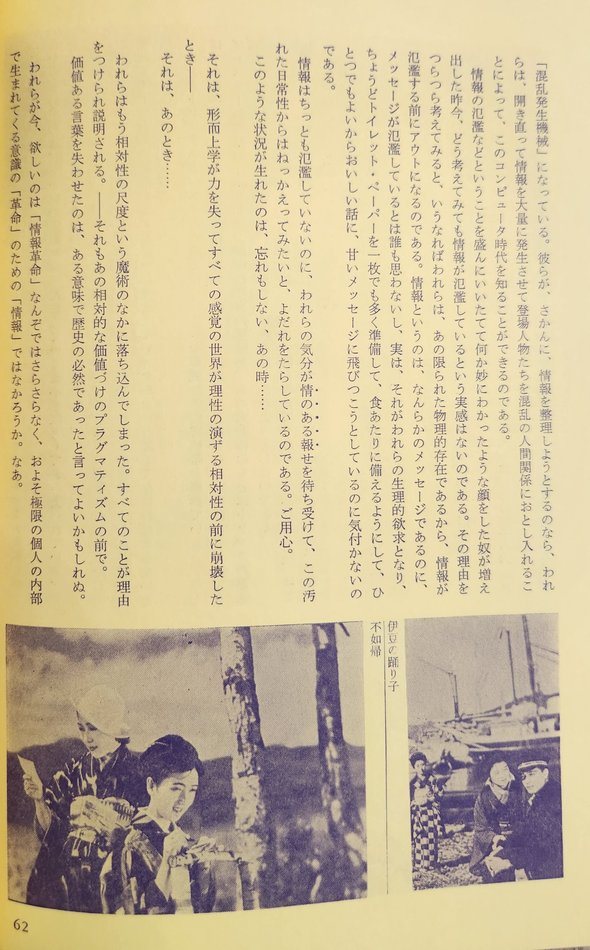
Chika Engeki page 56: the essay's title page, with a detail of the COMPUTER DRAMA program listing Chika Engeki page 57: the Ginza miniskirt dilemma and the dice in the pocket, with stills from Kimi no Na wa and Mata Au Hi Made Chika Engeki page 58: the zero-one die and the invisible hand, with stills from Nogiku no Gotoki Kimi Nariki and Izu no Odoriko Chika Engeki page 59: the probabilistic-theater passage, with CTG's Computer Kennedy and a still from Yukiguni Chika Engeki page 60: the hundred-character cast, the Cyrano-Tengu and the love matrix, with a still from Izu no Odoriko Chika Engeki page 61: Presley, Heartbreak Hotel and the IBM cards, with a still from Waga Koi Seshi Otome Chika Engeki page 62: the closing pages on information and revolution, with stills from Izu no Odoriko and Hototogisu
Applied & Commissioned Design
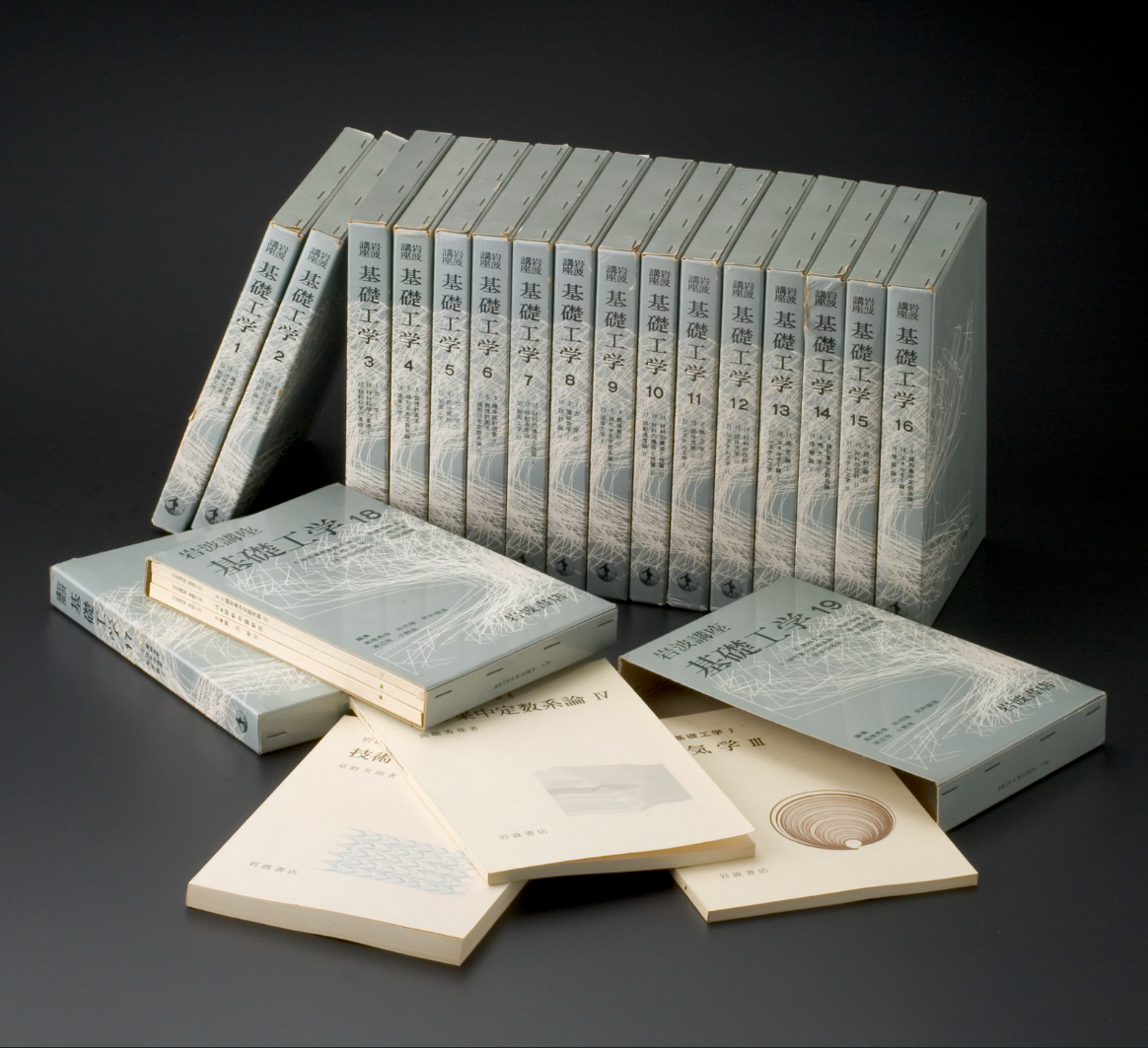
Iwanami Lecture Series on Fundamental Engineering, 19 volumes

Iwanami Lecture Series on Fundamental Engineering, complete 19-volume set

1967–1971 · Books, complete set

Specialized volumes covering the fundamental theories of engineering with covers created by CTG.
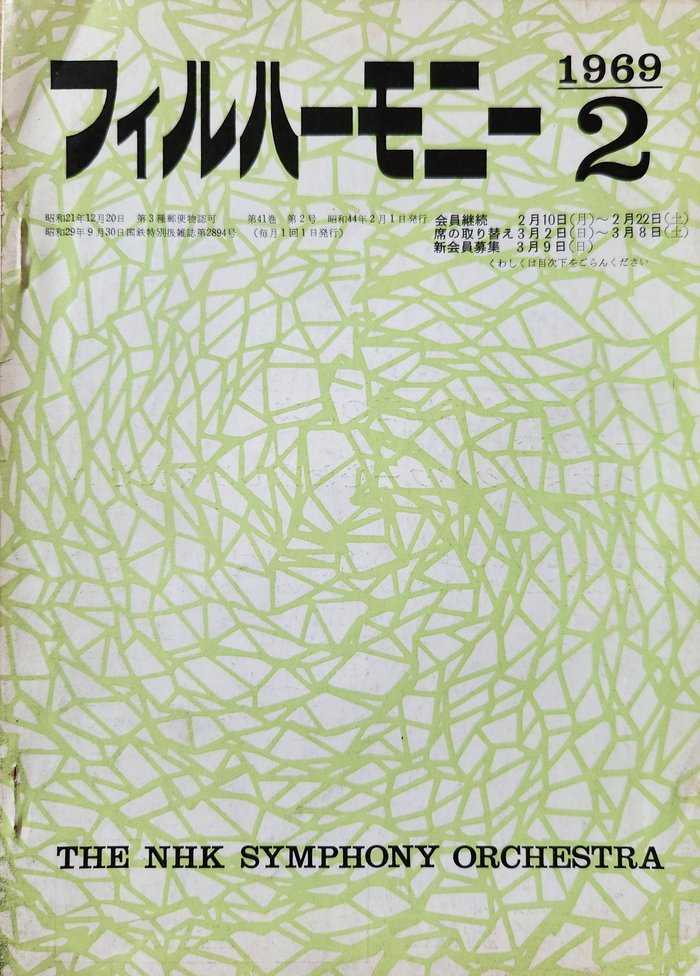
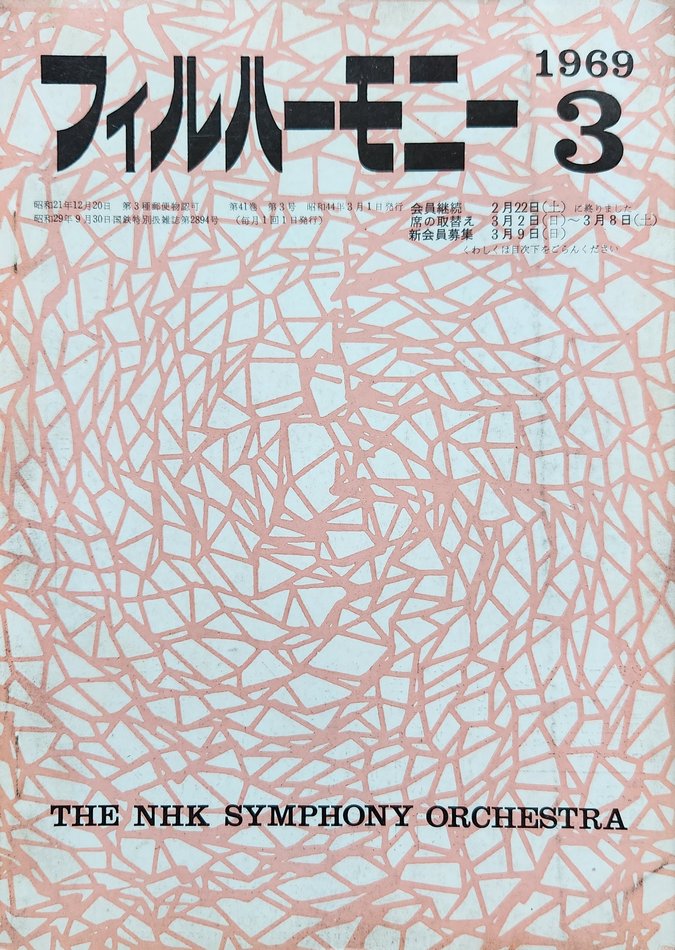
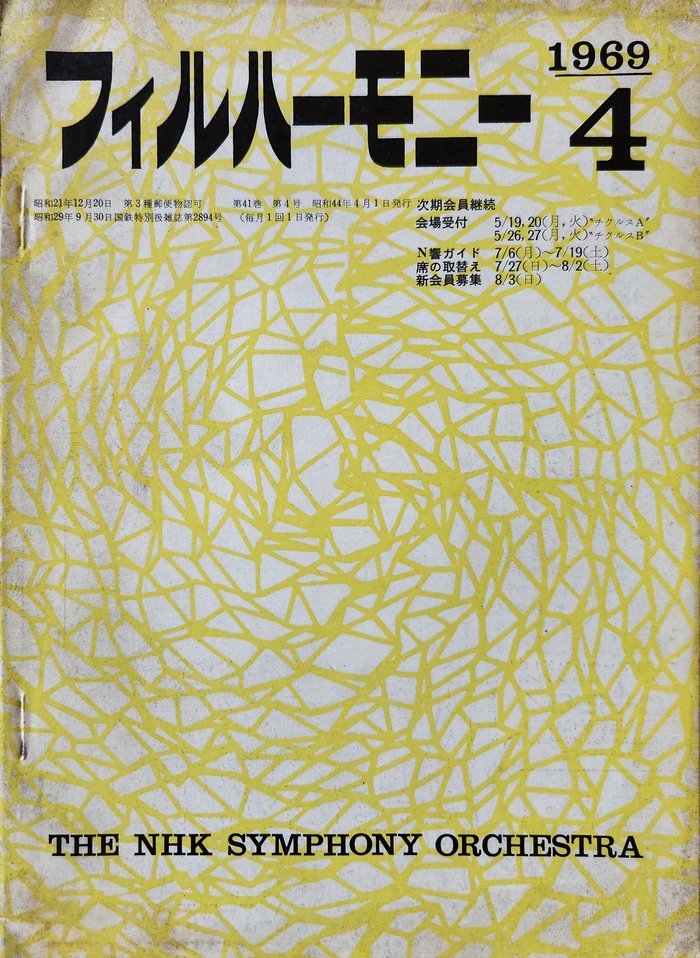
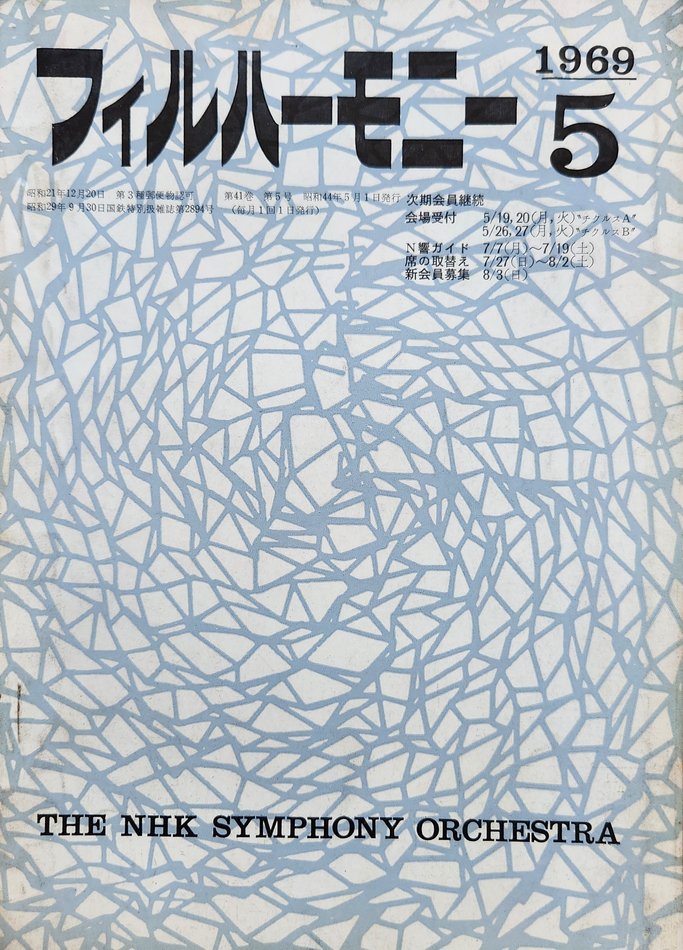
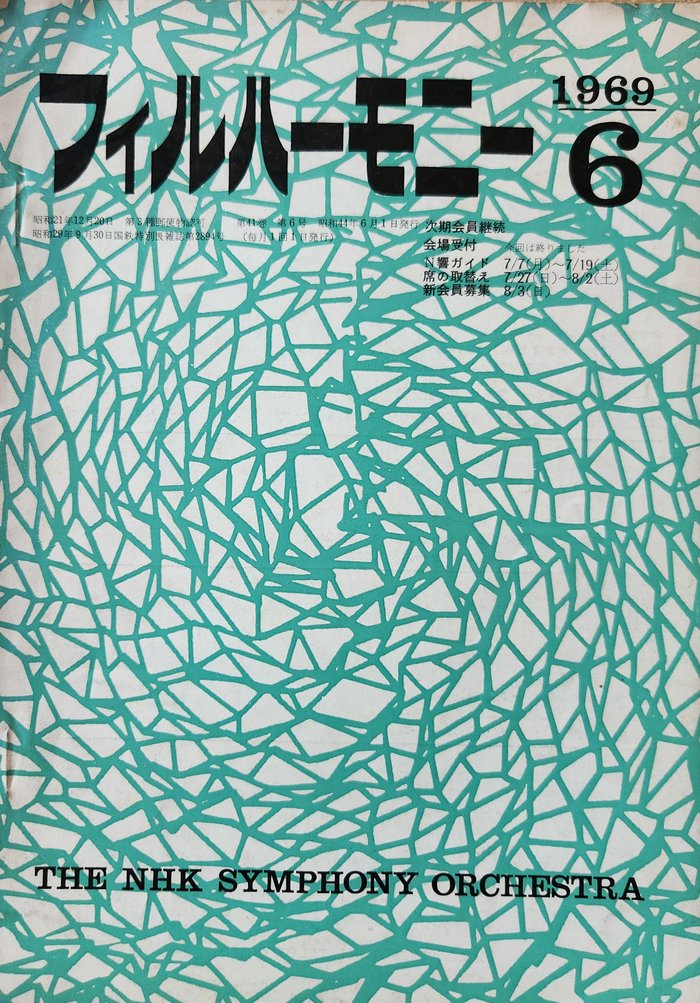
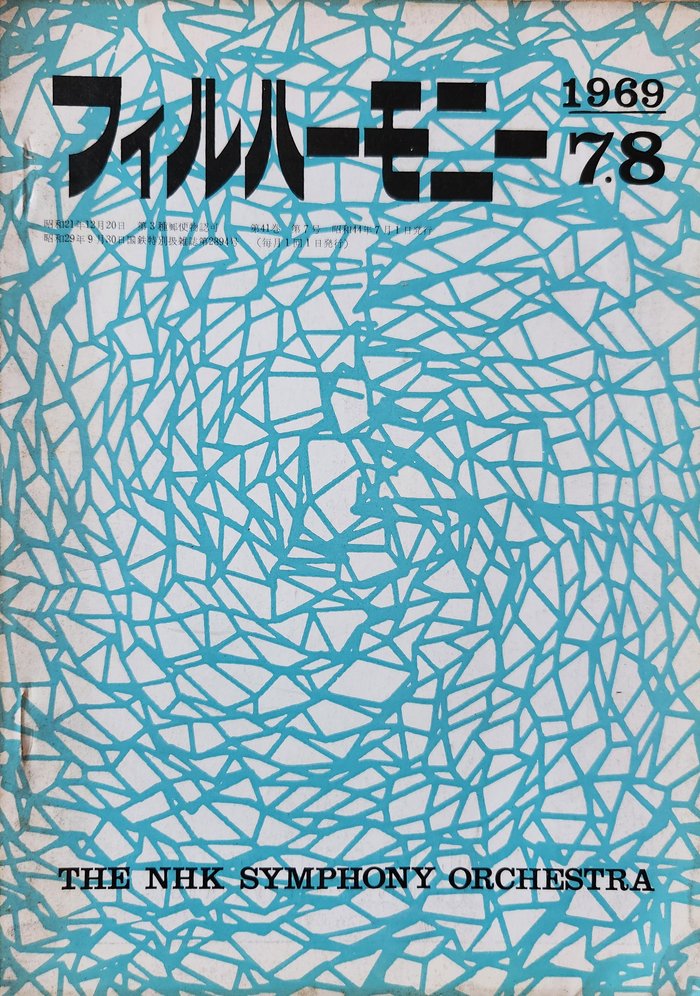
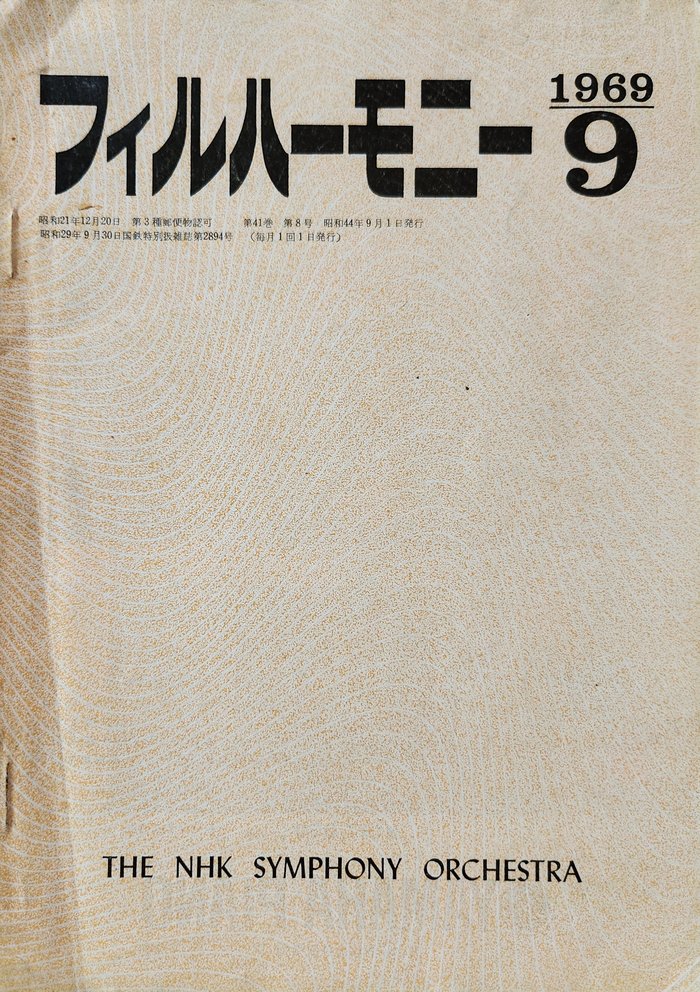
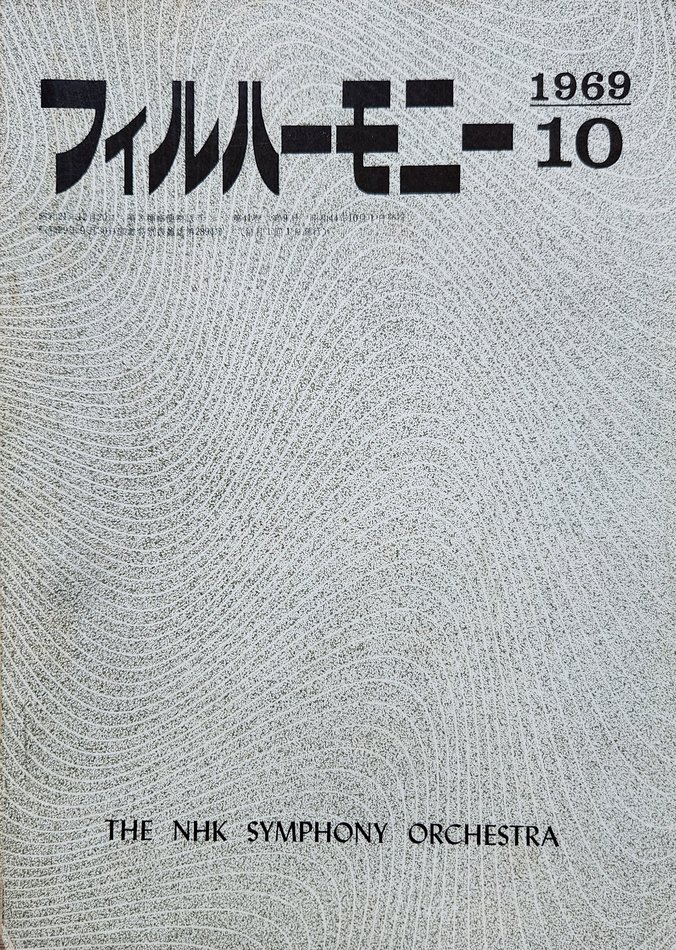
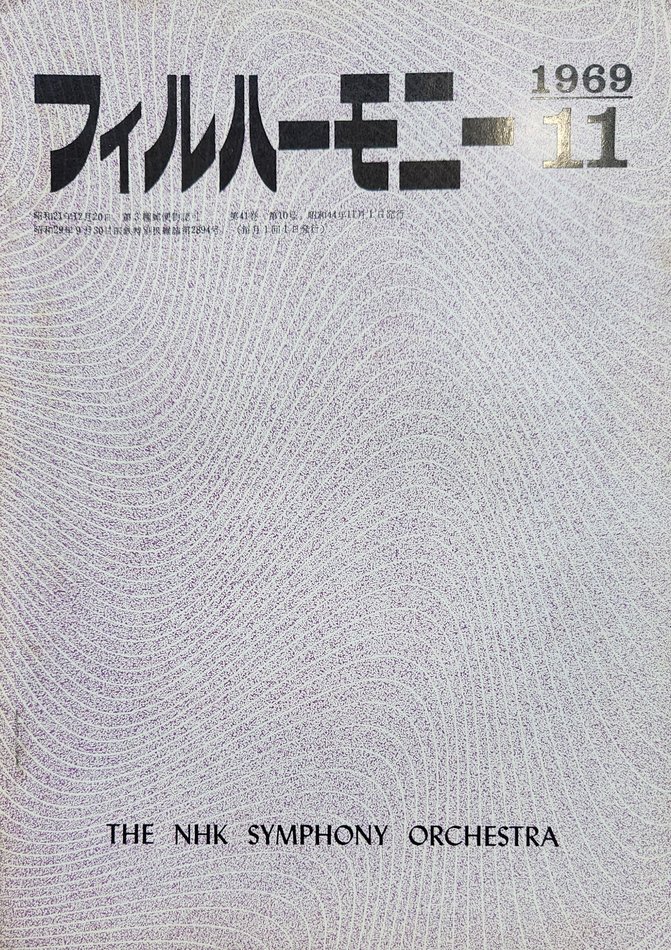
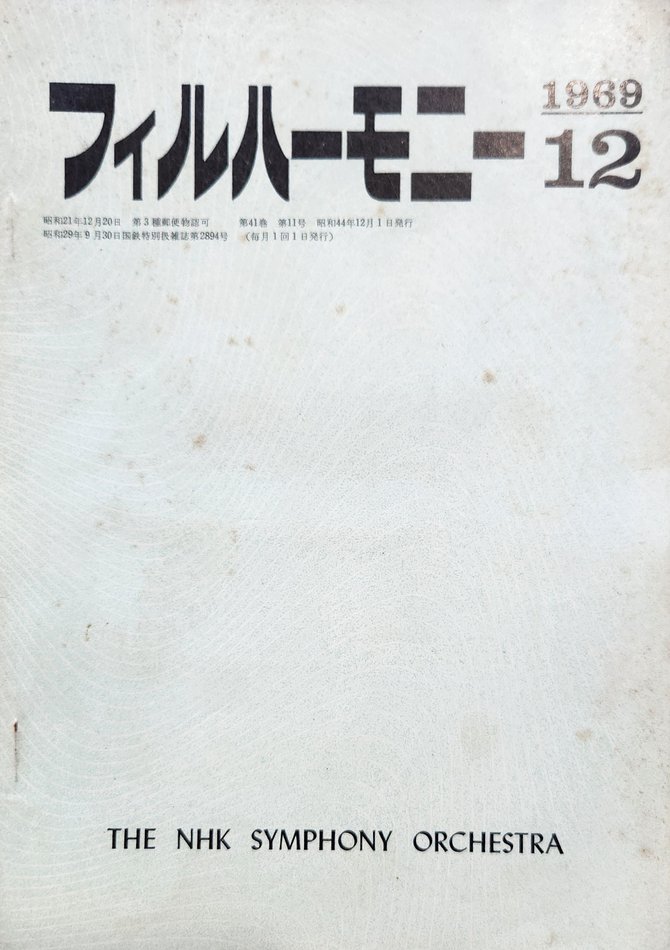
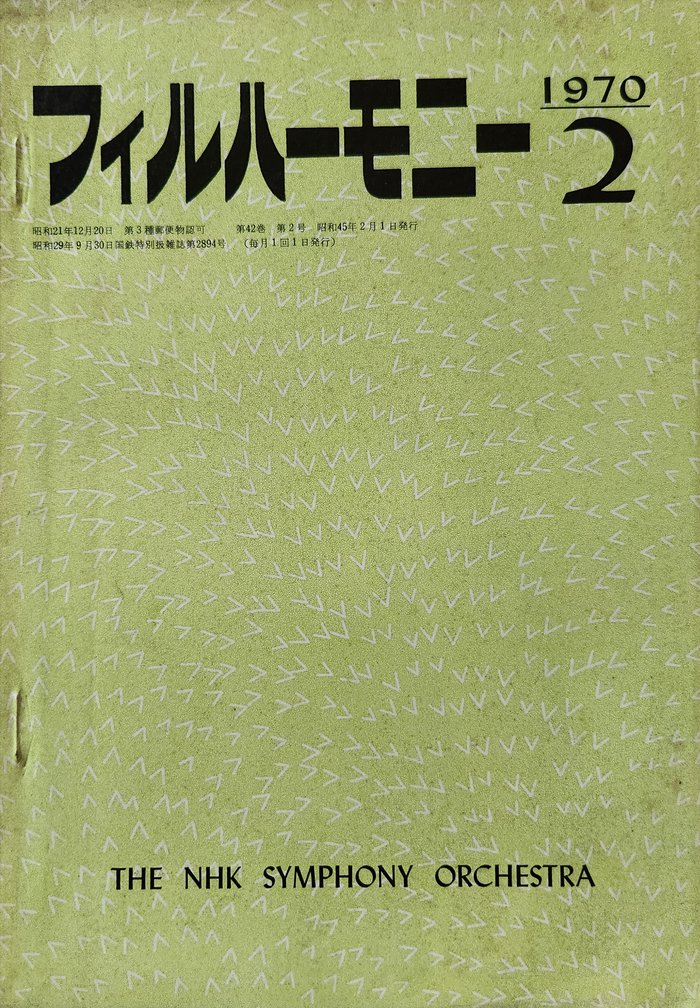
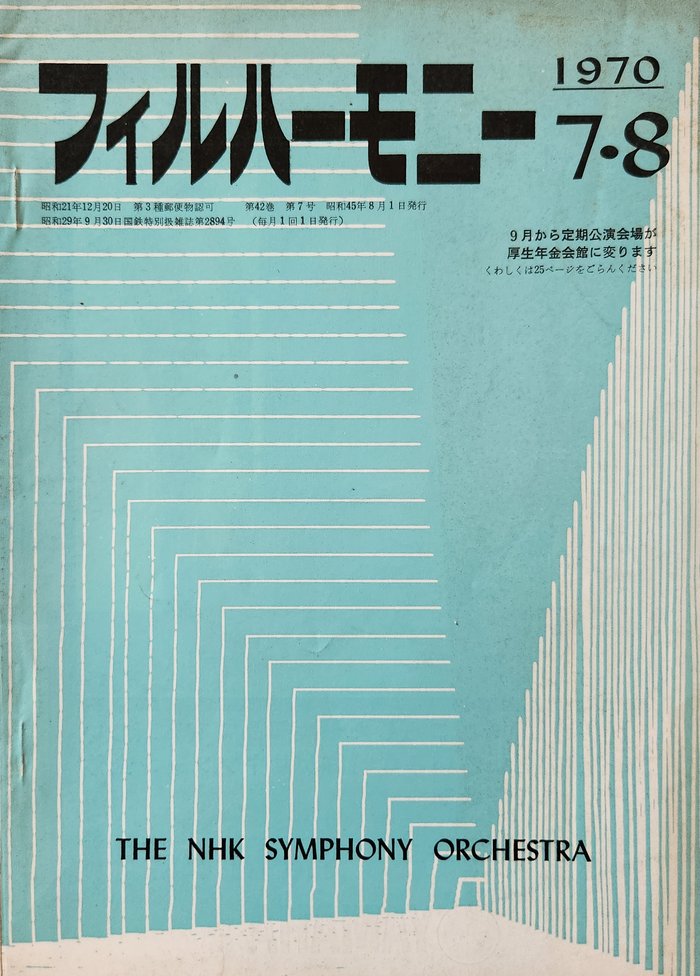
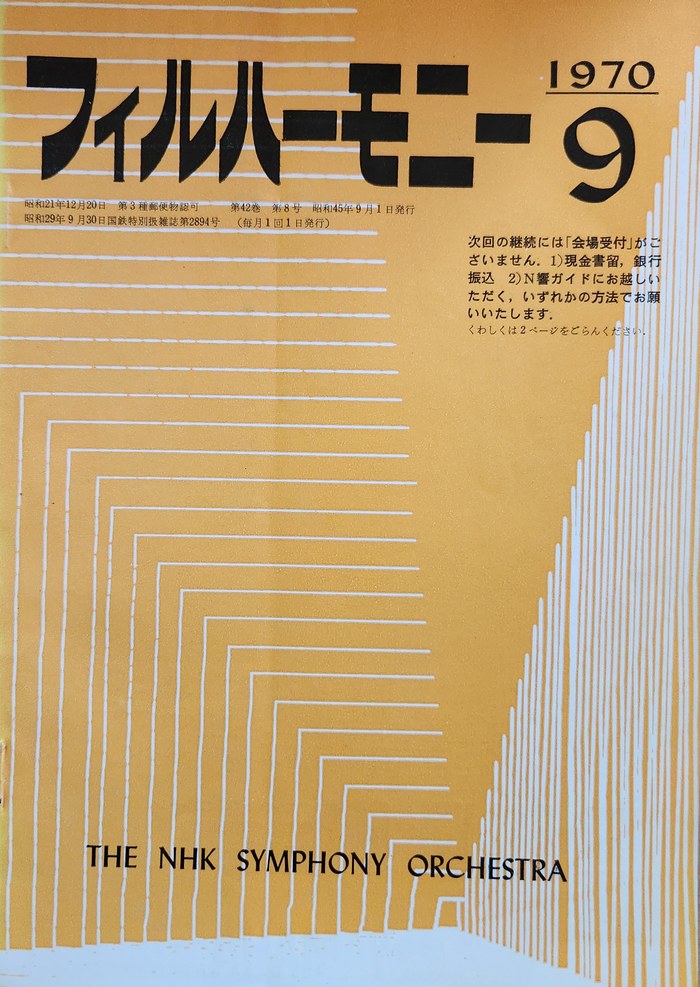
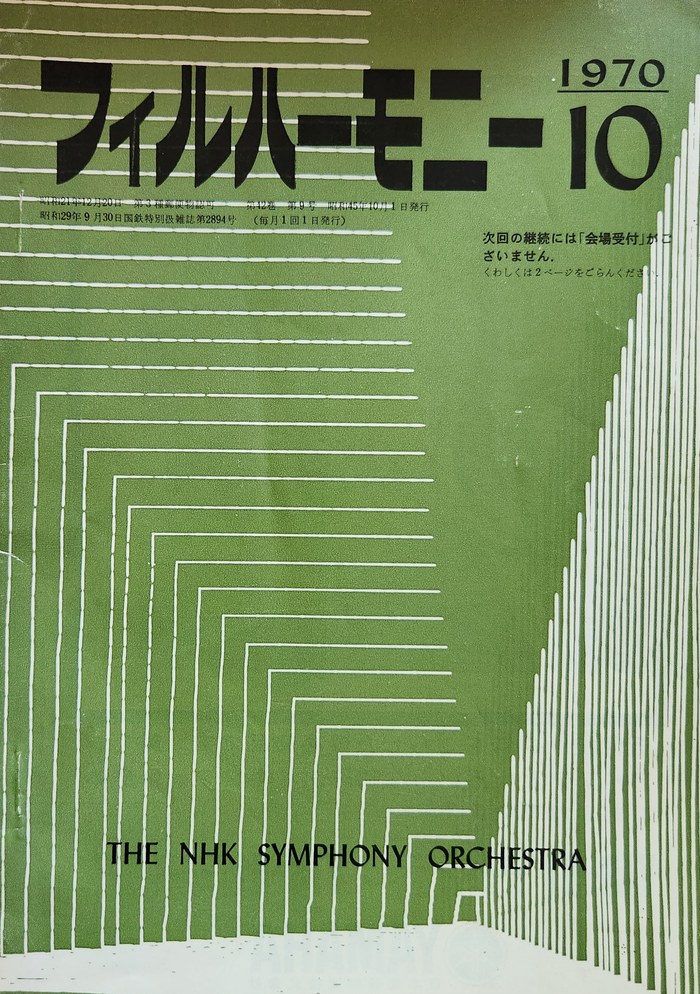
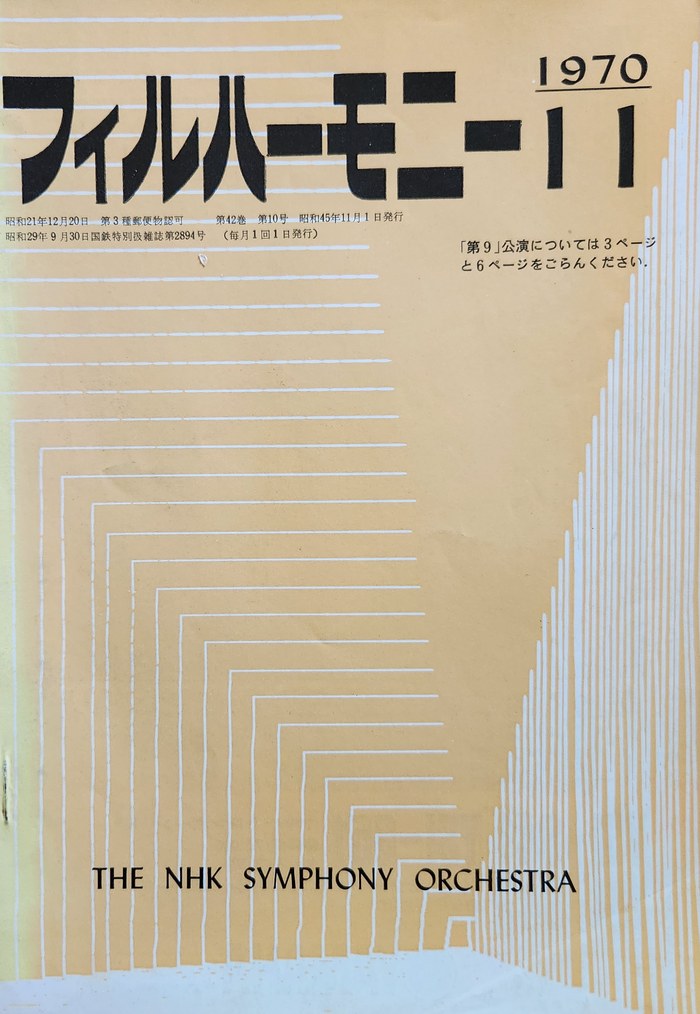
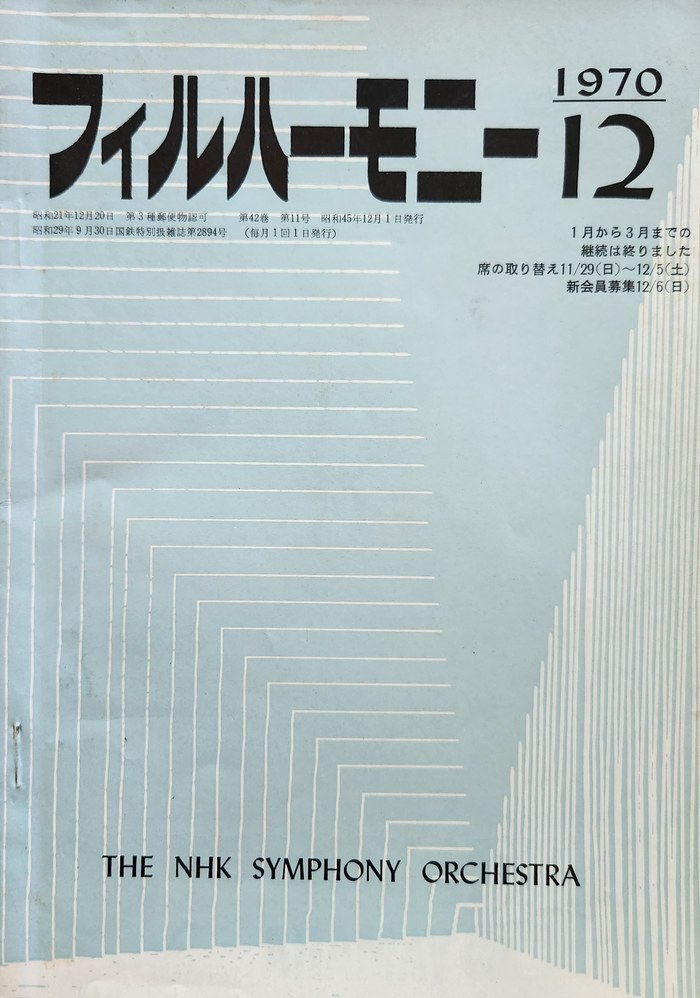
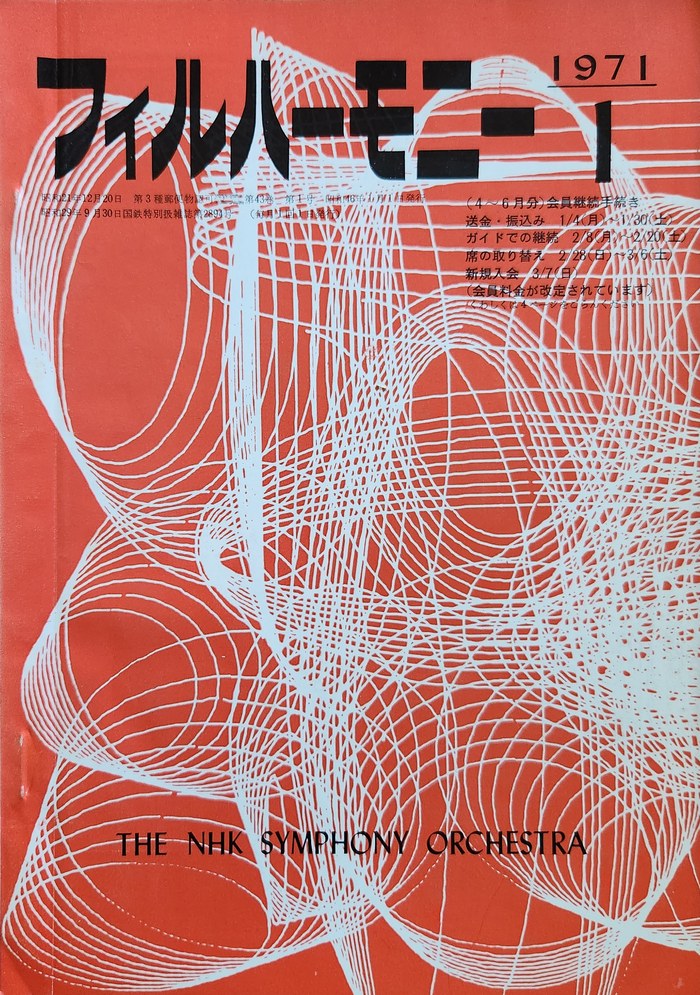
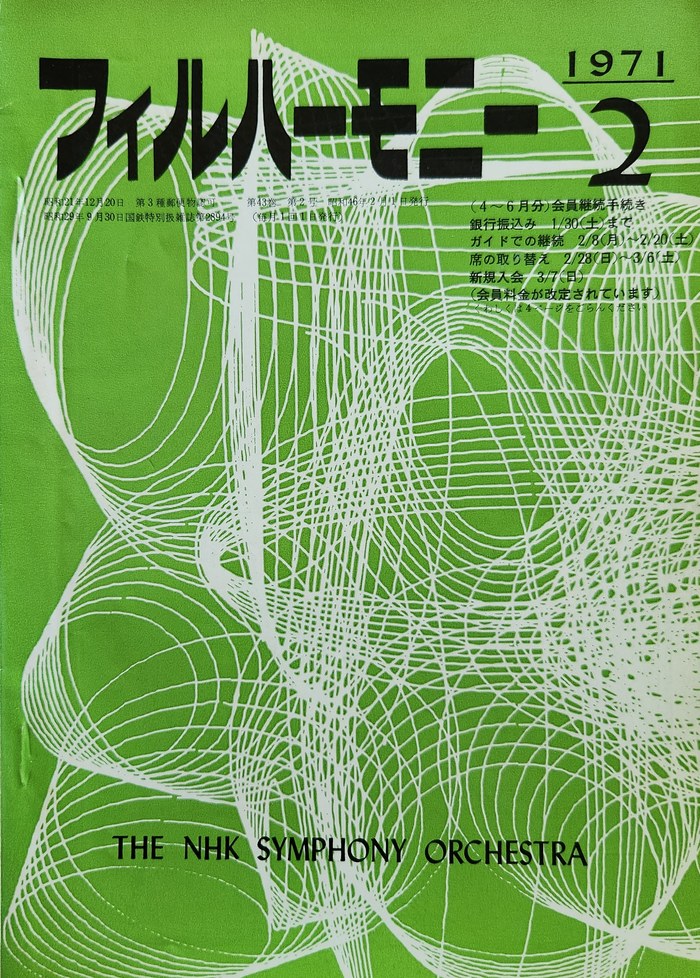
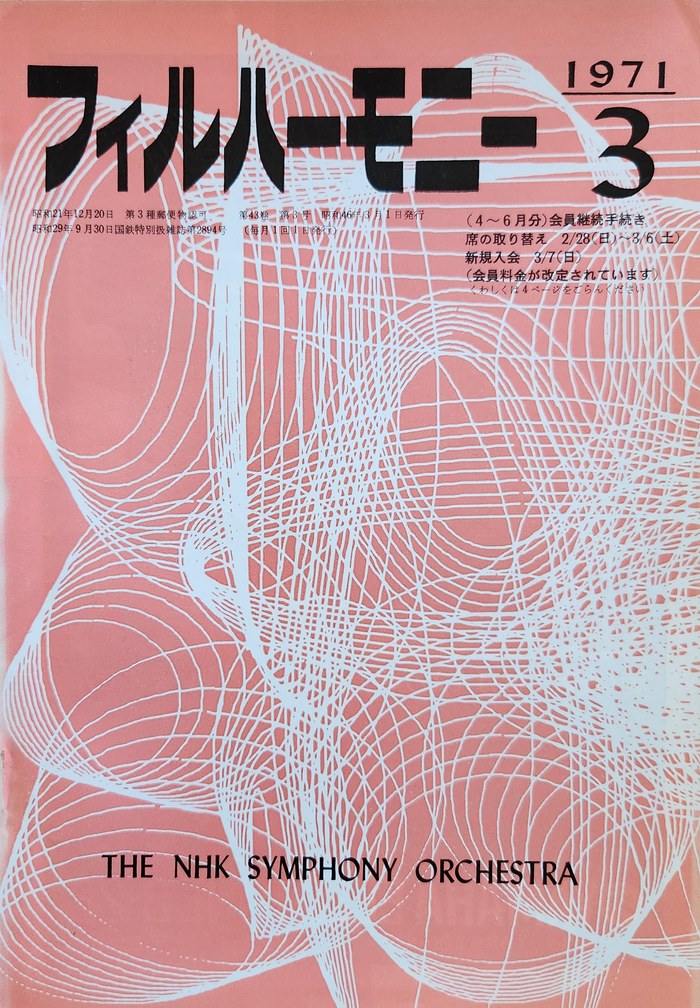
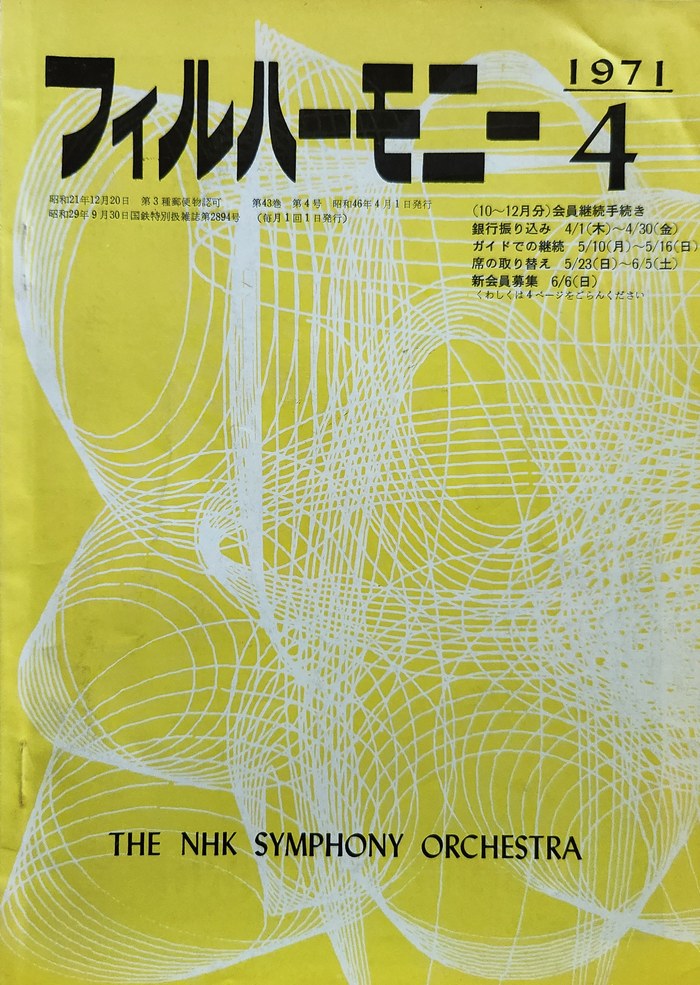
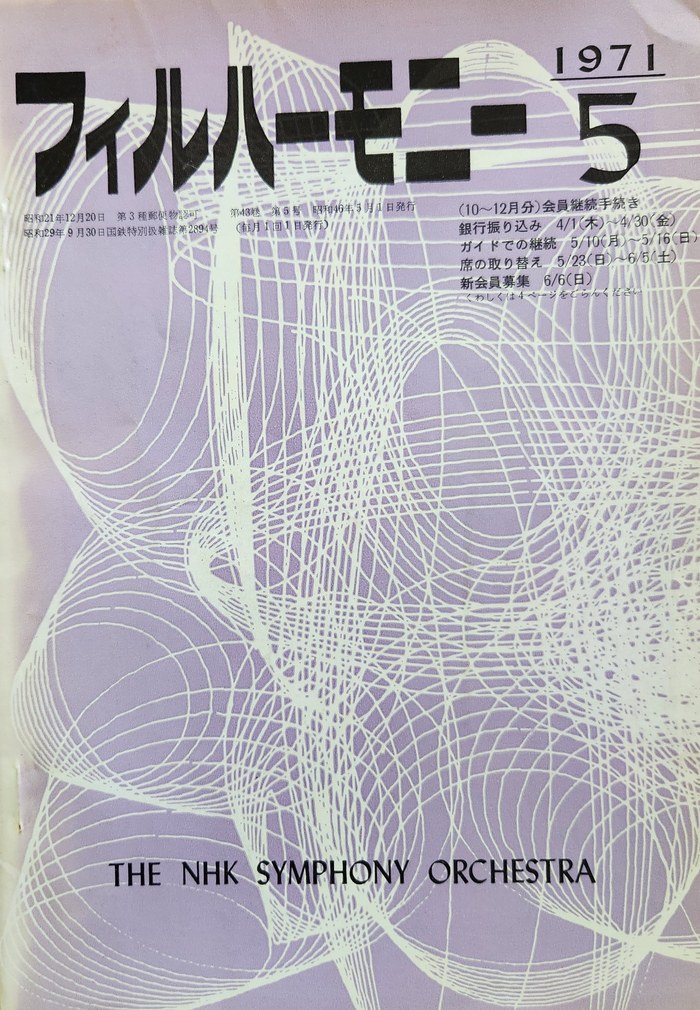
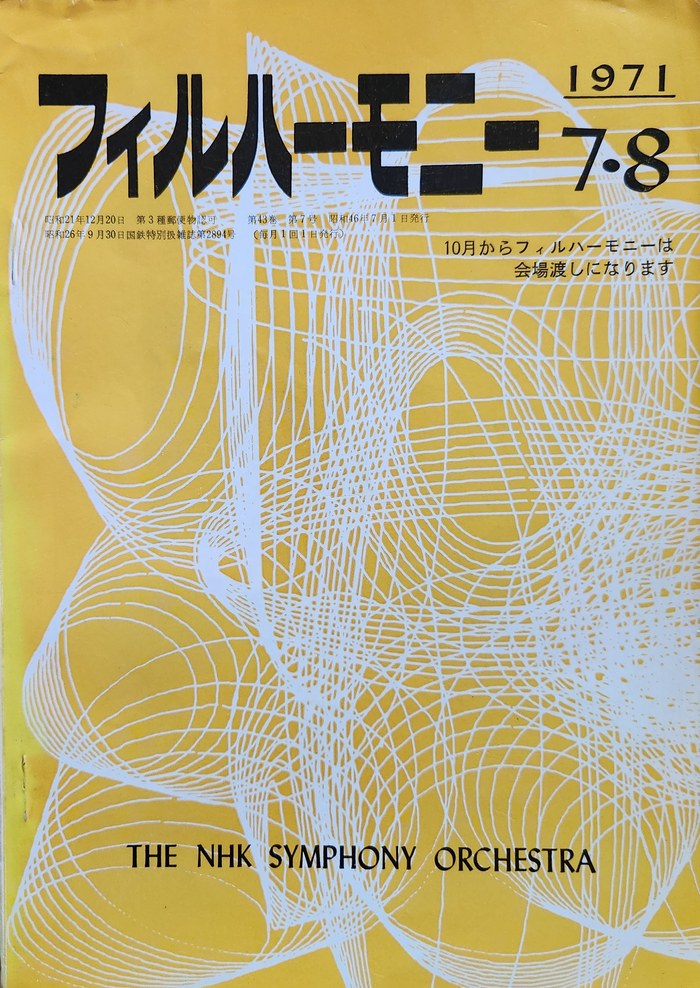
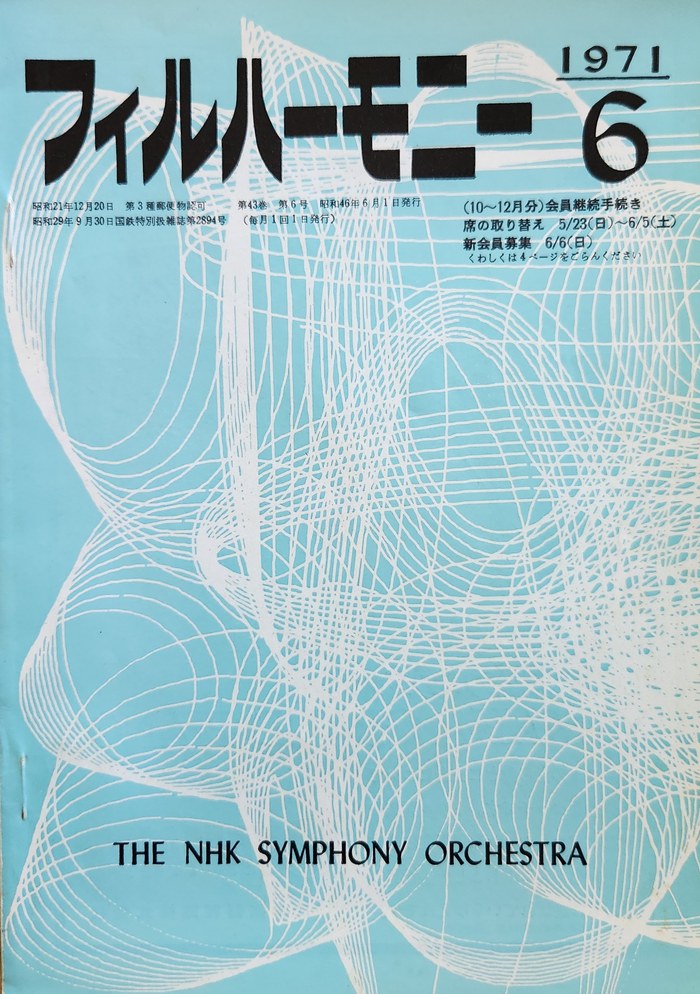
Philharmony, NHK Symphony Orchestra journal, February 1969, CTG Random Flower cover

Philharmony フィルハーモニー, twenty-eight issues

1969–1971 · NHK Symphony Orchestra members’ journal

For two and a half years the monthly program journal of the NHK Symphony Orchestra used CTG cover designs. Two issues contain CTG articles: February 1969 and September 1969, written just before dissolution.
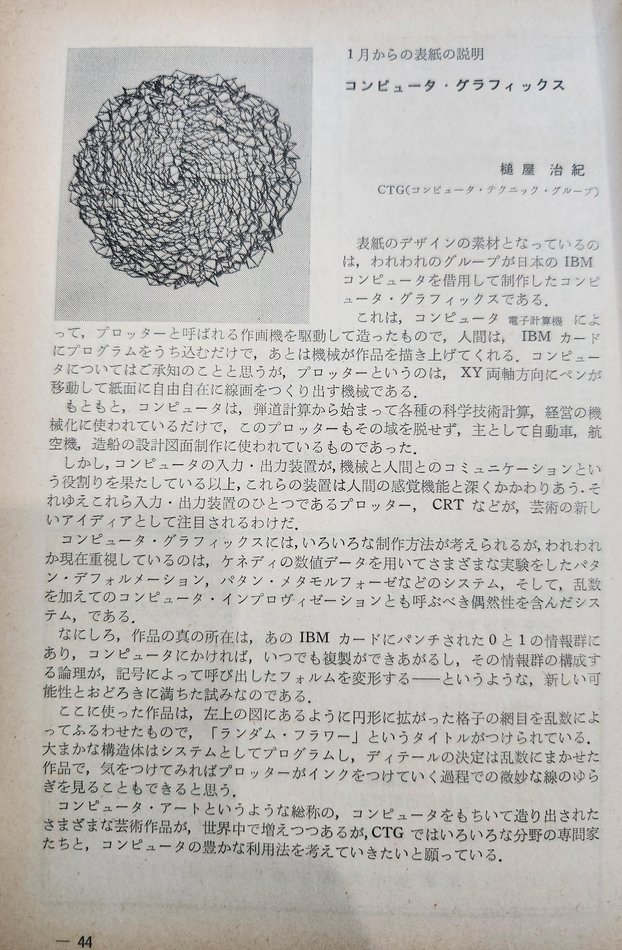
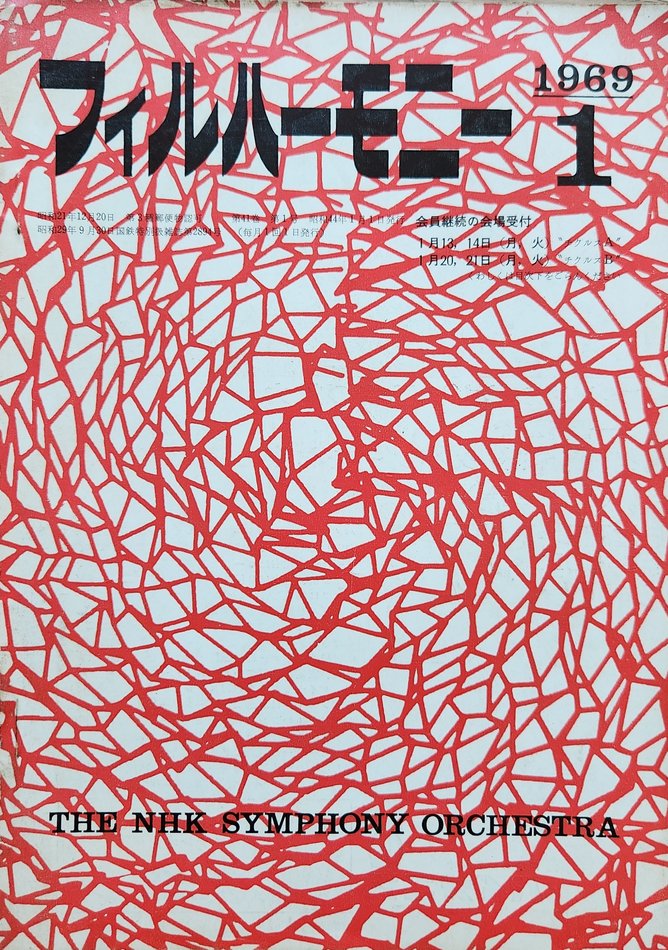
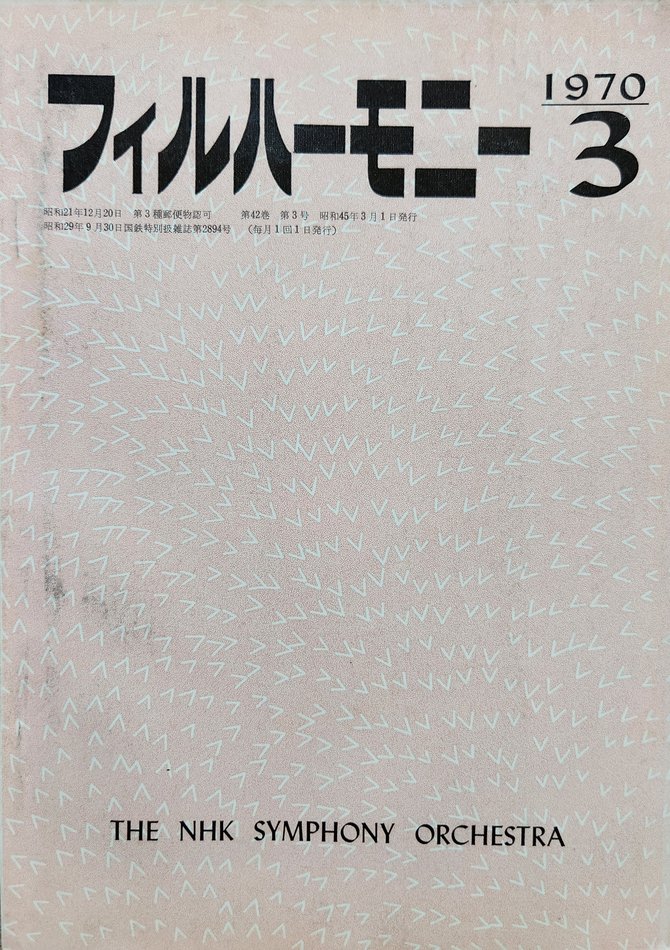
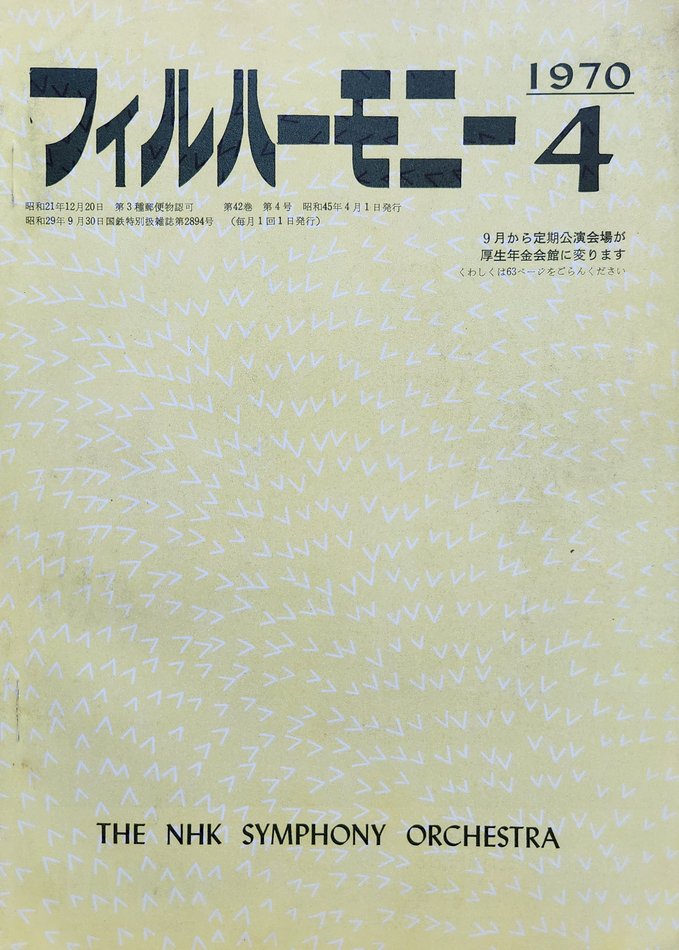
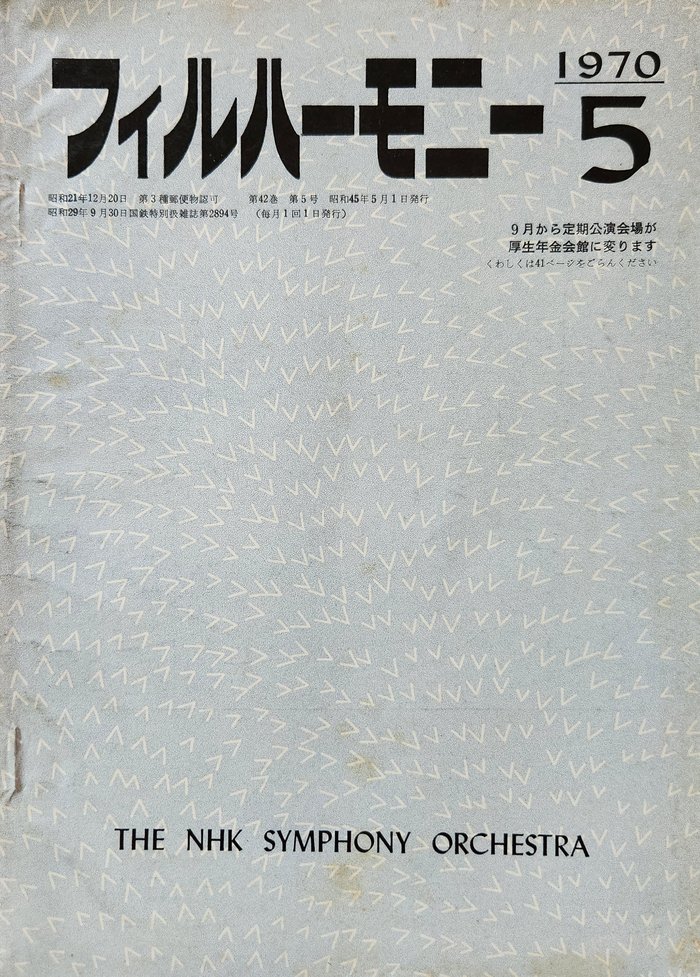
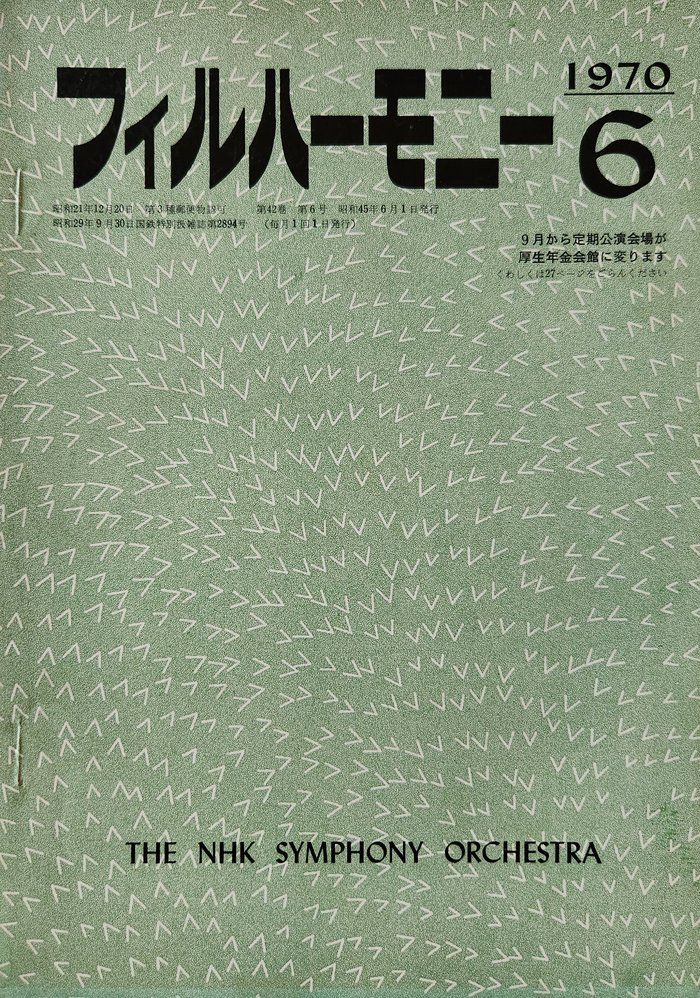
Philharmony February 1969 p. 44: Tsuchiya's explanation of the covers from January, with the Random Flower plate Philharmony 1969 no. 1 cover, the first of the run: red web pattern Philharmony 1969 no. 3 cover, pink web pattern Philharmony 1969 no. 4 cover Philharmony 1969 no. 5 cover, blue-gray web pattern Philharmony 1969 no. 6 cover Philharmony 1969 no. 7-8 cover Philharmony 1969 no. 9 cover, sine-curve rotation program Philharmony 1969 no. 10 cover, gray contour-wave pattern Philharmony 1969 no. 11 cover, purple contour-wave pattern Philharmony 1969 no. 12 cover, pale contour-wave pattern Philharmony 1970 no. 2 cover Philharmony 1970 no. 3 cover, pink chevron-field pattern Philharmony 1970 no. 4 cover, yellow chevron-field pattern Philharmony 1970 no. 5 cover Philharmony 1970 no. 6 cover Philharmony 1970 no. 7-8 cover Philharmony 1970 no. 9 cover Philharmony 1970 no. 10 cover Philharmony 1970 no. 11 cover Philharmony 1970 no. 12 cover Philharmony 1971 no. 1 cover Philharmony 1971 no. 2 cover Philharmony 1971 no. 3 cover Philharmony 1971 no. 4 cover Philharmony 1971 no. 5 cover Philharmony 1971 no. 6 cover Philharmony 1971 no. 7-8 cover, the last CTG cover of the run
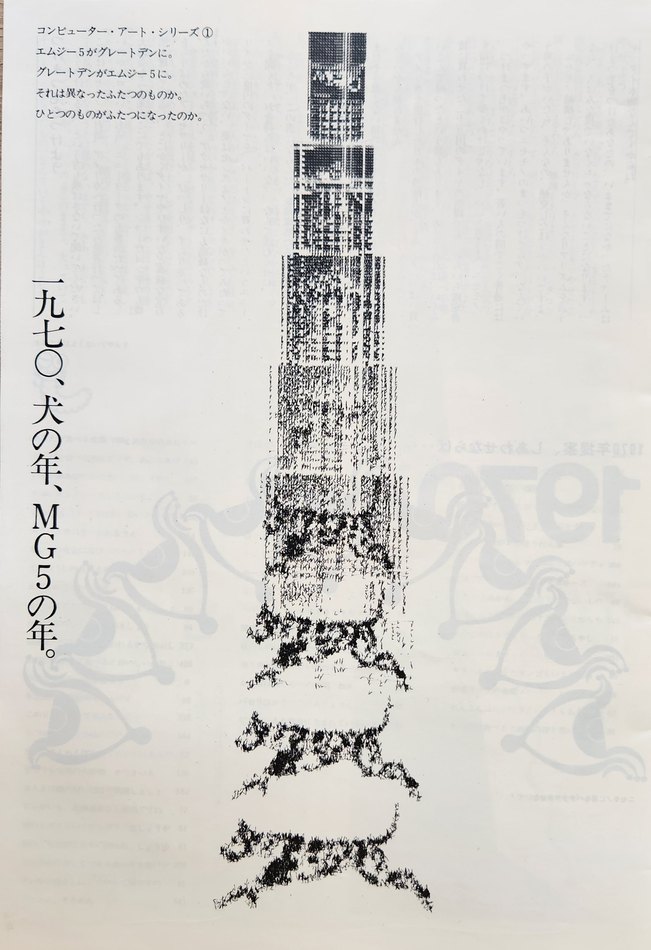
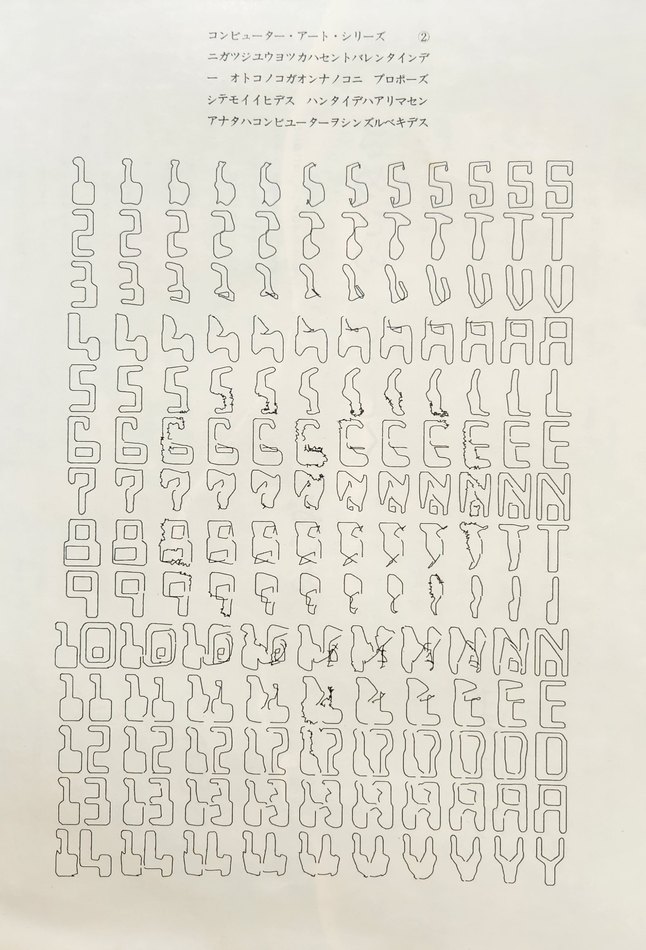
Hanatsubaki no. 235 page 3, Computer Art Series 1: a Great Dane transformed frame by frame into the MG5 mark

Hanatsubaki 花椿, nos. 235 and 236

January and February 1970 · Shiseido’s house magazine · two issues

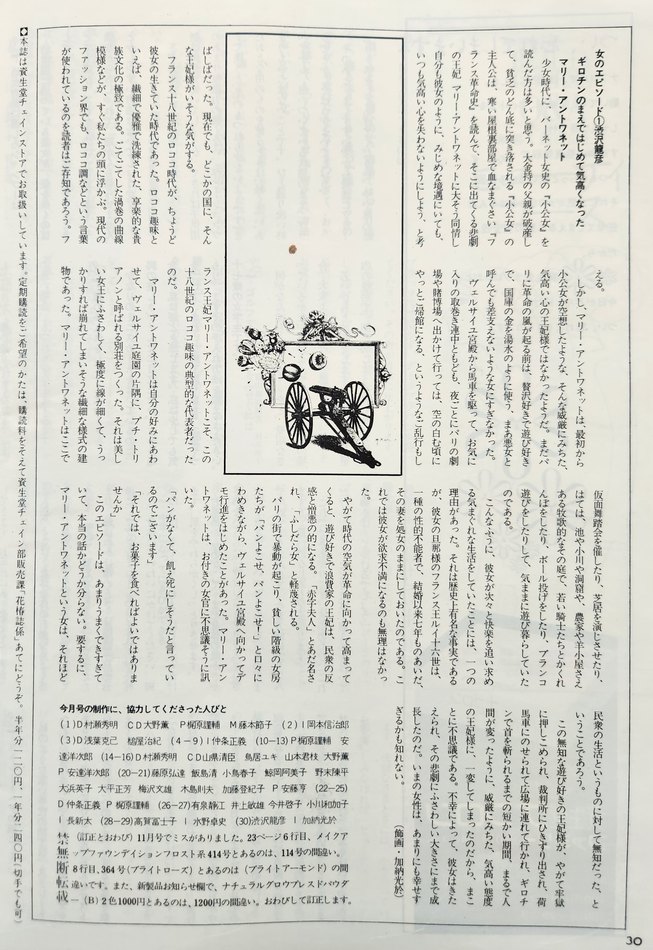
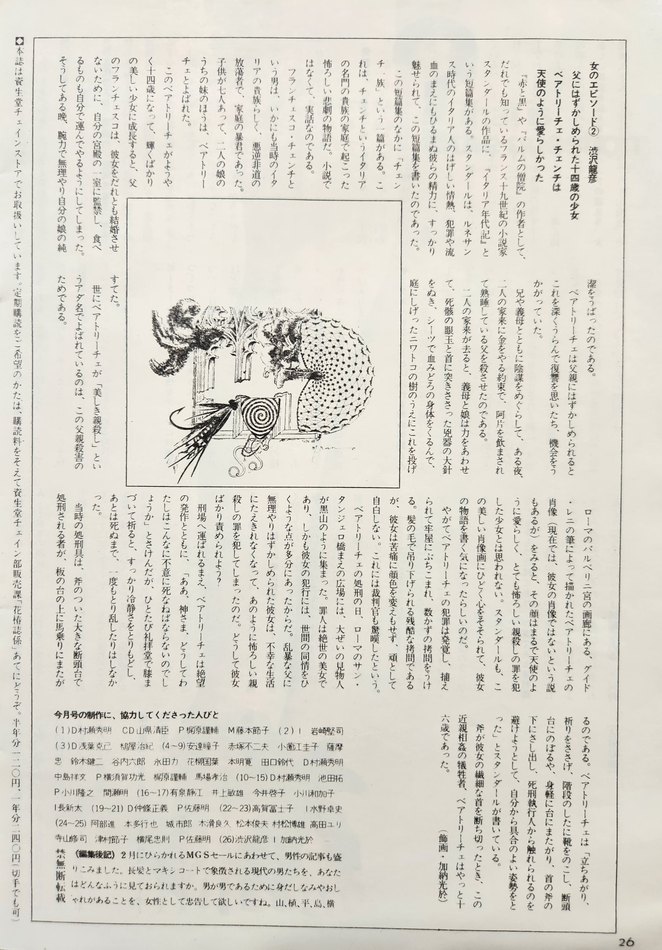
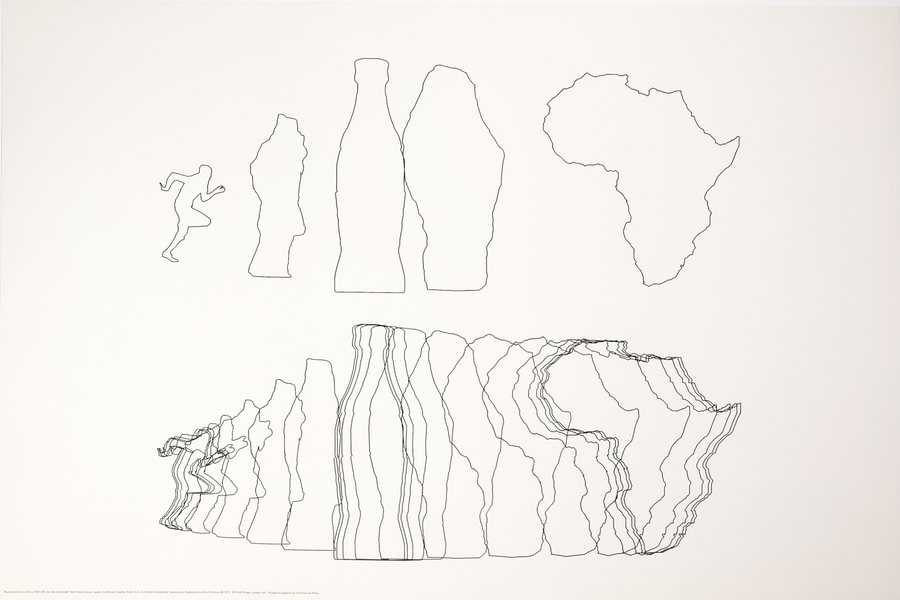
Shiseido’s monthly “Computer Art Series.” Each installment is a metamorphosis in the manner of Running Cola is Africa!. In January a running Great Dane becomes the mark of MG5, Shiseido’s men’s line. In February the numerals 1 to 14 each cross the page in twelve steps to become a letter, spelling “St. Valentine Day.”

Each issue credits page 3 to Katsumi Asaba and Haruki Tsuchiya. The pages were produced in the last weeks of 1969, after CTG’s dissolution.

Hanatsubaki no. 236 page 3, Computer Art Series 2: numerals 1 to 14 transformed step by step into the letters of St. Valentine Day Hanatsubaki no. 235 cover, January 1970: model in a red knitted hat holding a compact Hanatsubaki no. 236 cover, February 1970: model in a black knitted hat and leather gloves, the tears issue Hanatsubaki no. 235 page 30: the contributors' block crediting page 3 to Katsumi Asaba and Haruki Tsuchiya Hanatsubaki no. 236 page 26: the contributors' block with the same credit
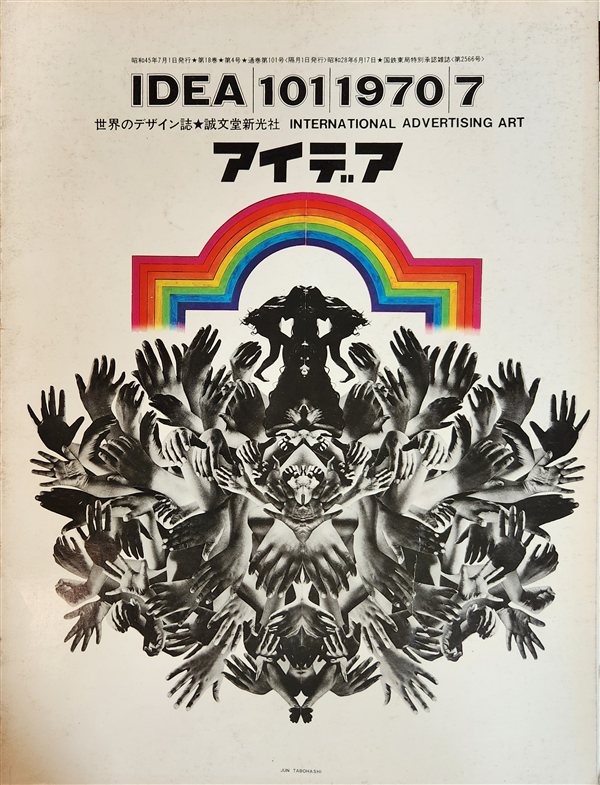
idea magazine no. 101, July 1970, cover by Jun Tabohashi

idea アイデア, no. 101

July 1, 1970 · Magazine · Seibundō Shinkōsha

The design monthly’s yearly survey of corporate calendars. Plate 16, the January–February leaf, is the Tōka Shikiso Chemical Industry’s calendar for 1970, created by CTG. The calendar won the Technical Prize at the 21st National Calendar Exhibition.
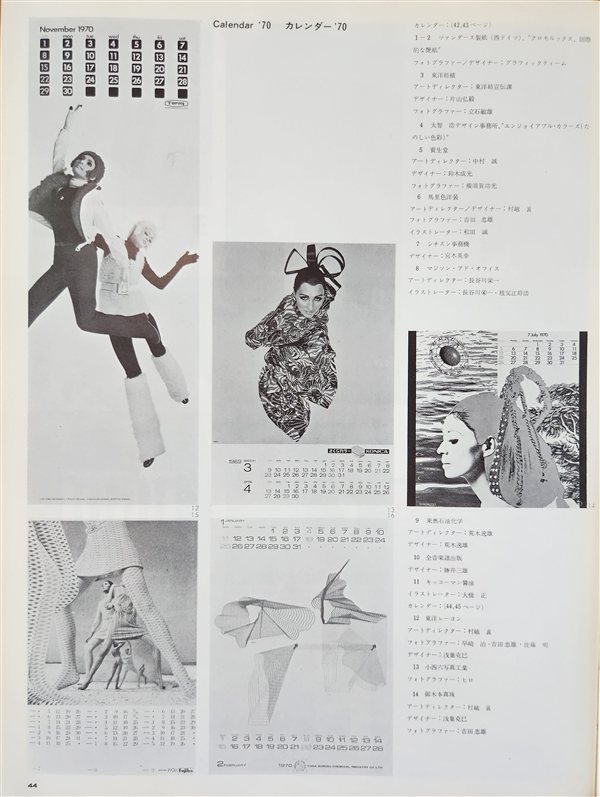
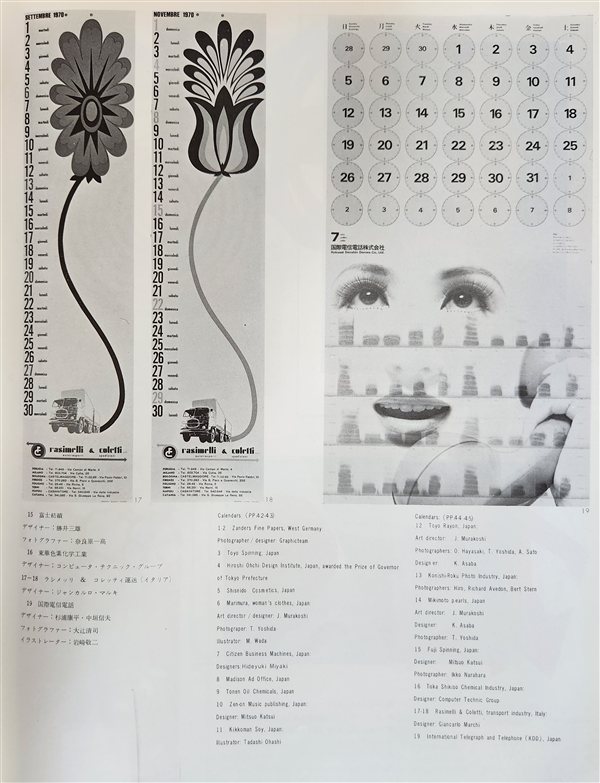
idea no. 101 page 44: Calendar '70 review, plate 16, the January-February leaf of the Toka Shikiso 1970 calendar with a CTG plotter drawing idea no. 101 page 45: credit lists in Japanese and English, entry 16: Toka Shikiso Chemical Industry, Designer: Computer Technic Group
Motif Editions Posters
Return to a Square lithograph, Motif Editions

Return to a Square

1968 · Lithograph, 30 × 20 in · Kohmura / Yamanaka / CTG
Running Cola is Africa! lithograph, Motif Editions

Running Cola is Africa!

1968 · Lithograph, 30 × 20 in · Kohmura / Ohtake / Fujino / CTG
Music / Sound
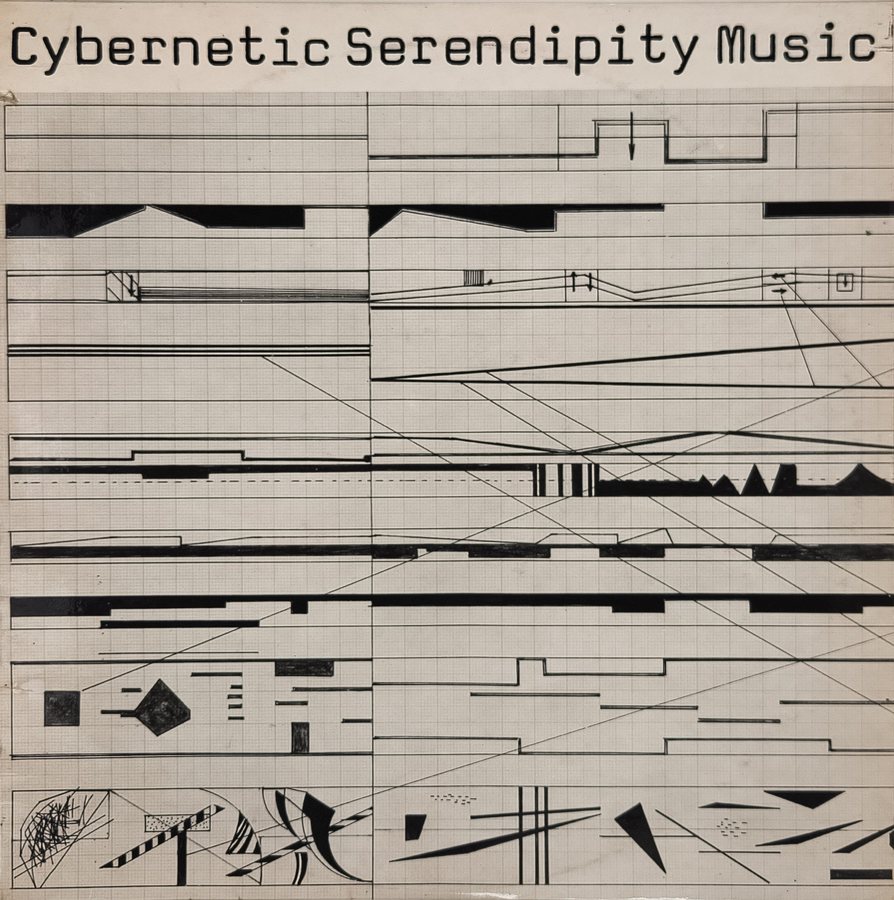
Cybernetic Serendipity Music LP

Cybernetic Serendipity Music

1968 · LP, 33⅓ rpm stereo · ICA, London · small pressing sold only at the ICA

The audio companion to the Cybernetic Serendipity exhibition. Contains Tsuchiya’s Bit Music, which the ICA’s tape sheet describes as “directly recorded onto tape from a plotter according to the programme of the computer graphic ‘The Individualisation Age.’”
Listen: Bit Music (excerpt), side B track 2, 2′46″ · recording: Internet Archive
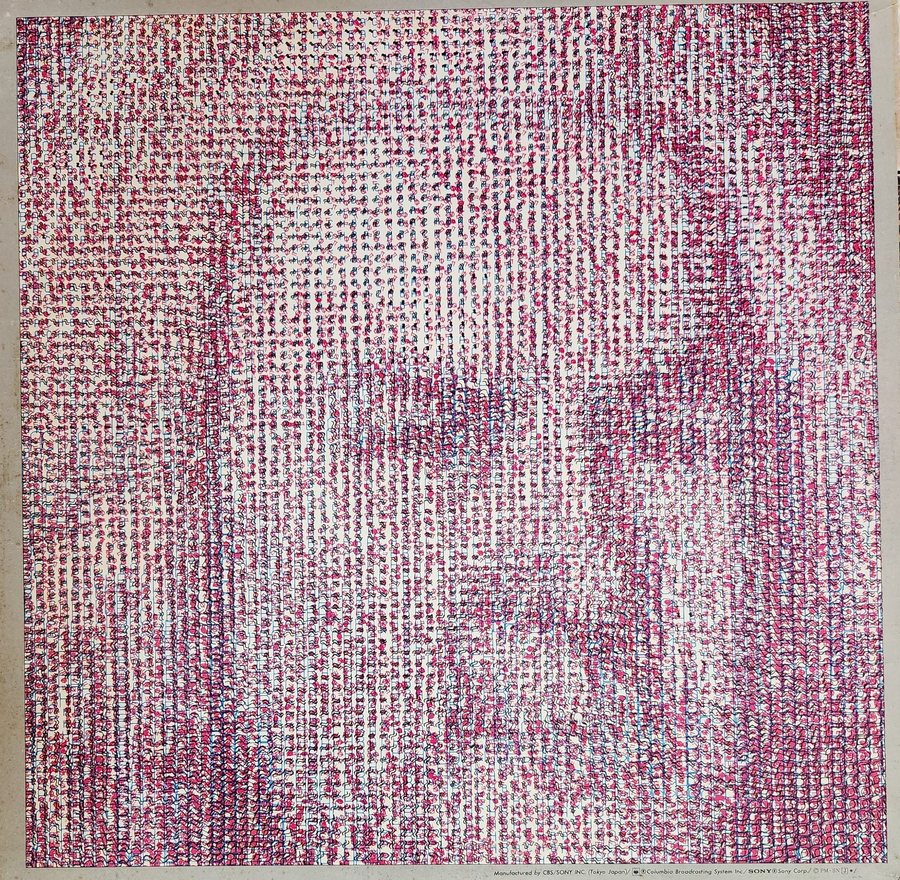
Switched-On Bach LP back cover

Switched-On Bach

1968 · LP, Japanese CBS/Sony edition

Reverse of the Japanese jacket shows Plot Bach (1968).
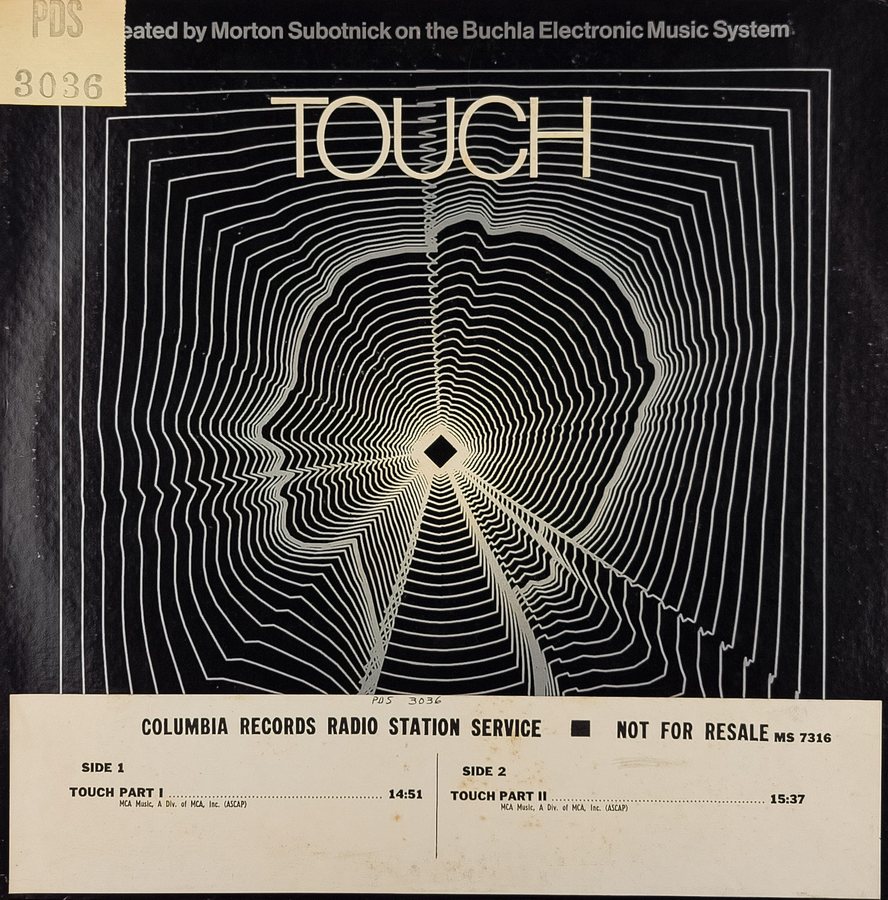
Touch LP by Morton Subotnick, cover art by CTG

Touch—Morton Subotnick

1969 · LP, Columbia · cover after CTG’s Return to a Square (b)

The cover shows Return to a Square (b) in negative.
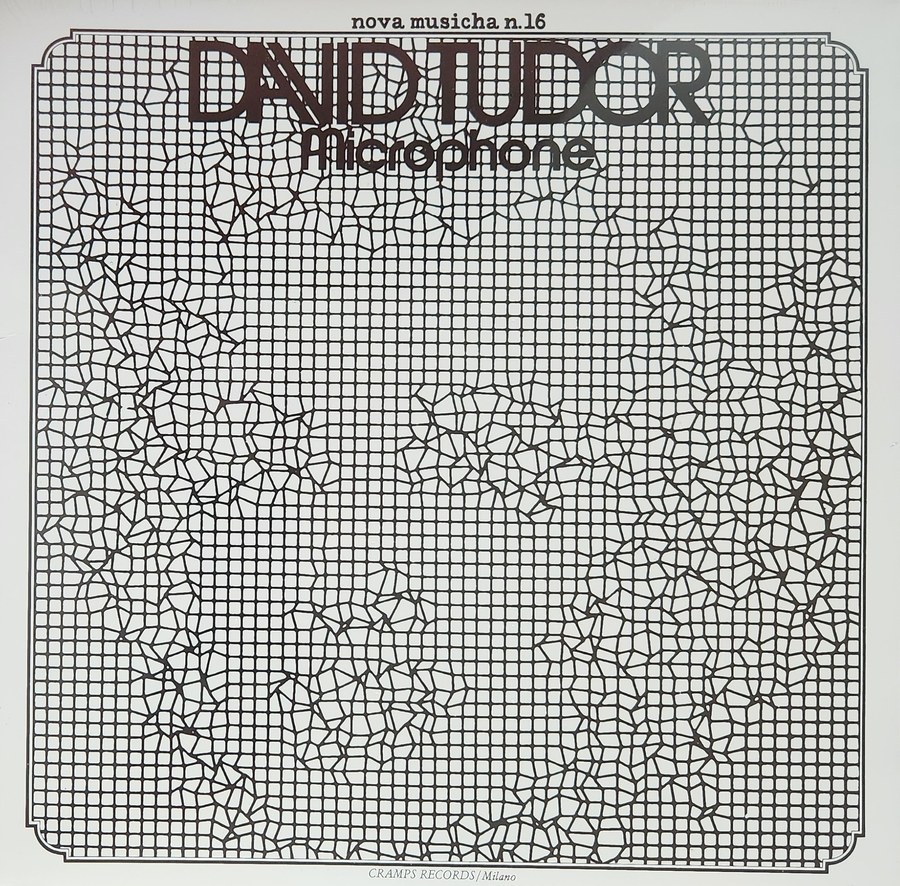
Microphone LP by David Tudor, Cramps Records nova musicha n.16

Microphone—David Tudor

1978 · LP, Cramps Records, Milano · nova musicha n. 16

The jacket shows Monroe in the Net.

Exhibition Catalogs & Invitations
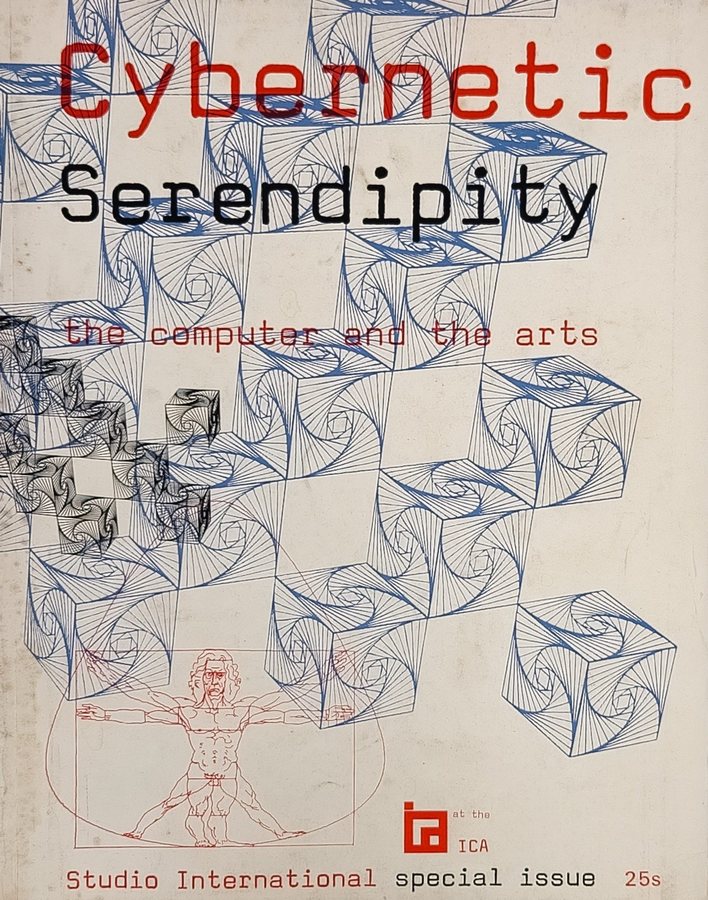
Cybernetic Serendipity: The Computer and the Arts, 1968 catalog

Cybernetic Serendipity: The Computer and the Arts

1968 · Special issue of Studio International, ed. Jasia Reichardt · cover by Franciszka Themerson

The catalog/book of the ICA exhibition with CTG’s twenty-four graphics, algorithm descriptions, and idea/program credits.
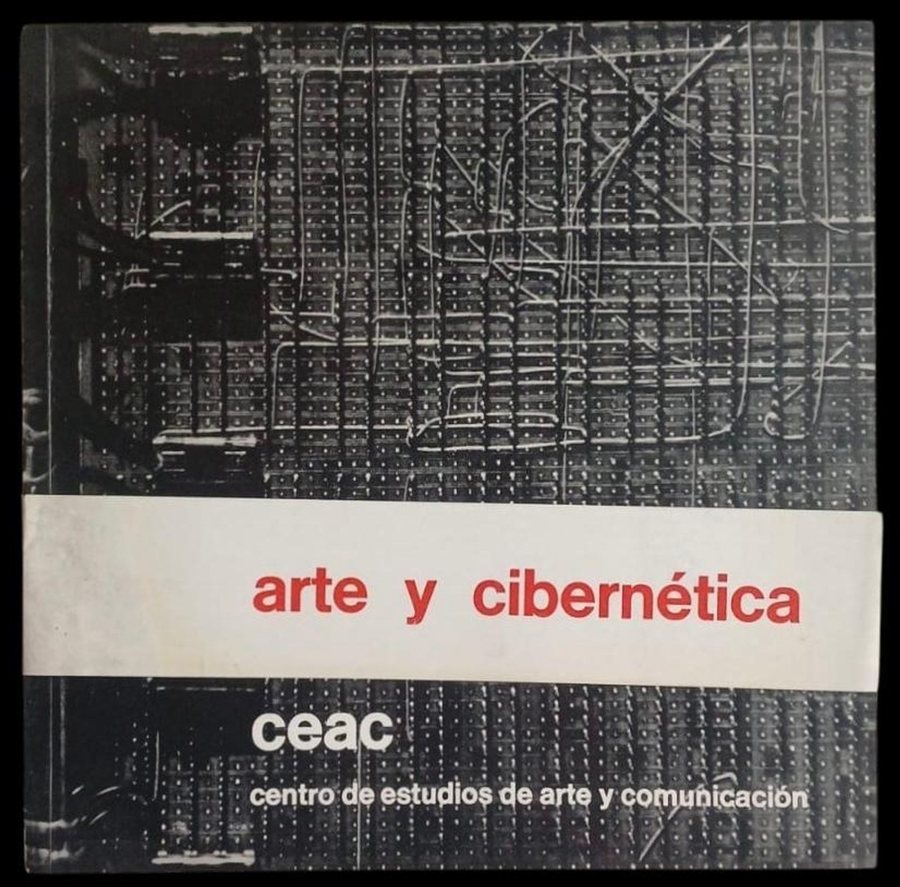
arte y cibernética catalog, Buenos Aires 1969

arte y cibernética

1969 · Exhibition catalog · Galería Bonino, Buenos Aires

Catalog of the first Arte y Cibernética show, among the first computer-art exhibitions in Argentina, organized by Jorge Glusberg, who founded his Grupo de Arte y Cibernética after meeting with CTG. Includes twenty CTG works.
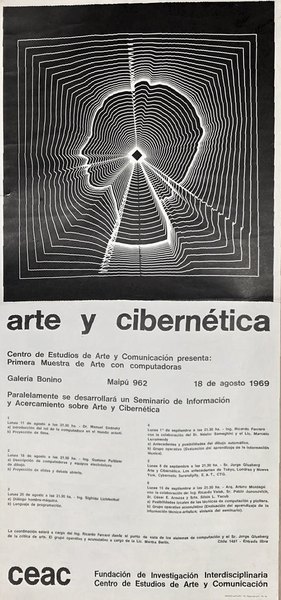
arte y cibernética poster, CEAC, Buenos Aires, 1969, with Return to a Square (b) above the seminar programme

arte y cibernética, poster

1969 · Exhibition poster · CEAC, Buenos Aires

The poster for the Bonino show, printed by CEAC with Return to a Square (b) as its image. Below the image it announces the opening on August 18 at Galería Bonino, and the seminar that ran alongside the exhibition on six Monday evenings.

Electromagica '69 tri-fold invitation, Sony, 1969

Electromagica ’69, invitation

April 26 – May 25, 1969 · Tri-fold invitation · Sony

Invitation to the international Psytech art exhibition at the Sony Building, Ginza, where CTG exhibited.

Electromagica '69 admission ticket stub, silver on black, Sony Building, Ginza, 1969

Electromagica ’69, ticket stub

April 26 – May 25, 1969 · Ticket stub · Sony Building, Ginza

Admission ticket stub from Electromagica.

Computer-Kunst: On the Eve of Tomorrow, 1969 exhibition catalog cover

Computer-Kunst: On the Eve of Tomorrow

1969 · Exhibition catalog, ed. Käthe Clarissa Schröder · Cubus, Hannover

Catalog of the computer-art exhibition held in Germany. CTG exhibited alongside Nees, Franke, Noll, Laposky, and others. Schröder later turned the exhibition into the traveling show IMPULSE computerkunst, which circulated from 1970 to 1976.
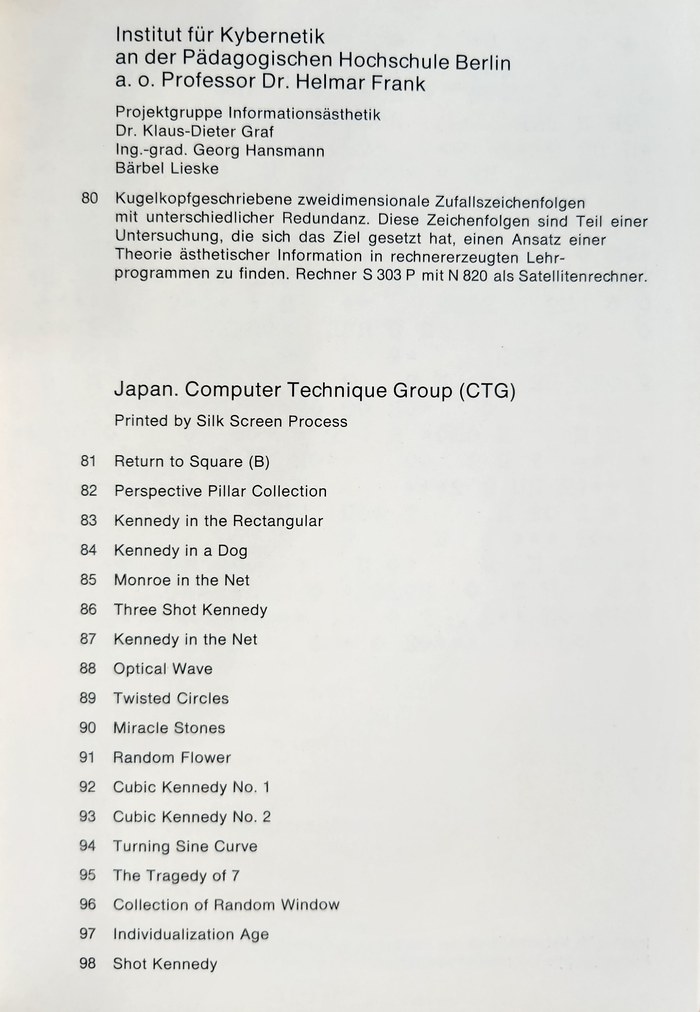
Computer-Kunst catalog checklist page: CTG's eighteen works, nos. 81–98, headed "Printed by Silk Screen Process"
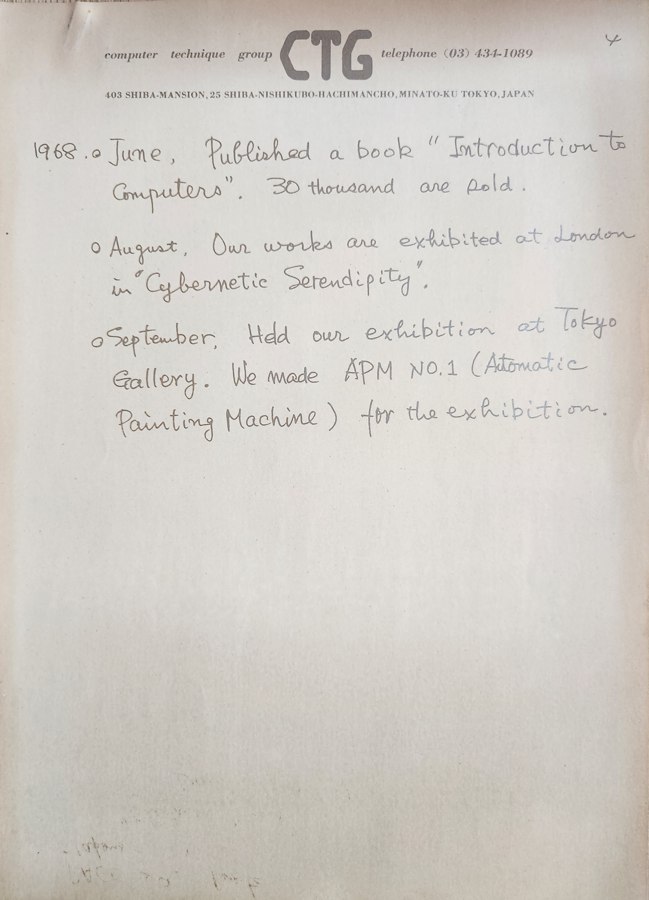
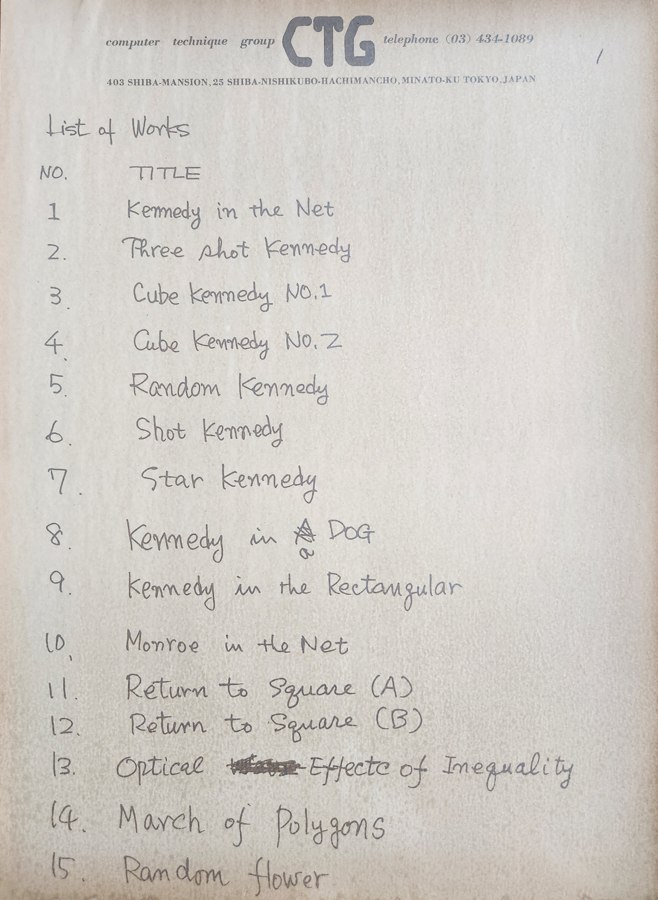
CTG letterhead sheet 1: handwritten List of Works, nos. 1–15

CTG works list and group history, in the group’s hand

c. 1968–69 · Four sheets, period Copyrapid diffusion-transfer copies · CTG letterhead, Tokyo

Four sheets on CTG office letterhead, handwritten in English and copied using the Agfa Copyrapid process. Sheets 1–2 list the twenty works of the Buenos Aires shipment. Sheets 3–4 give a group history and the Cybernetic Serendipity history.
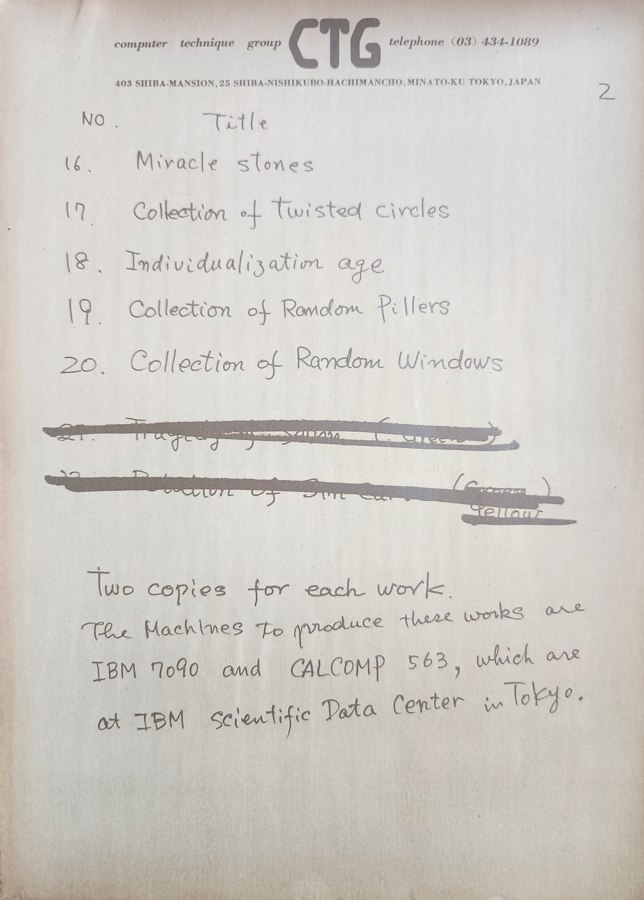
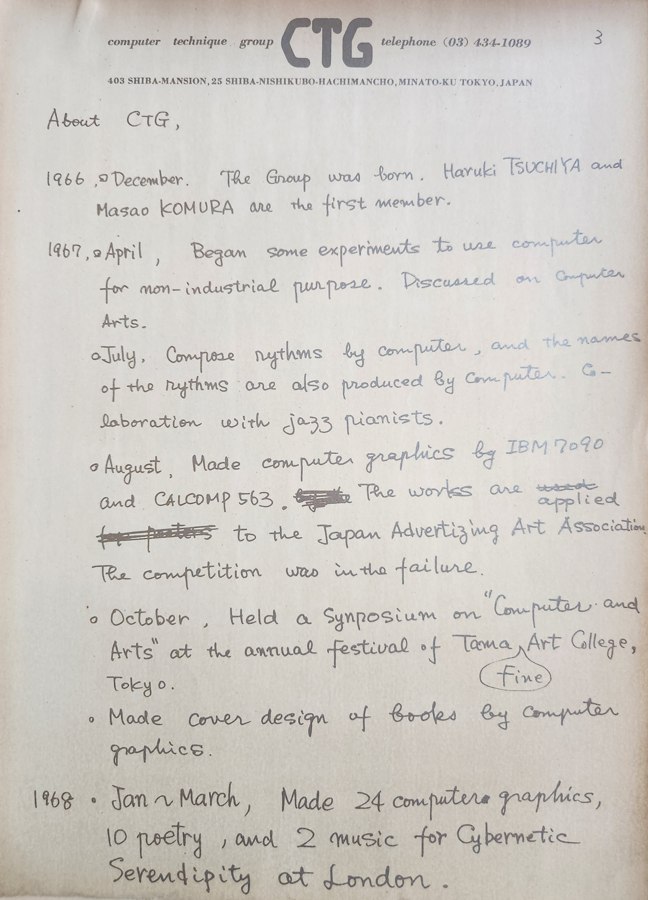
Sheet 2: works 16–20, two struck entries, and the two-copies note Sheet 3: About CTG, 1966–1968 Sheet 4: 1968—the book, Cybernetic Serendipity, Tokyo Gallery and APM No. 1
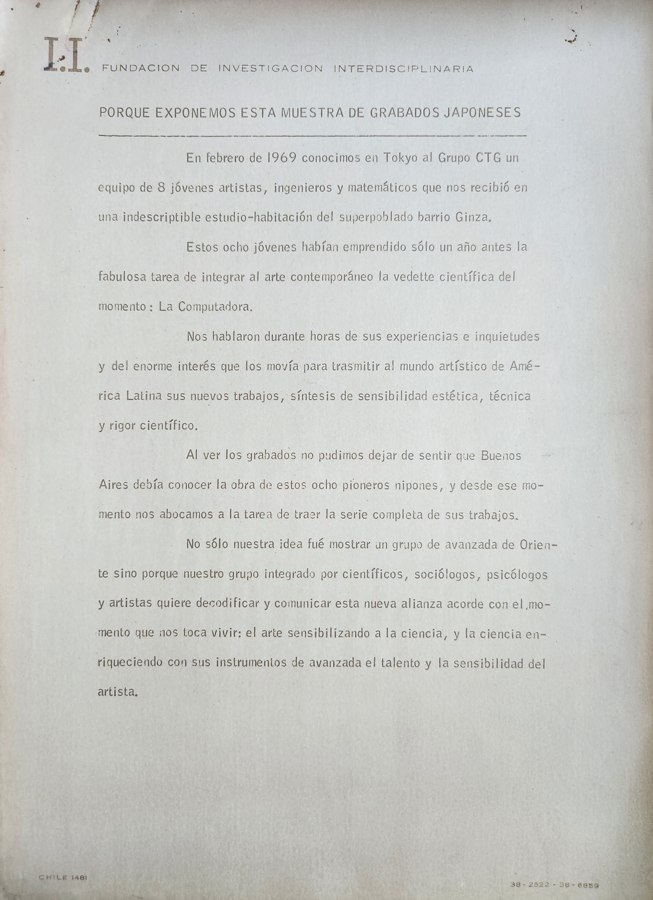
CEAC typescript: Por qué exponemos esta muestra de grabados japoneses, 1969

Por qué exponemos esta muestra de grabados japoneses

1969 · Typescript · CEAC, Buenos Aires

CEAC office typescript of the text written to present the CTG works in Buenos Aires.
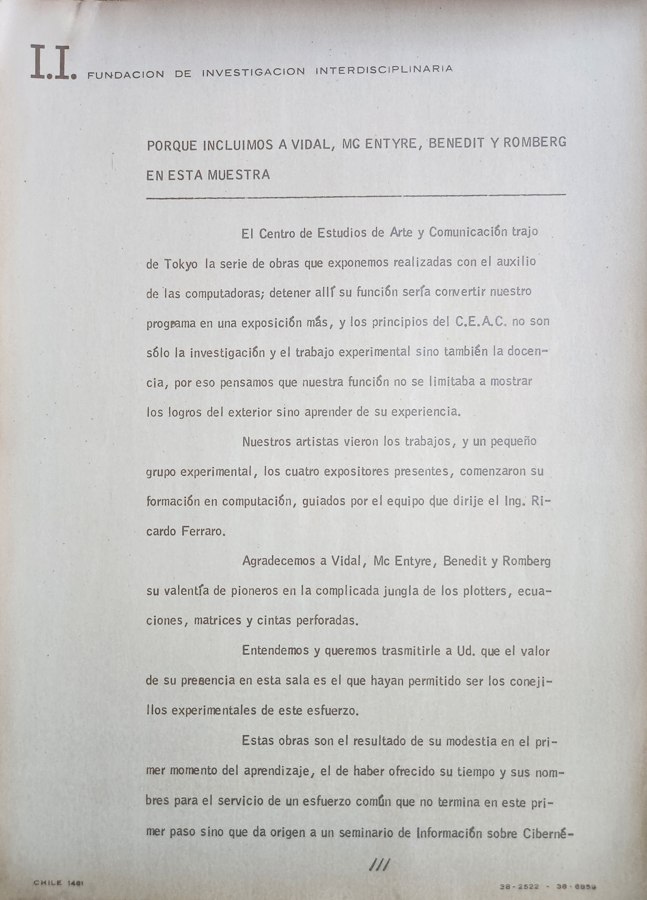
CEAC typescript: Porque incluimos a Vidal, Mc Entyre, Benedit y Romberg, 1969

Porque incluimos a Vidal, Mc Entyre, Benedit y Romberg

1969 · Typescript, two sheets · CEAC, Buenos Aires

Typescript written while the CEAC information seminar was running.
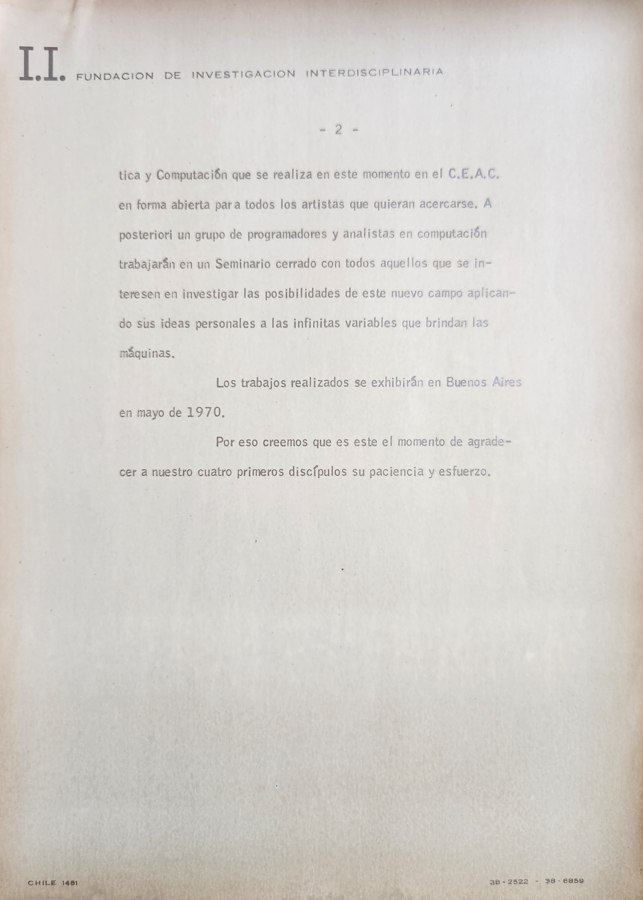
Second sheet: the seminar and the May 1970 exhibition announcement
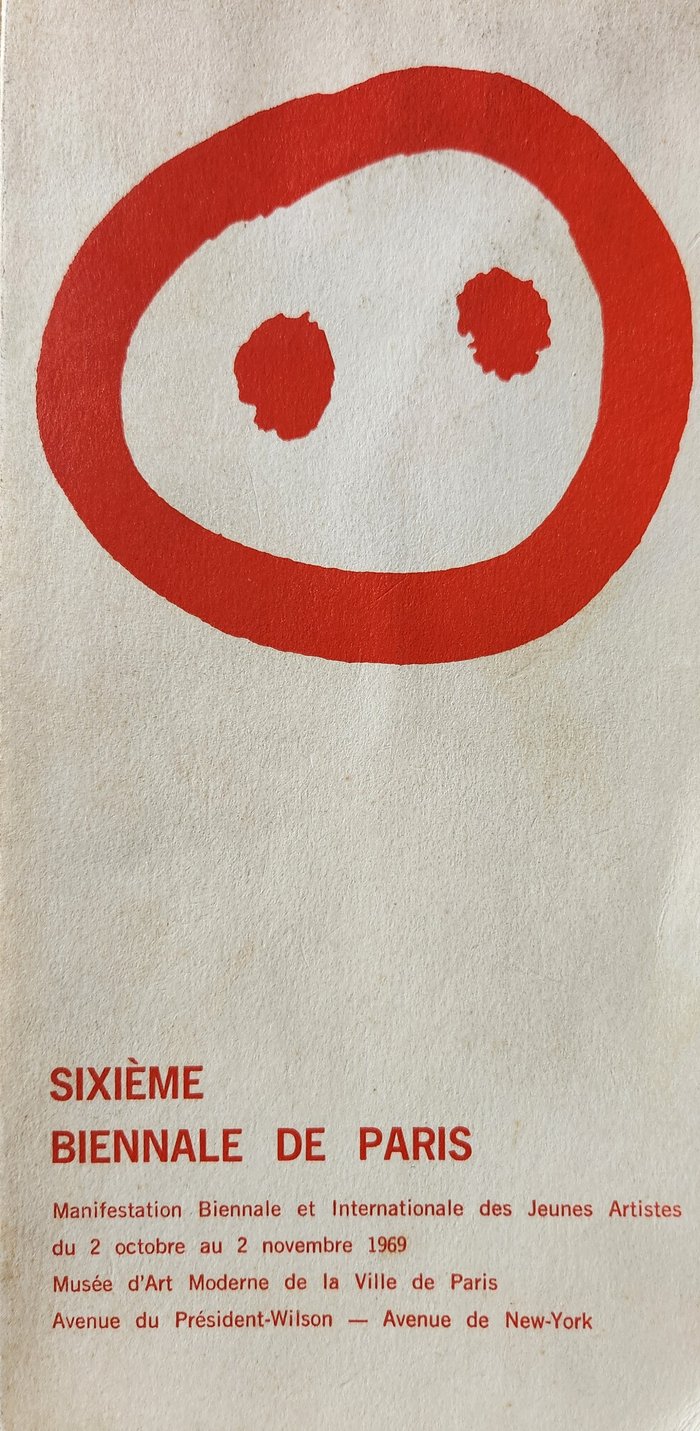
Sixième Biennale de Paris 1969 catalog

Sixième Biennale de Paris

Oct 2 – Nov 2, 1969 · Exhibition catalog · Musée d’Art Moderne de la Ville de Paris

Catalog of the sixth Paris Biennale, where CTG exhibited. The catalog contains three CTG computer art panels and one animation.
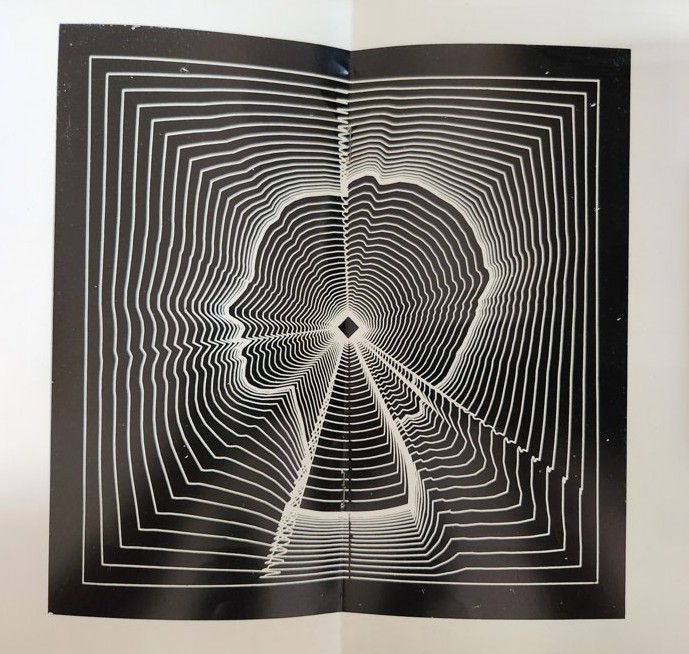
Arte y Cibernética, Montevideo 1970—Return to a Square gatefold

arte y cibernética—Montevideo

June–July 1970 · Exhibition catalog · Comisión Nacional de Artes Plásticas, Montevideo · ed. Ángel Kalenberg

The catalog of the tour’s Uruguayan stop. A full-page gatefold reproduction of Return to a Square is bound at the center.

Ricerca e Progettazione, 35th Venice Biennale 1970, catalog cover

Ricerca e Progettazione: Proposte per una esposizione sperimentale

1970 · Special-section catalog · 35th Venice Biennale

The catalog of the Venice Biennale. The computer art is listed as a single collective entry—“Opere grafiche ottenute con computer da: Computer Technique Group (CGT) [sic] Giappone, Herbert W. Franke, Auro Lecci, Frieder Nake, Georg Nees, Philip Peterson e altri.” The plate on pp.92–93 shows the Motif Editions portfolio, including William Fetter’s Boeing human-figure sequence, printed under CTG’s name.
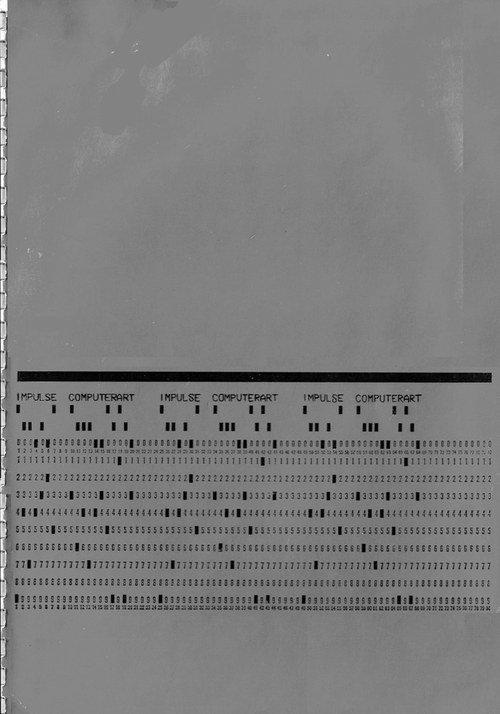
Computer e arte, Goethe-Institut 1971, catalog cover: punch card printed black on silver

Computer e arte

February 1971 · Exhibition catalog · Goethe-Institut, Munich · ed. Herbert W. Franke

The Italian-language catalog of the Goethe-Institut tour that grew from the Hannover show, for the stations at Rome, Genoa, Naples, Palermo, Florence, Milan, Turin and Trieste.
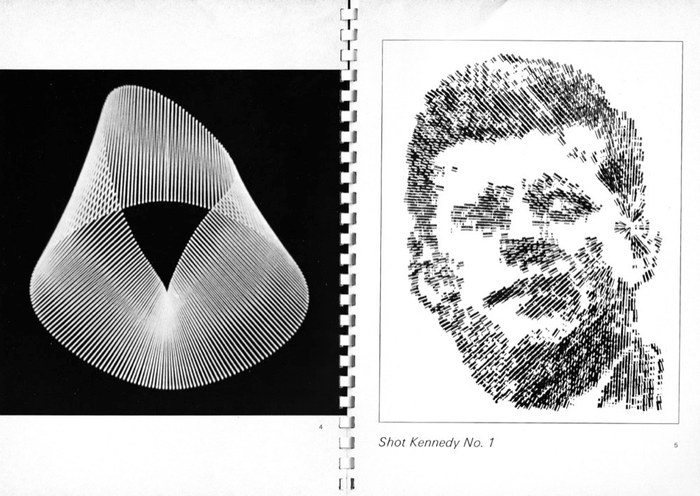
Computer e arte pp. 4–5: plate 5, CTG, Shot Kennedy No. 1
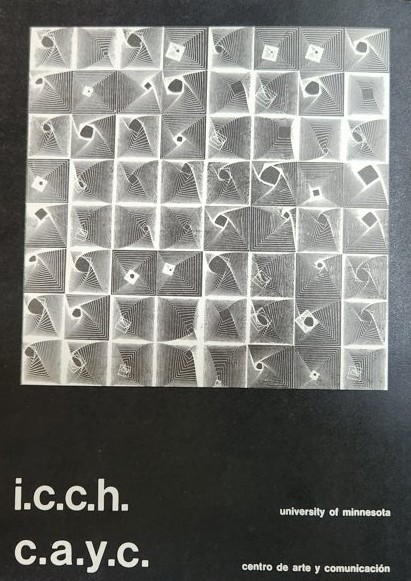
Arte y computadoras en Latinoamérica, CAyC/ICCH 1973—back cover with Collection of Random Windows

Arte y computadoras en Latinoamérica

July 1973 · Bilingual catalog, Spanish/English · CAyC, Buenos Aires · for the ICCH, University of Minnesota

Created for the International Conference on Computers in the Humanities in Minneapolis (July 20–22, 1973). The chronology of CAyC’s computer-art exhibitions shows CTG works were shown at Bonino (1969), Santa Fe (1969), Medellín (1970), Rosario (August 1971) and the Museo Genaro Pérez, Córdoba (September 1971). The back cover is Collection of Random Windows.
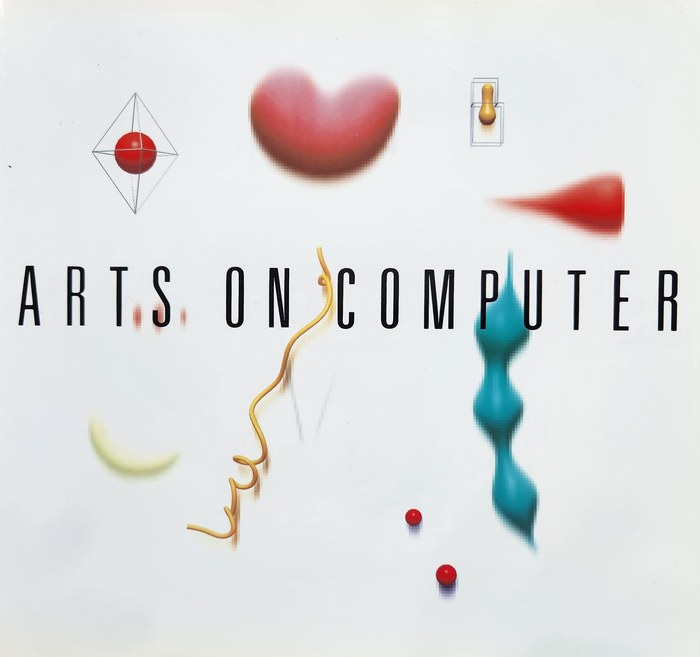
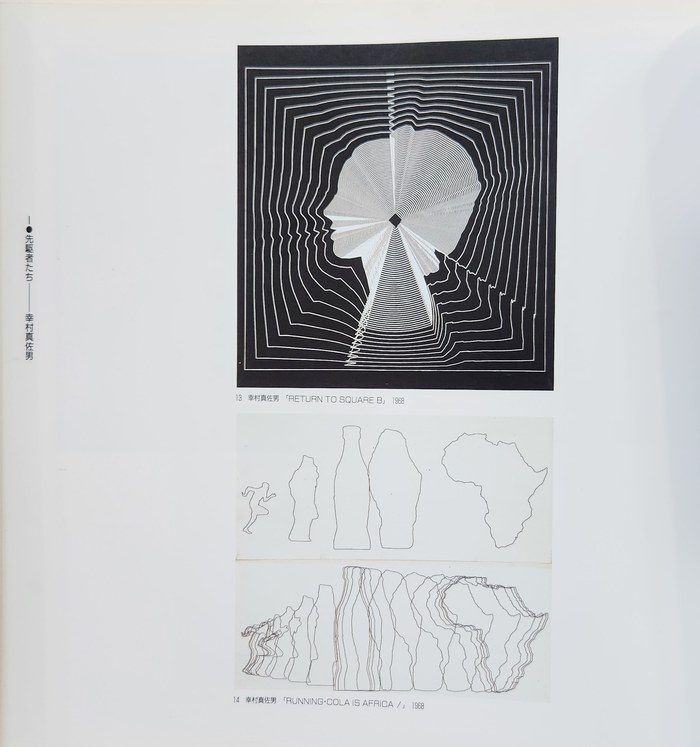
Arts on Computer: Japanese C·G Art, O Art Museum, Tokyo, 1987, catalog cover

Arts on Computer: Japanese C·G Art

June 1987 · Exhibition catalog · O Art Museum, Tokyo

Catalog of the O Art Museum’s opening exhibition. Includes four pages on Kohmura with plates of Kennedy in the Net, Return to a Square (b) and Running Cola is Africa!, printed beside two of his later works.
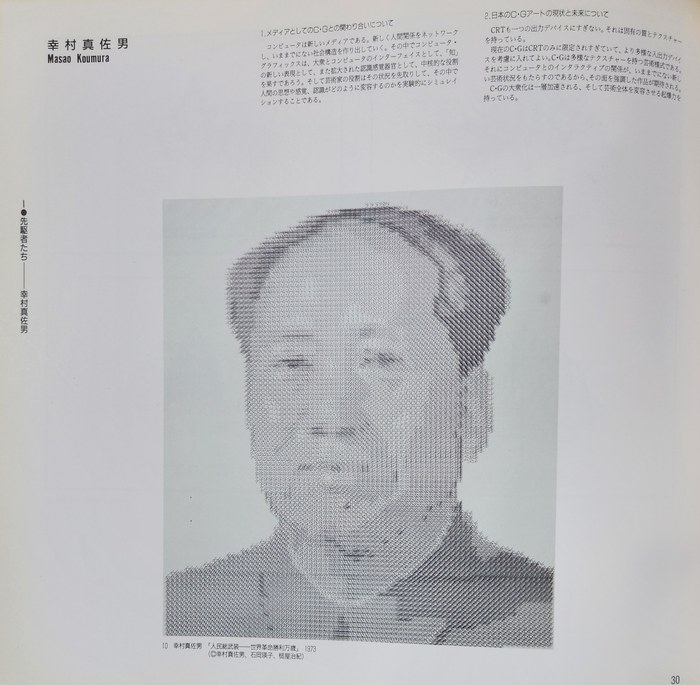
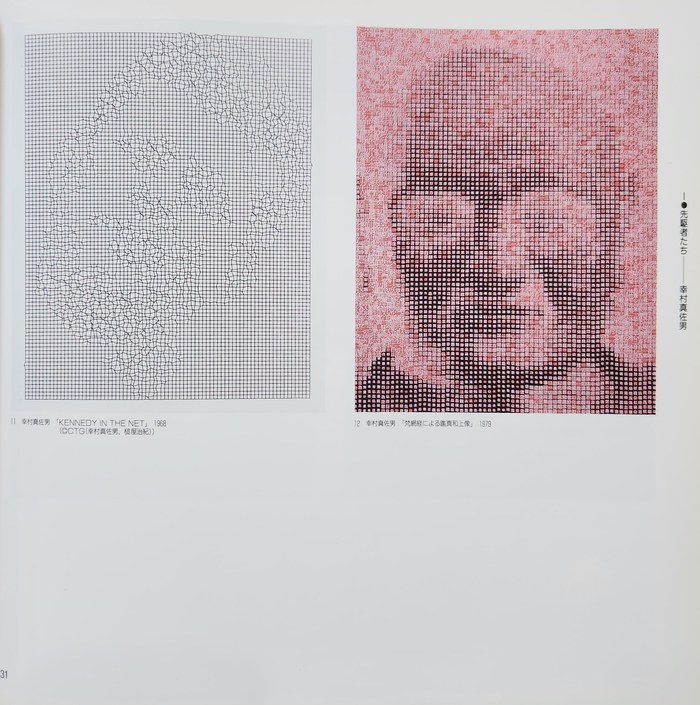
Arts on Computer p. 30: Kohmura's statement and the 1973 Mao portrait made with Eiko Ishioka and Tsuchiya Arts on Computer p. 31: Kennedy in the Net, 1968, and a 1979 portrait of Ganjin built from sutra text Arts on Computer p. 32: Return to a Square (b) and Running Cola is Africa!, both 1968
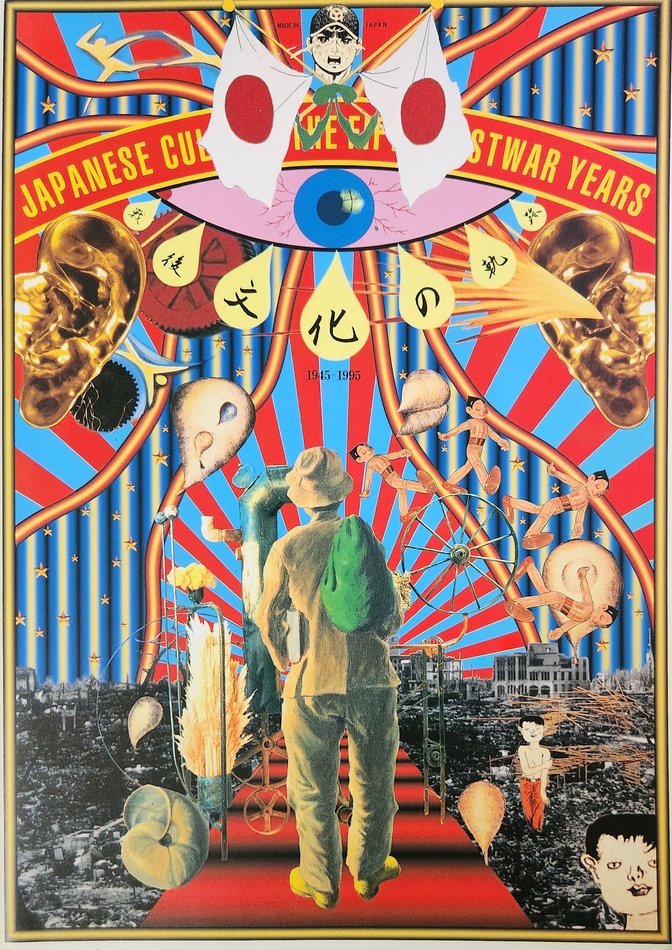
Japanese Culture: The Fifty Postwar Years, 1995, catalog cover by Tadanori Yokoo

Japanese Culture: The Fifty Postwar Years 戦後文化の軌跡 1945–1995

April 1995 · Exhibition catalog · Meguro Museum of Art, Hiroshima City Museum of Contemporary Art, Hyōgo Prefectural Museum of Modern Art, Fukuoka Prefectural Art Museum

Catalog of the fiftieth-anniversary survey of postwar Japanese culture, shown at four museums in 1995. Includes Deformation of Kennedy, with a caption calling it “a monumental expression that grasped, for the first time, the computer’s possibilities as something creative.”
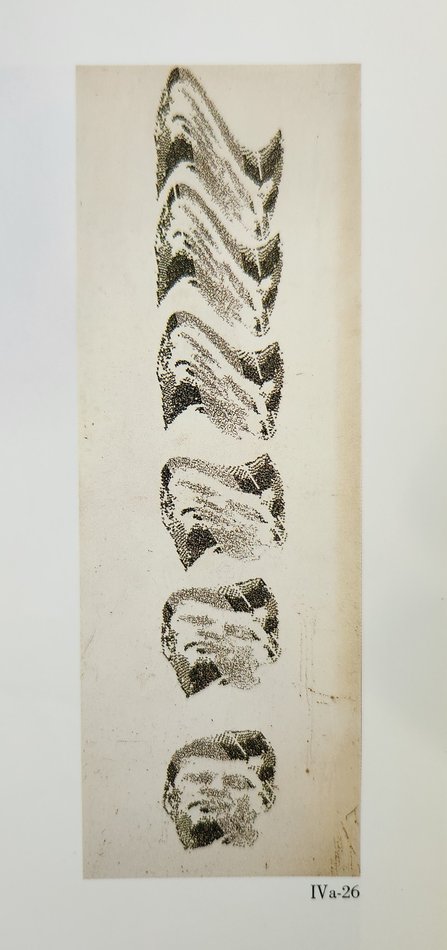
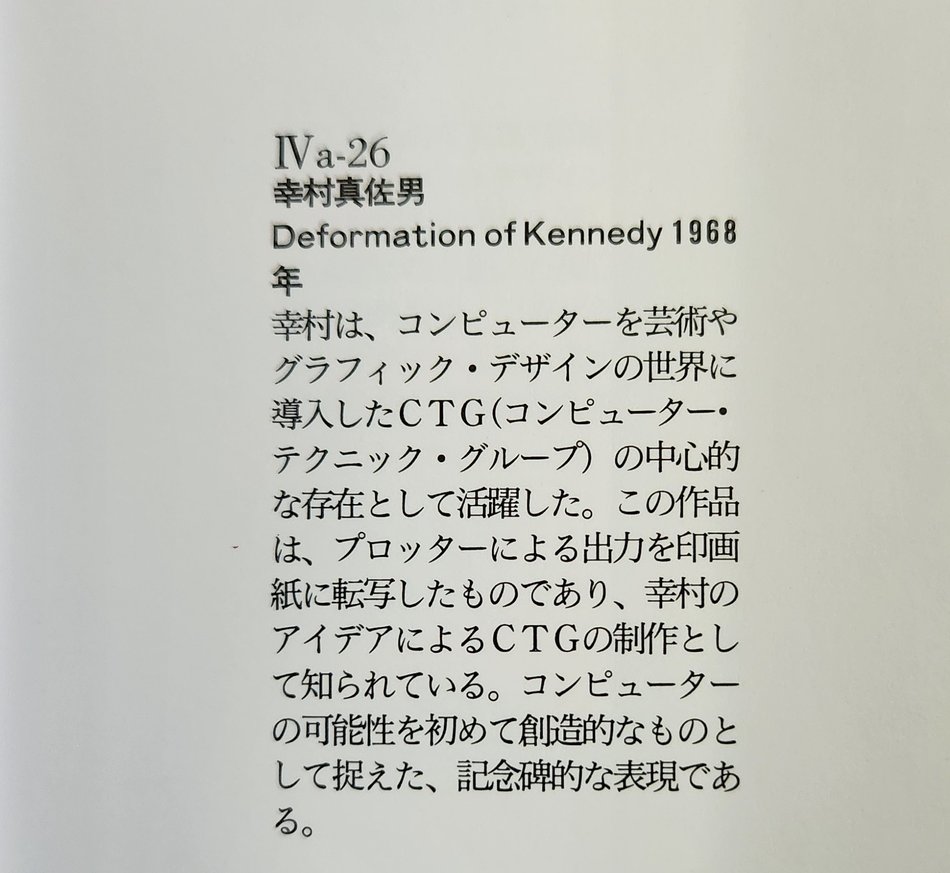
Deformation of Kennedy, 1968, plate IVa-26: six stages of Kennedy's face shearing into sine waves Catalog entry IVa-26: Kohmura, Deformation of Kennedy, with the curators' caption
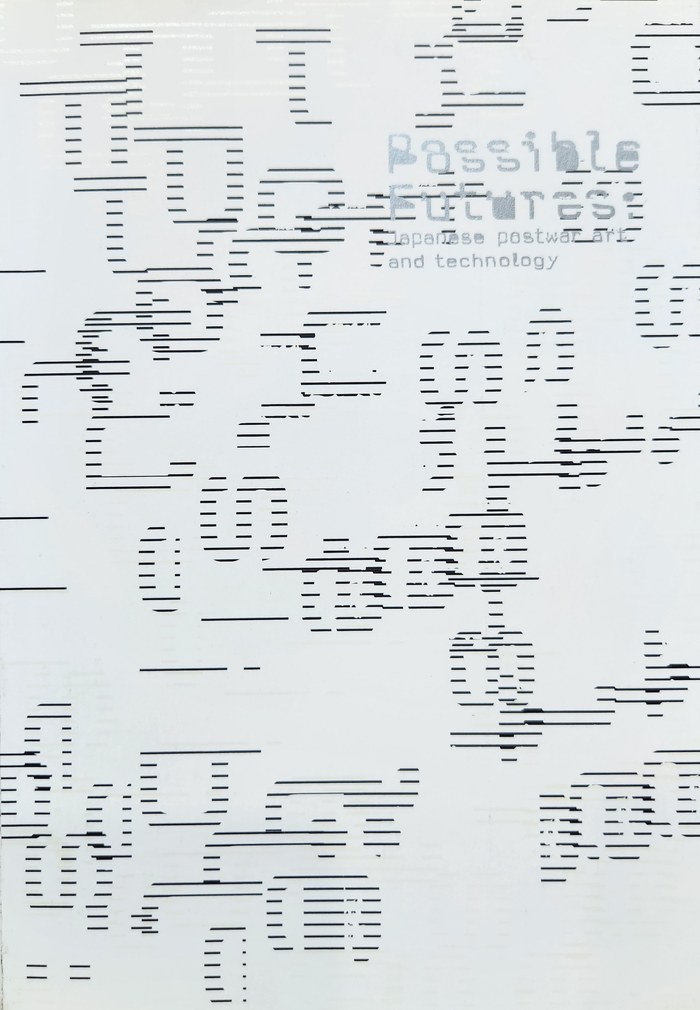
Possible Futures: Japanese Postwar Art and Technology, ICC, Tokyo, 2005, catalog cover

Possible Futures: Japanese Postwar Art and Technology

2005 · Exhibition catalog · NTT InterCommunication Center [ICC], Tokyo

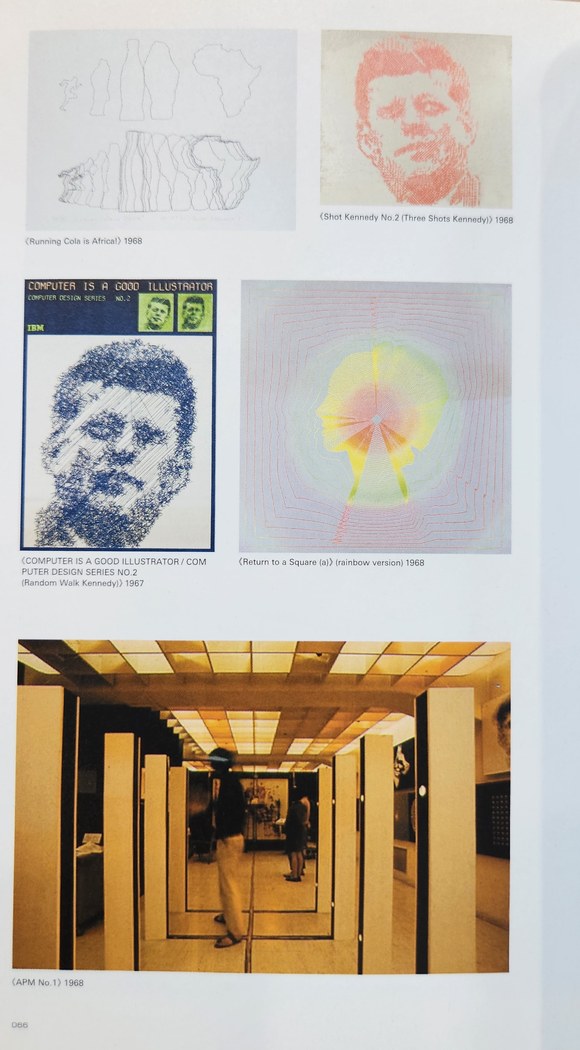
Catalog of the exhibition. Includes five works by CTG: Running Cola is Africa!; Shot Kennedy No. 2; the 1967 IBM Computer Design Series No. 2, Random Walk Kennedy; Return to a Square (a) in the rainbow version; and a photograph of APM No. 1.
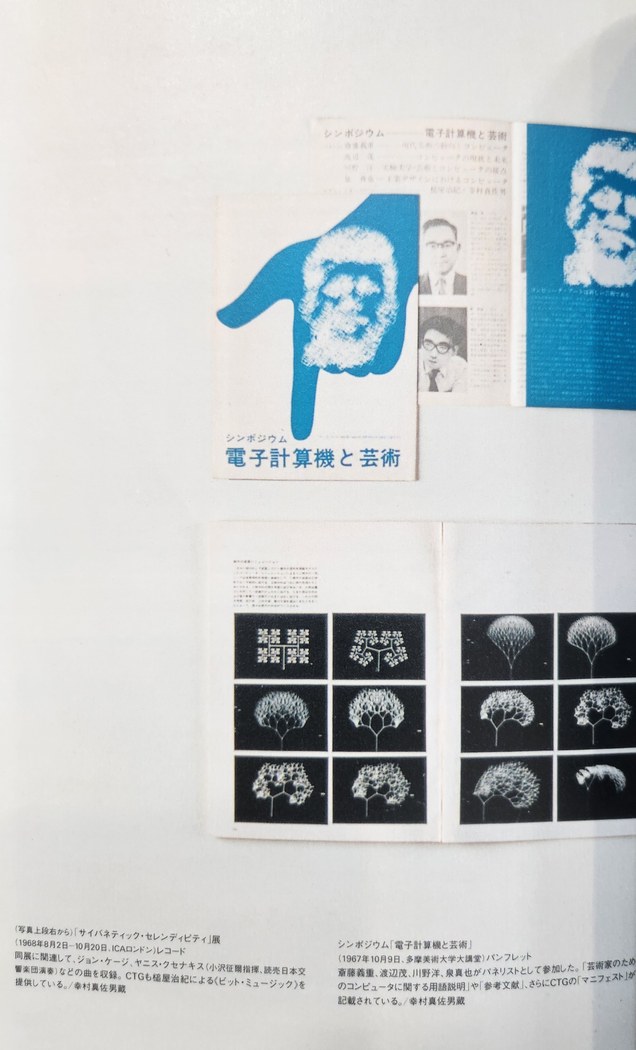
Possible Futures: the 1967 symposium pamphlet and the Cybernetic Serendipity Music LP, both from Kohmura's collection Possible Futures p. 66: five CTG works including APM No. 1 among its sensor pillars
Afterlives
Ningen no Seiki volume, Ushio Shuppansha, 1973, binding after CTG's Return to a Square

Ningen no Seiki 人間の世紀, two volumes

1973 · Books, vols. 4 and 6 of 7 · Ushio Shuppansha · binding: Eiko Ishioka

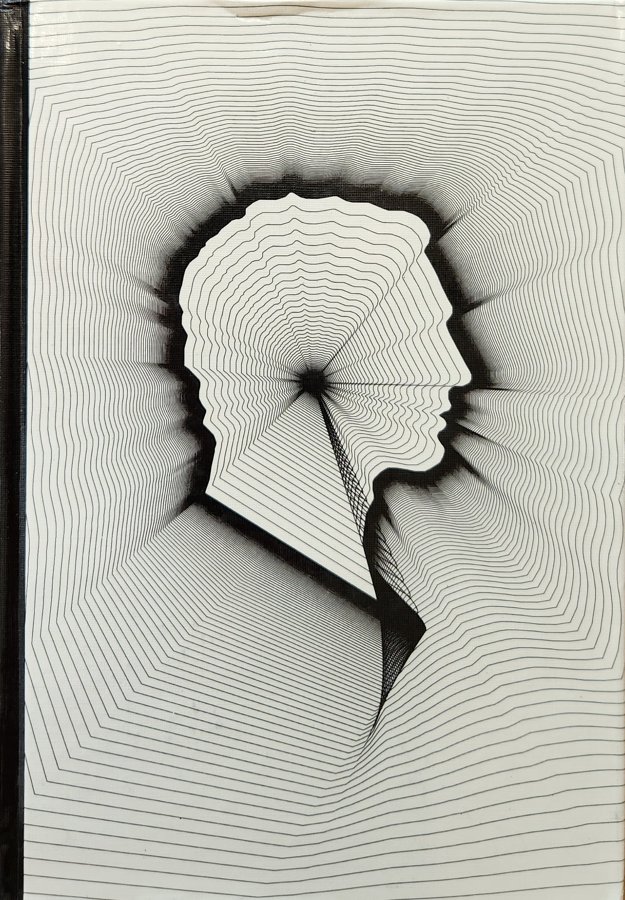
Two volumes from a seven-volume anthology of humanist essays. The covers (and slip cases) are reconstructions of Return to a Square created by Eiko Ishioka (perhaps in collaboration with Kohmura).
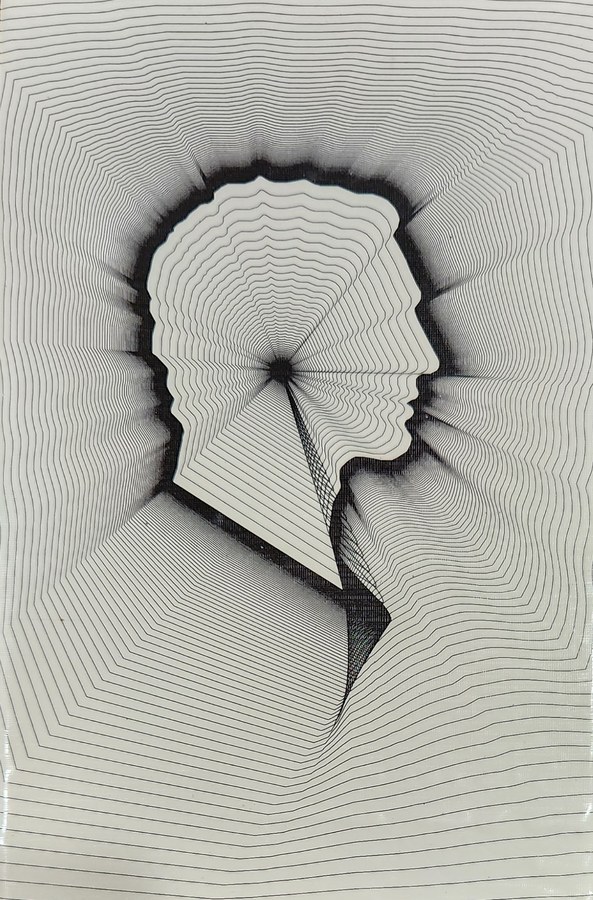
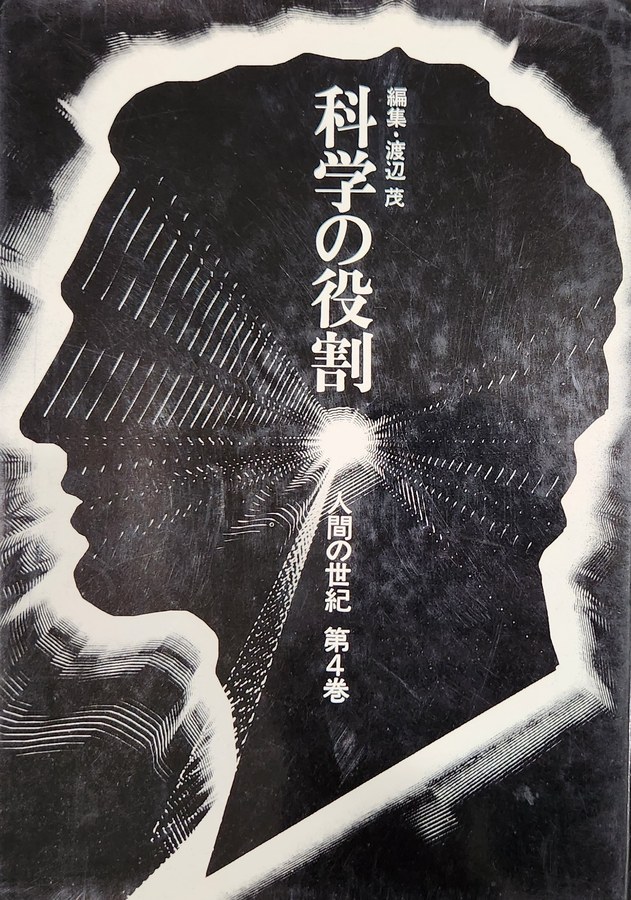
Ningen no Seiki vol. 4 board: male profile in concentric contours with converging fan, the Return to a Square construction Ningen no Seiki vol. 4 slipcase: The Role of Science, ed. Shigeru Watanabe, silhouette in negative with starburst
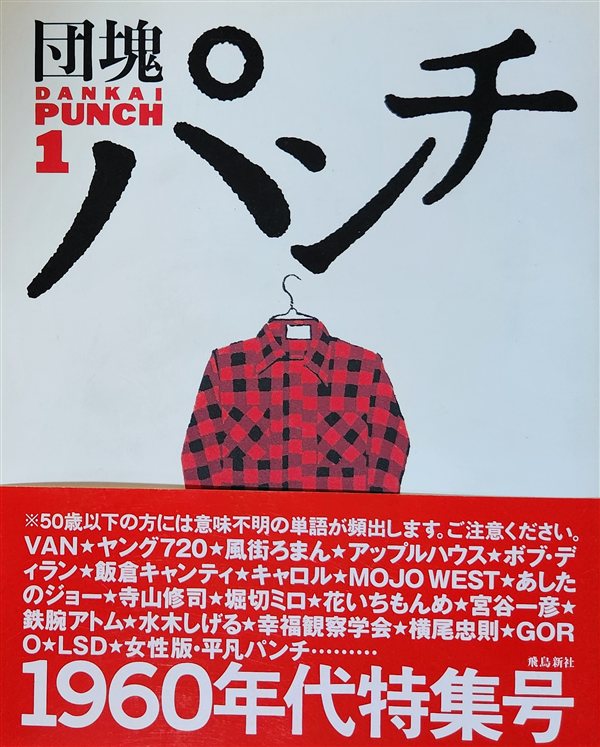
Dankai Punch vol. 1, no. 1, April 2006, 1960s special issue, Asuka Shinsha

Dankai Punch 団塊パンチ, vol. 1, no. 1

April 2006 · Mook, “1960s special issue” · Asuka Shinsha

The first issue of a nostalgia mook for Japan’s boomer generation. On page 198, illustrating Hideki Kimura’s memoir of the Kyoto rock scene, Return to a Square (b) sits between Che Guevara and Marilyn Monroe.
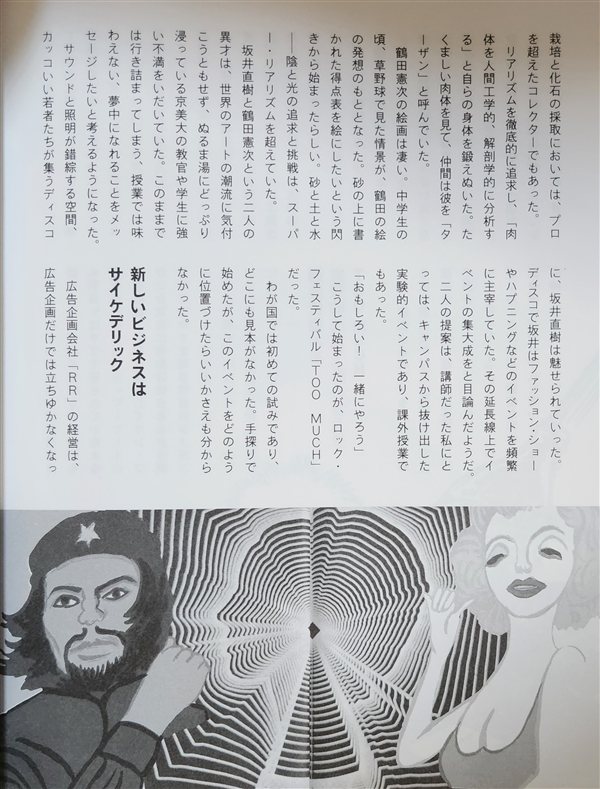
Dankai Punch page 198: Yamagata Fukashi's illustration with Return to a Square (b) as a tunnel between Che Guevara and Marilyn Monroe
Press / Research
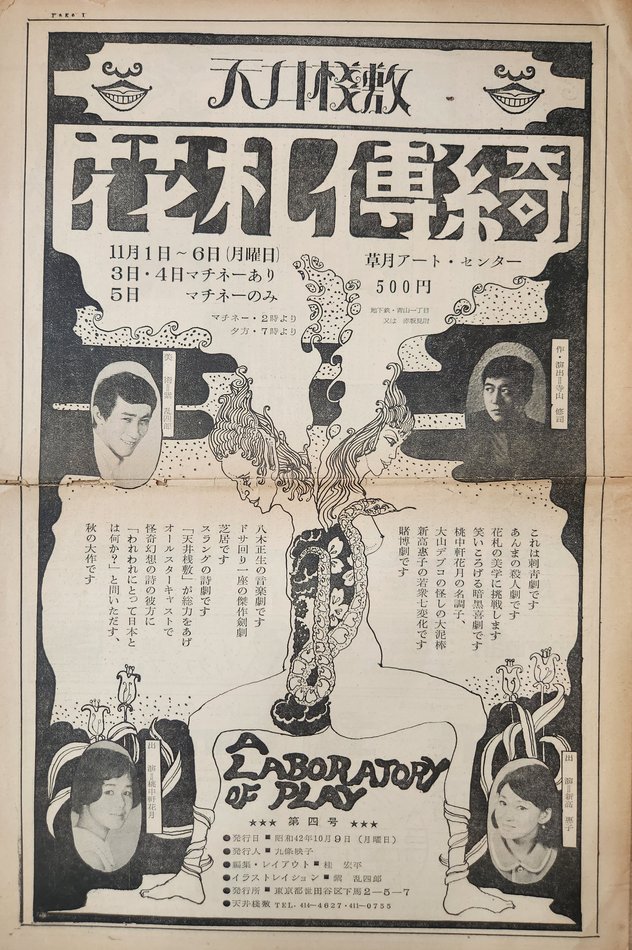
Tenjō Sajiki Shimbun no. 4, October 9, 1967: front page announcing Hanafuda Denki at the Sōgetsu Art Center

Tenjō Sajiki Shimbun 天井桟敷新聞, no. 4

October 9, 1967 · Newspaper, four pages · Tenjō Sajiki, Tokyo

The paper of Shūji Terayama’s theater laboratory, published for the Hanafuda Denki production at the Sōgetsu Art Center. Page two has a notice of the computer melodrama: a tie-up with Nihon IBM has “come to show considerable possibility of being realized,” and Tenjō Sajiki’s Haruki Tsuchiya is composing the script. A classified box advertises for participants.
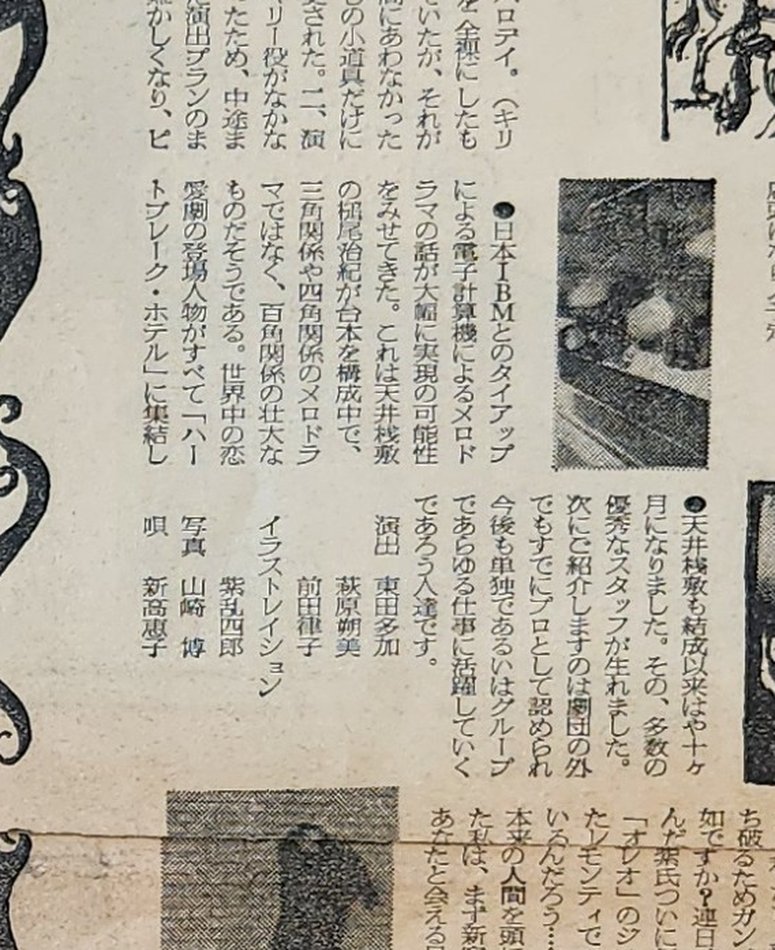
Page two, news column: the item announcing the Nihon IBM tie-up, naming Tsuchiya and the Heartbreak Hotel Classified box calling for people to perform in or attend the melodrama by electronic computer, set upside down on the page and turned here to be read
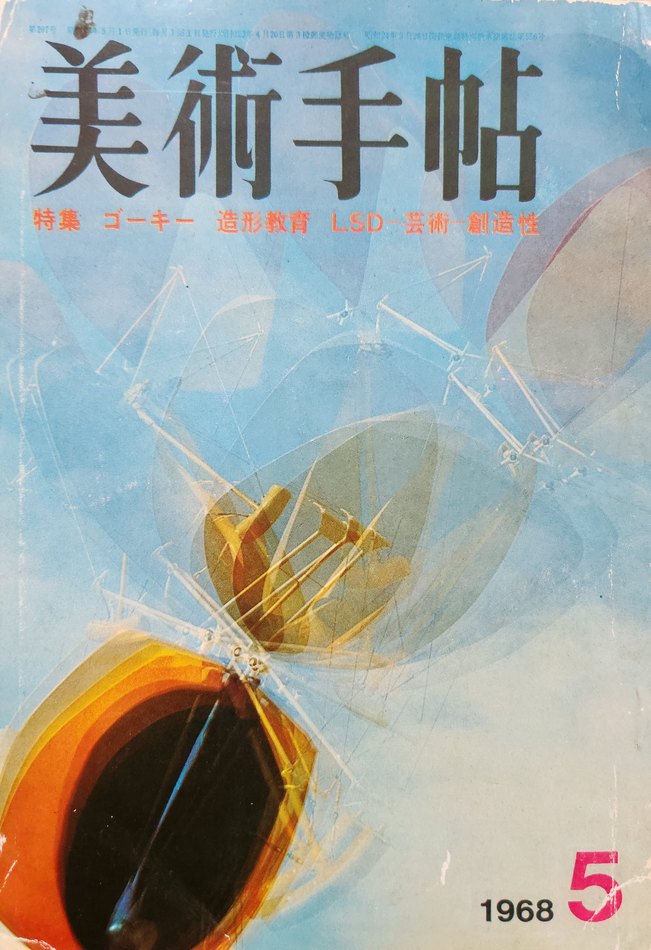
Bijutsu Techō no. 297, May 1968: Susumu Shingu's kinetic sculpture Friends of the Sun on the cover, photographed by Yukio Futagawa

Bijutsu Techō 美術手帖, no. 297

May 1, 1968 · Magazine · Bijutsu Shuppan-sha

Published five weeks after CTG’s first public showing. The “Picked up in town” column reports “Japan’s first Computer Art Contest,” the Computopia anniversary exhibition at the Sankei Kaikan in Ōtemachi, and includes a photograph of the venue.

Also included is Yoshio Kitamura’s feature on art education that uses a photograph of CTG’s symposium, showing Tsuchiya, Kohmura at the lectern, and Yoshishige Saitō on one side; Shigeru Watanabe, Hiroshi Kawano and Shin’ya Izumi on the other.
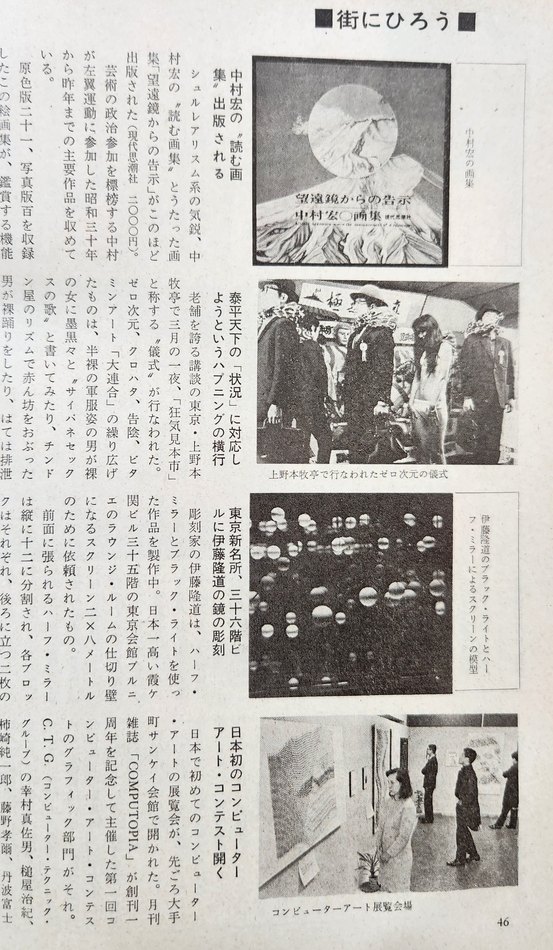
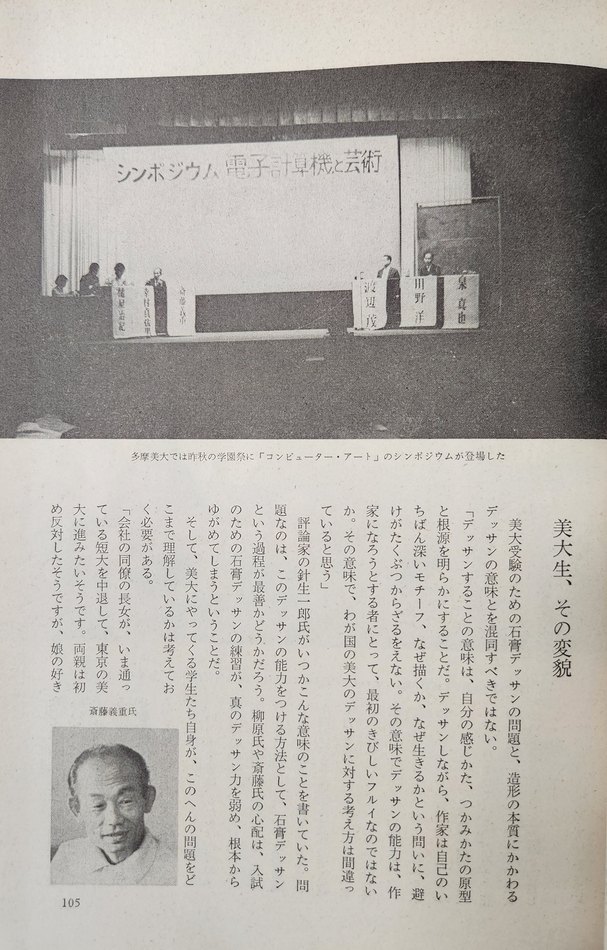
Bijutsu Techō no. 297 page 46: the Picked up in town column reporting Japan's first Computer Art Contest, with a photograph of the exhibition venue at the Sankei Kaikan Bijutsu Techō no. 297 page 105: the symposium The Electronic Computer and Art on stage at Tama Art University, October 1967, with Kohmura at the lectern and placards for Tsuchiya, Saitō, Watanabe, Kawano and Izumi
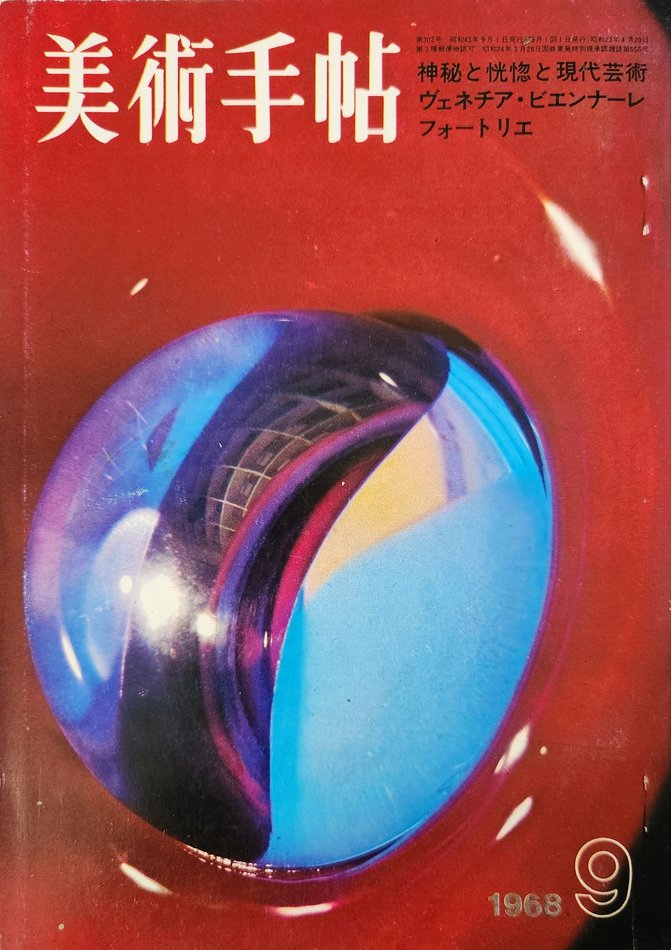
Bijutsu Techō no. 302, September 1968, Mystery, Ecstasy and Contemporary Art issue

Bijutsu Techō 美術手帖, no. 302

September 1, 1968 · Magazine · Bijutsu Shuppan-sha

Published the month the Tokyo Gallery exhibition opened. Includes CTG’s Tragedy of Seven. The exhibition calendar at the back announces the show as the group’s “first works exhibition,” and shows Kennedy in a Dog.
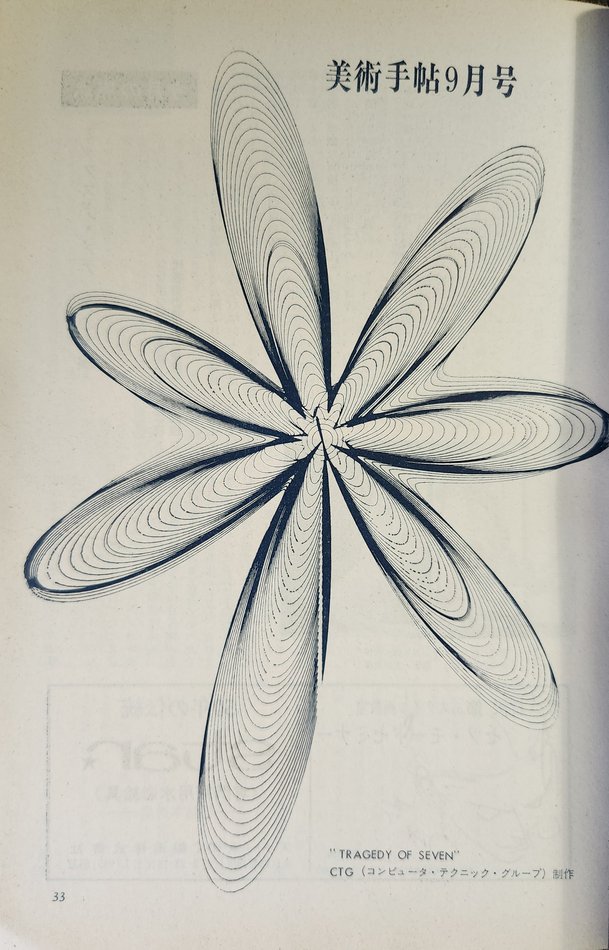
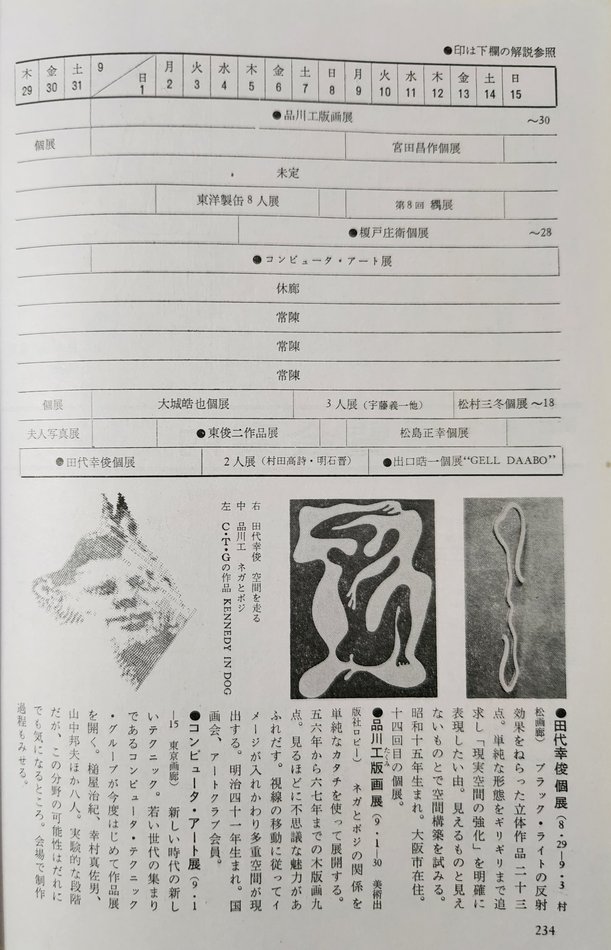
Bijutsu Techō no. 302 page 33: Tragedy of Seven as the issue's frontispiece, produced by CTG Bijutsu Techō no. 302 page 234: the exhibition calendar announcing the Computer Art Exhibition at Tokyo Gallery, with a plate of Kennedy in a Dog
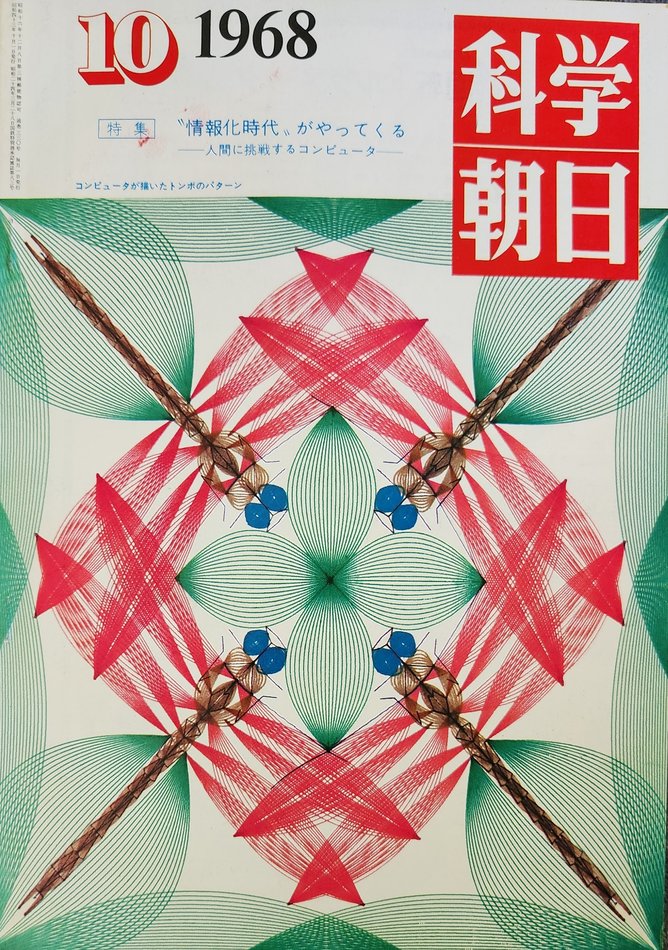
Kagaku Asahi, October 1968, with the computer-drawn dragonfly cover

Kagaku Asahi 科学朝日, October 1968

October 1, 1968 · Magazine · Asahi Shimbun-sha · special feature “The Information Age Is Coming”

The article “‘Artworks’ Made by Computers” on pp.66–67 shows three CTG works: Monroe in the Net, Running Cola is Africa!, and Return to a Square (a). The text explains the group’s ICA entry, describes the group as eight members formed two years before, and prints a line-printer work by Hiroshi Kawano with its hand-coloring process.
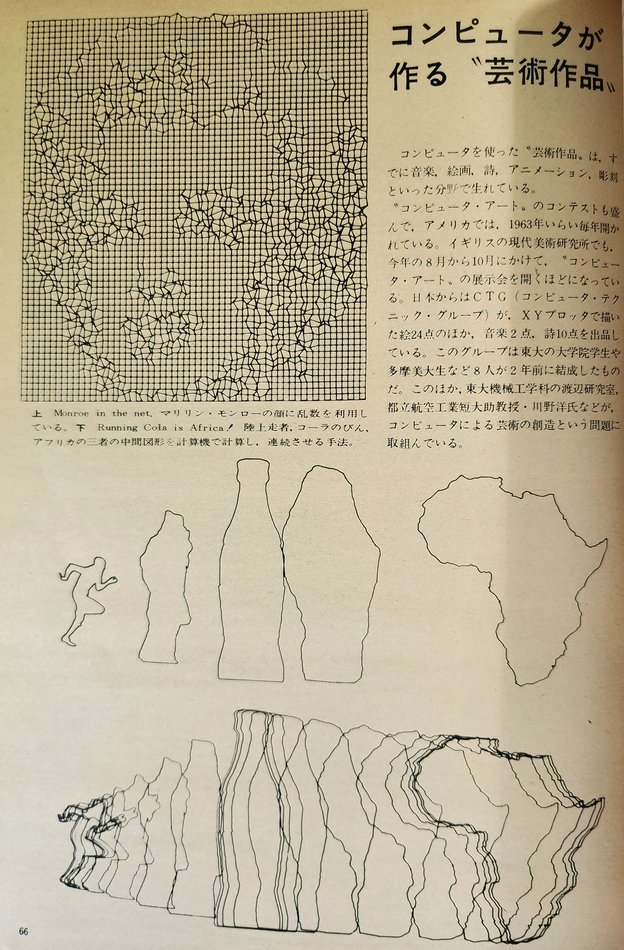
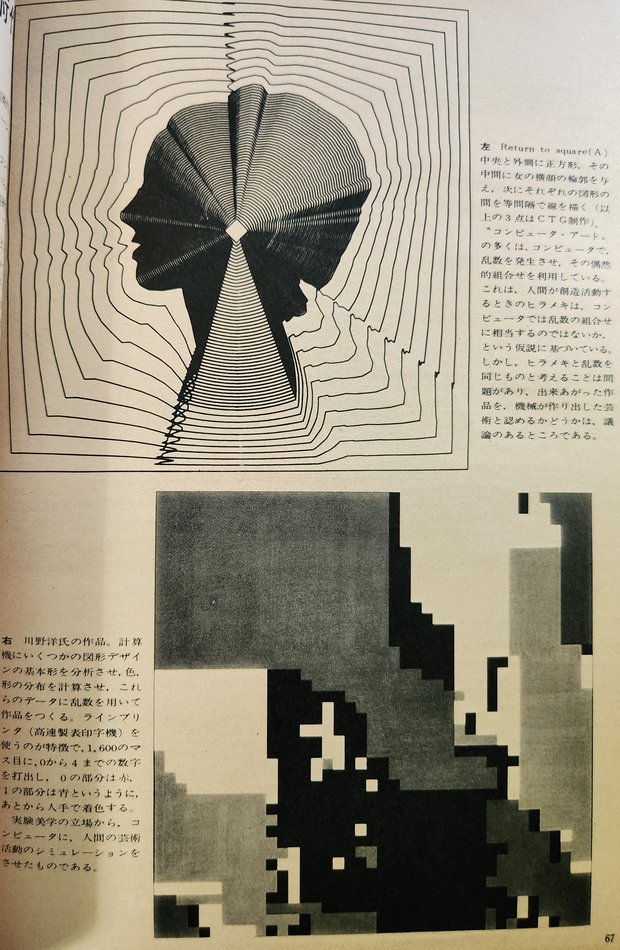
Kagaku Asahi October 1968 page 66: Monroe in the Net and the two versions of Running Cola is Africa! Kagaku Asahi October 1968 page 67: Return to a Square (a), with a line-printer work by Hiroshi Kawano below
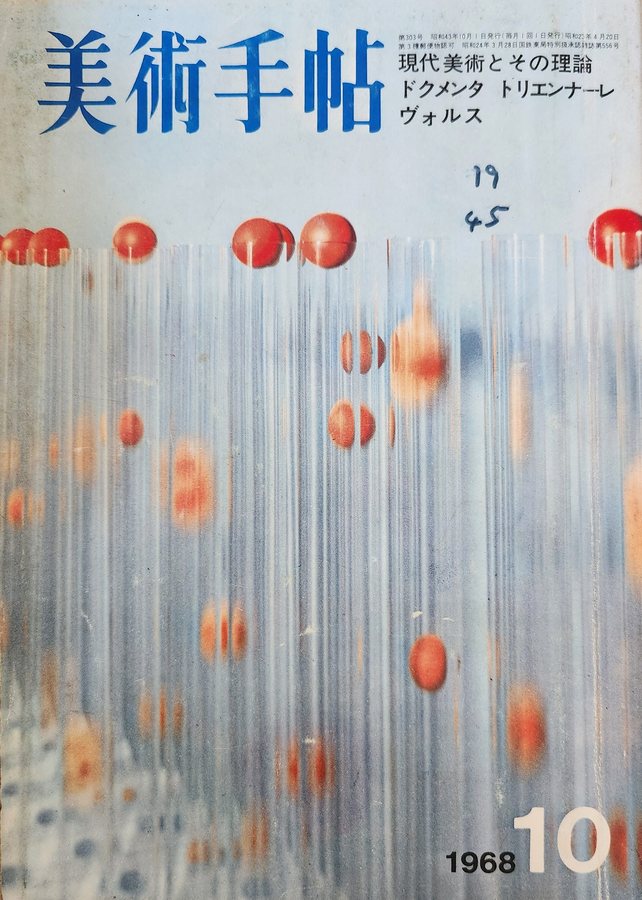
Bijutsu Techō no. 303, October 1968

Bijutsu Techō 美術手帖, no. 303

October 1968 · Magazine · Bijutsu Shuppan-sha

A roundtable on contemporary art and design in which Kohmura speaks about computer art, with the work “Do you know Kennedy?”
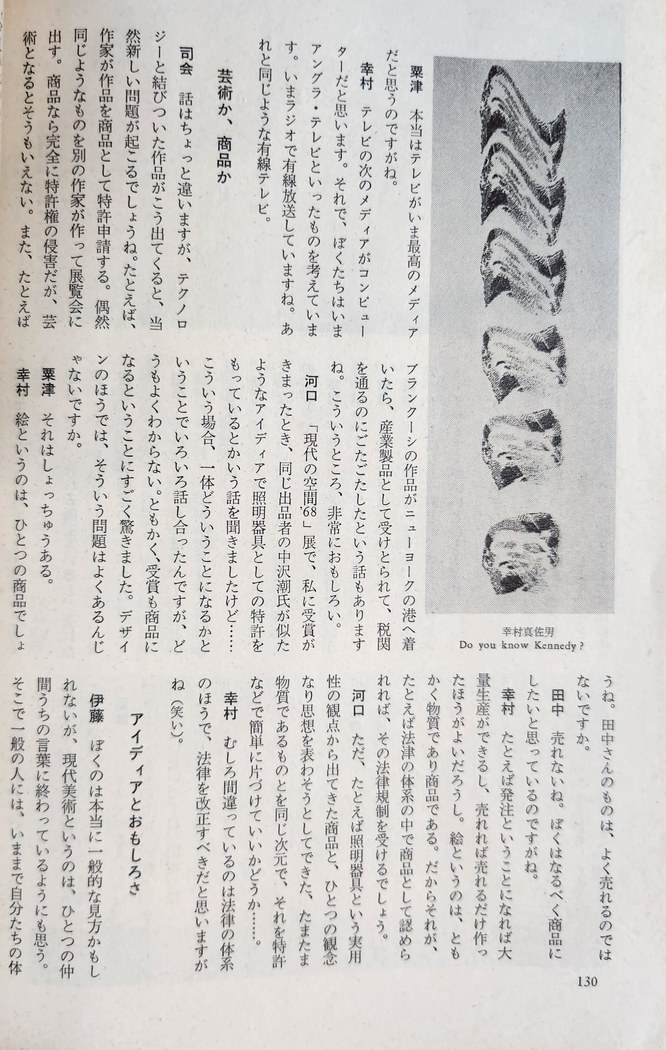
Bijutsu Techō no. 303 page 130: Kohmura's plate “Do you know Kennedy?” printed beside the roundtable
Sansai magazine no. 236, October 1968

Sansai 三彩, no. 236

October 1968 · Magazine · Sansai-sha

A contemporary review of the Tokyo Gallery solo exhibition, published in the fine-arts monthly’s “Art Notes” column with an installation photograph.
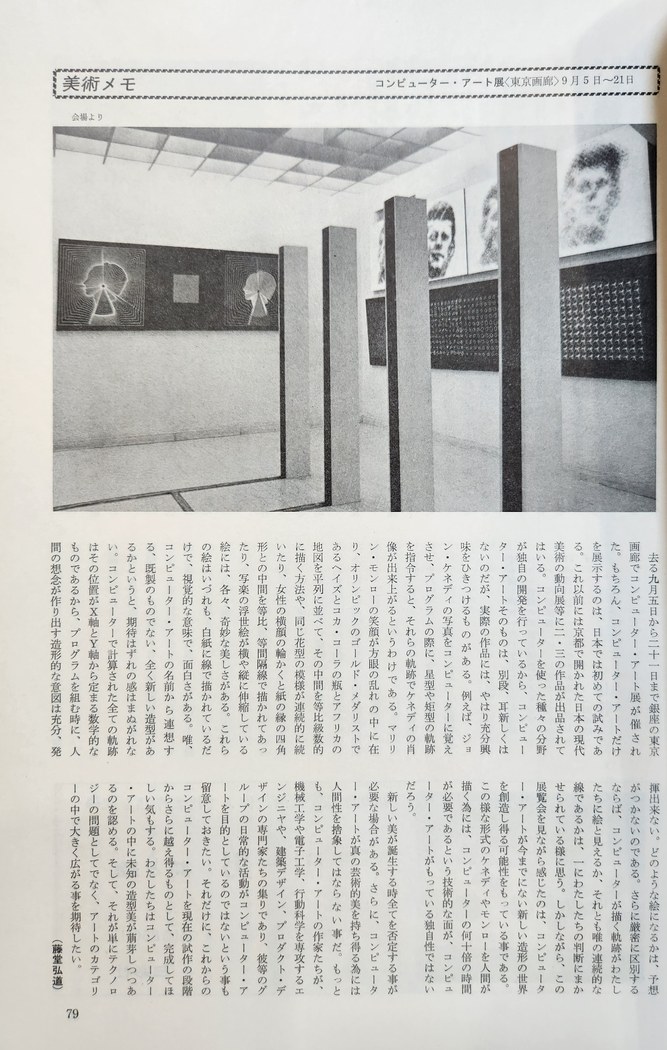
Sansai no. 236 page 79: review of the Computer Art exhibition at Tokyo Gallery with installation photograph
Shakai to Jōhō (Society and Information), NHK Information Science Course 8, 1968: cover with a punched-paper-tape dot pattern

Shakai to Jōhō 社会と情報 (Society and Information), NHK Information Science Course 8

October 1968 · Book, 253 pages · edited by Toshio Kitagawa · NHK Publishing

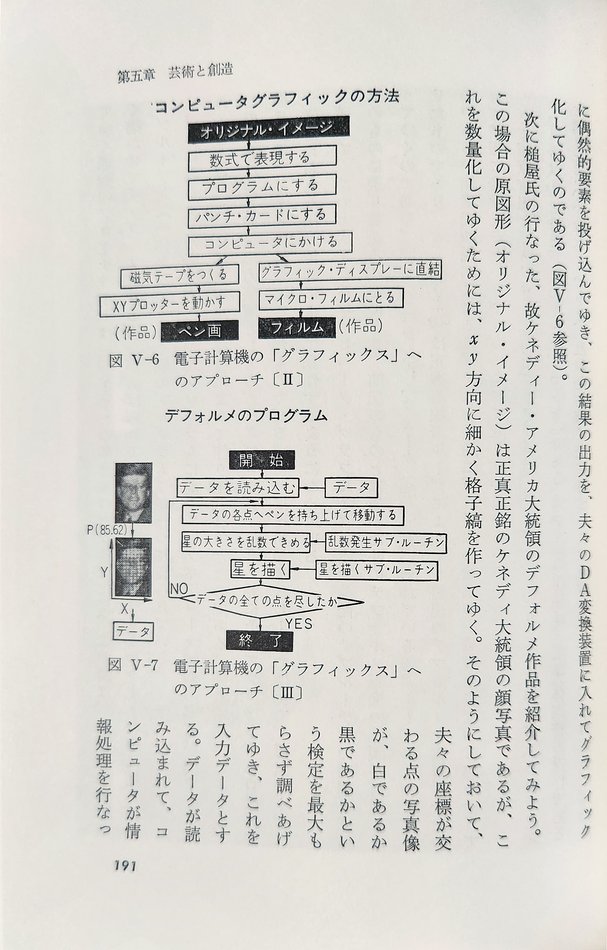
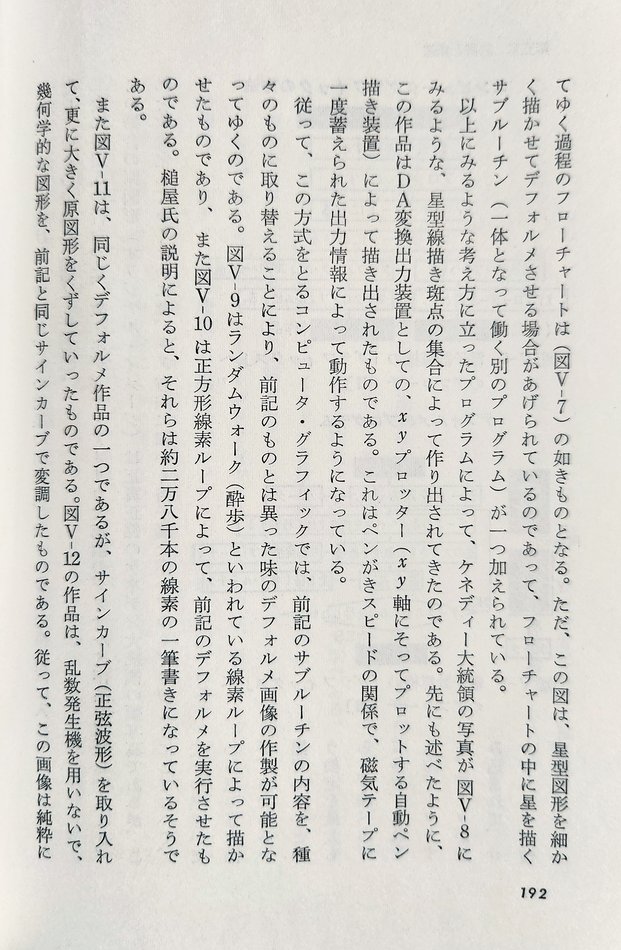
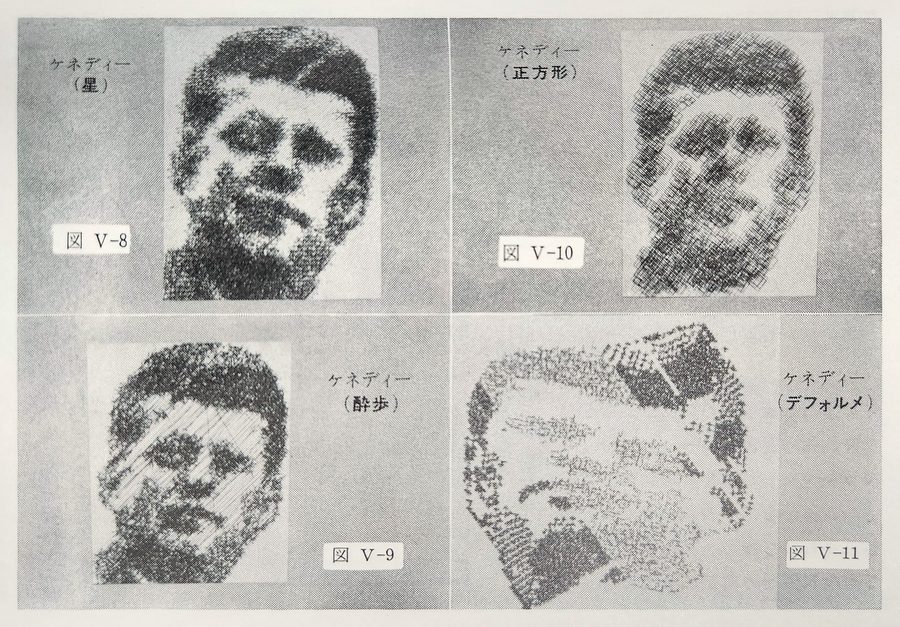
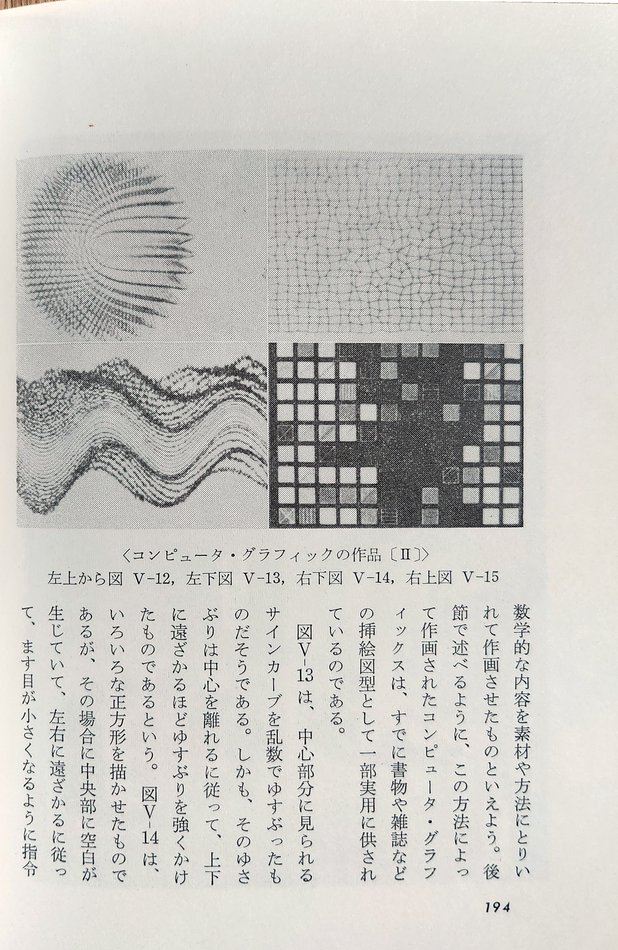
The book edition of NHK Educational TV’s series on information science. Chapter 5, “Art and Creation,” by theorist Kikuya Ichikawa, grows out of the broadcast of January 28, 1968, on which Tsuchiya sat on the panel. The section “Works of Computer Graphics” prints the flowchart of the Star Kennedy program. A full-page plate shows four Kennedy portraits: Star Kennedy, Random Walk Kennedy, Cube Kennedy and a sine-curve deformation.
Page 187: Haruki Tsuchiya of the Watanabe Laboratory, University of Tokyo, introduced, with his definition of computer graphics Page 190: section 6, Works of Computer Graphics, setting out the production process according to Tsuchiya Page 191: the method of computer graphics (fig. V-6) and the Star Kennedy program flowchart (fig. V-7), with the Kennedy deformation credited to Tsuchiya Page 192: the plotter method, and Tsuchiya's figure of about 28,000 segments for the random-walk and square versions Page 193: plate of four Kennedy portraits, figs. V-8 to V-11 (star, random walk, square, deformation), printed sideways on the page and turned here to be read Page 194: plate of four uncredited pattern graphics, figs. V-12 to V-15
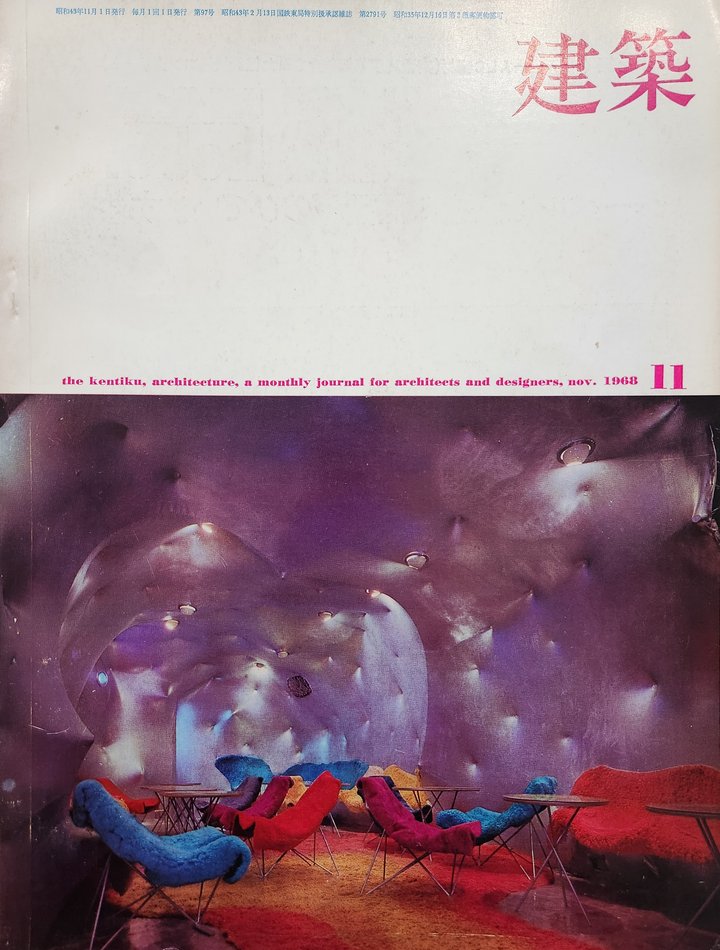
Kenchiku no. 97, November 1968: cover with a photograph of an inflatable lounge interior

Kenchiku 建築, no. 97

November 1, 1968 · Magazine · Chūgai Shuppan

Manabu Yamada’s review of CTG’s exhibition at Tokyo Gallery, comparing APM No. 1 to Jean Tinguely’s drawing machine Méta-Matic. Includes a photograph of APM No. 1.
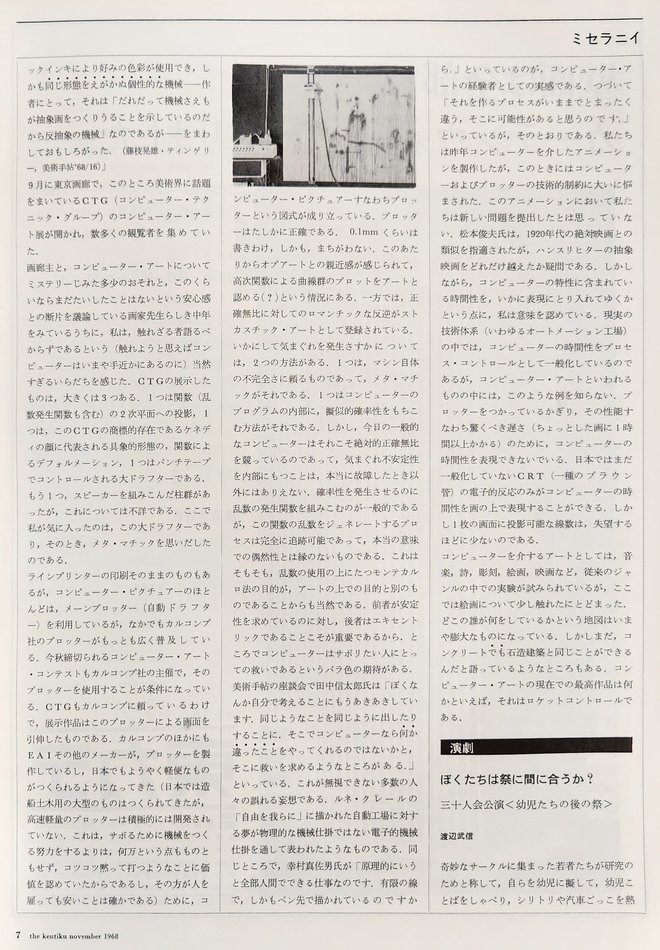
Kenchiku no. 97, p. 5: the Art column opens with Manabu Yamada's The Age of the Electronic Méta-Matic: Computer Pictures Kenchiku no. 97, p. 7: the review continues, describing CTG's Tokyo Gallery exhibition, with a photograph of APM No. 1's control box and canvas
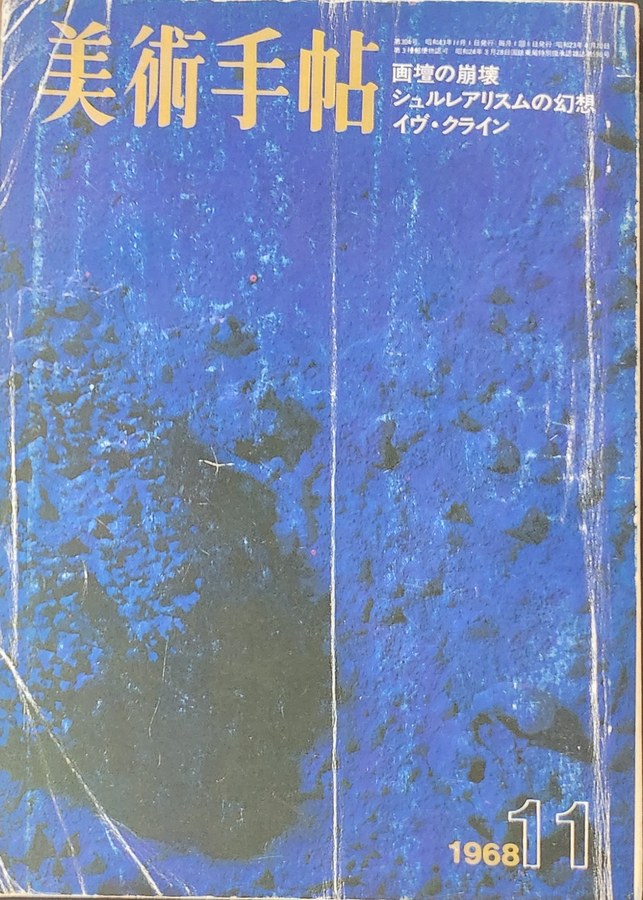
Bijutsu Techō no. 304, November 1968, The Collapse of the Art World issue

Bijutsu Techō 美術手帖, no. 304

November 1968 · Magazine · Bijutsu Shuppan-sha

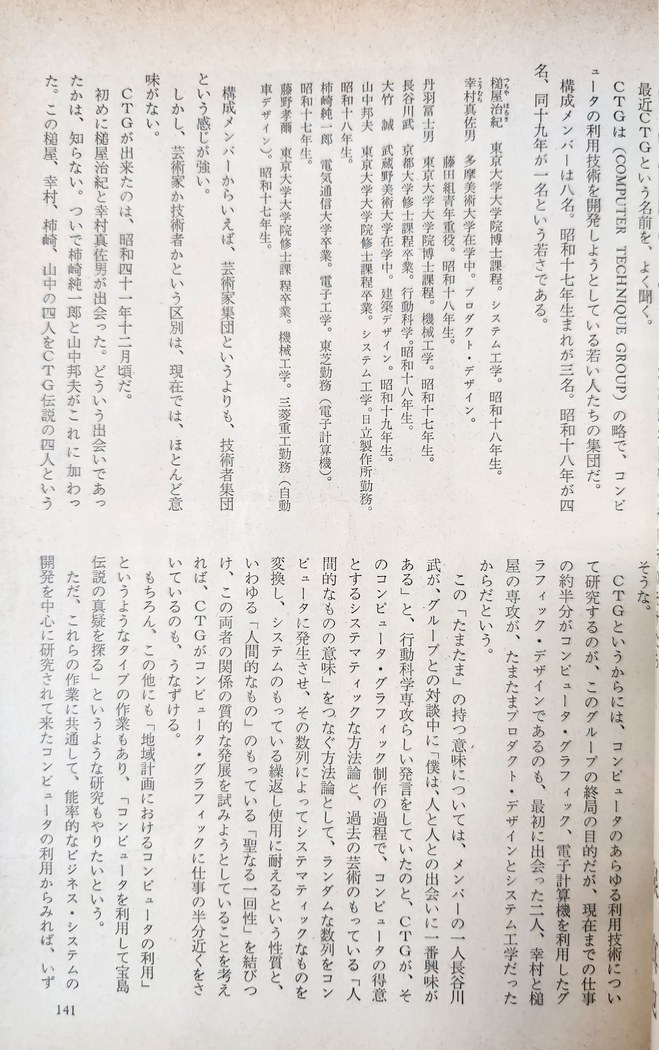
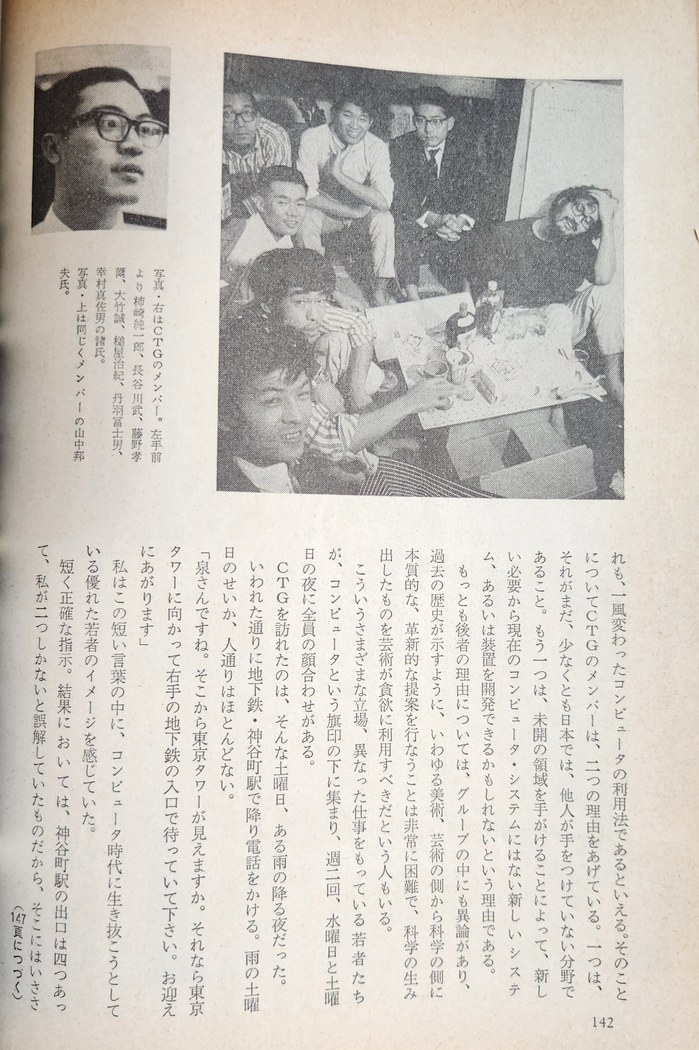
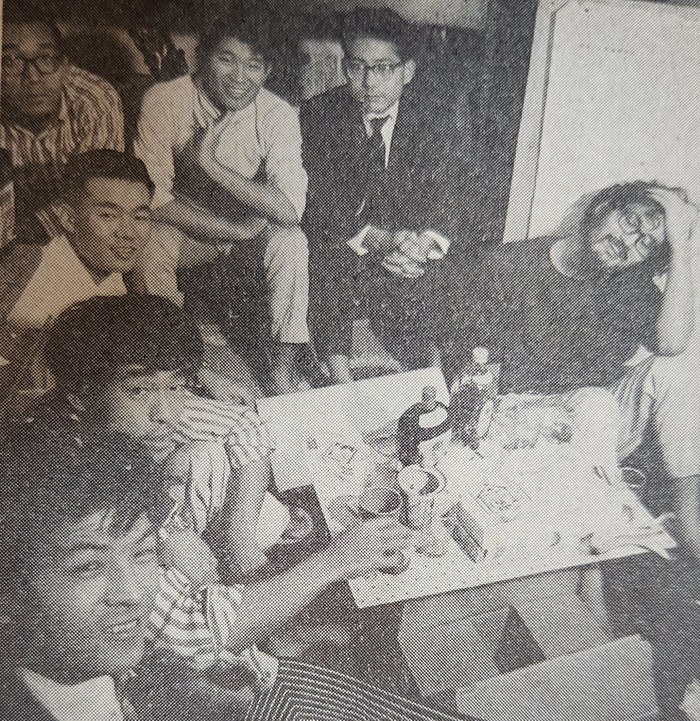
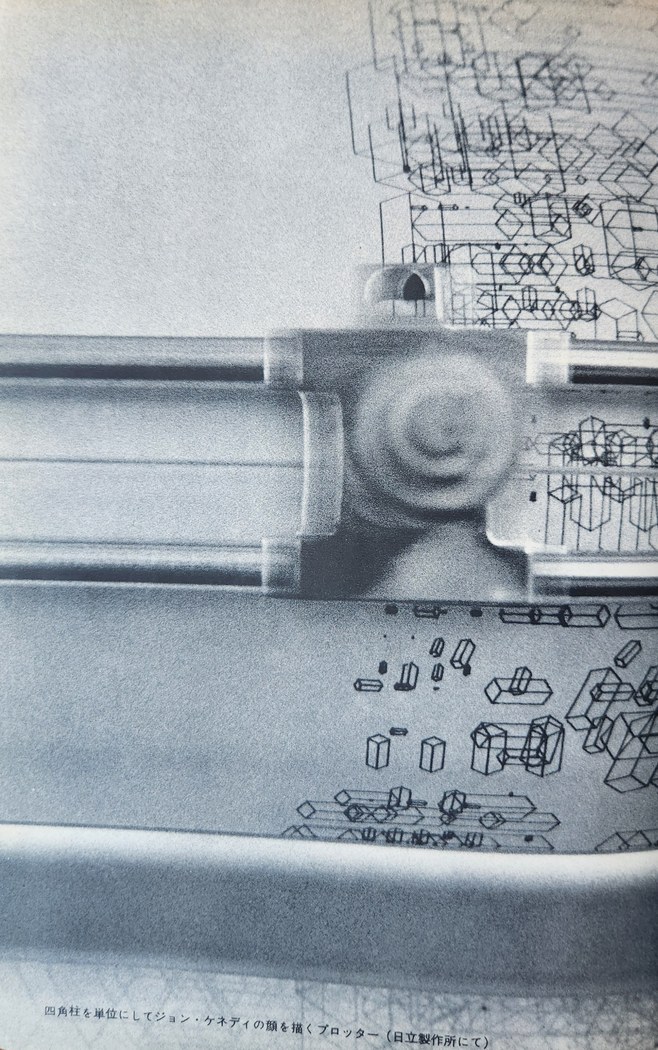
Shinya Izumi’s feature on CTG, the “computer guerrillas.”
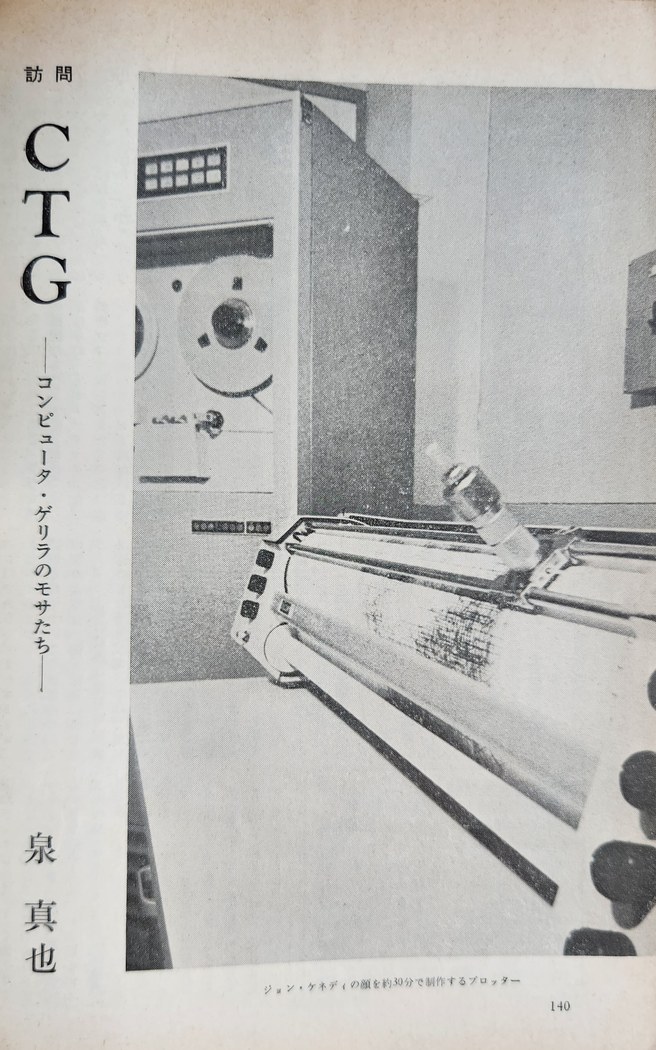
Bijutsu Techō no. 304 page 140: the opening of Shinya Izumi's visit feature, with a plotter drawing Kennedy Bijutsu Techō no. 304 page 141: the member roster, with university, field and birth year for each Bijutsu Techō no. 304 page 142: a captioned group photograph of seven members, with a portrait of Kunio Yamanaka above Detail of the group photograph, Bijutsu Techō no. 304 page 142 The plotter drawing Kennedy's face in square prisms, at Hitachi, Bijutsu Techō no. 304
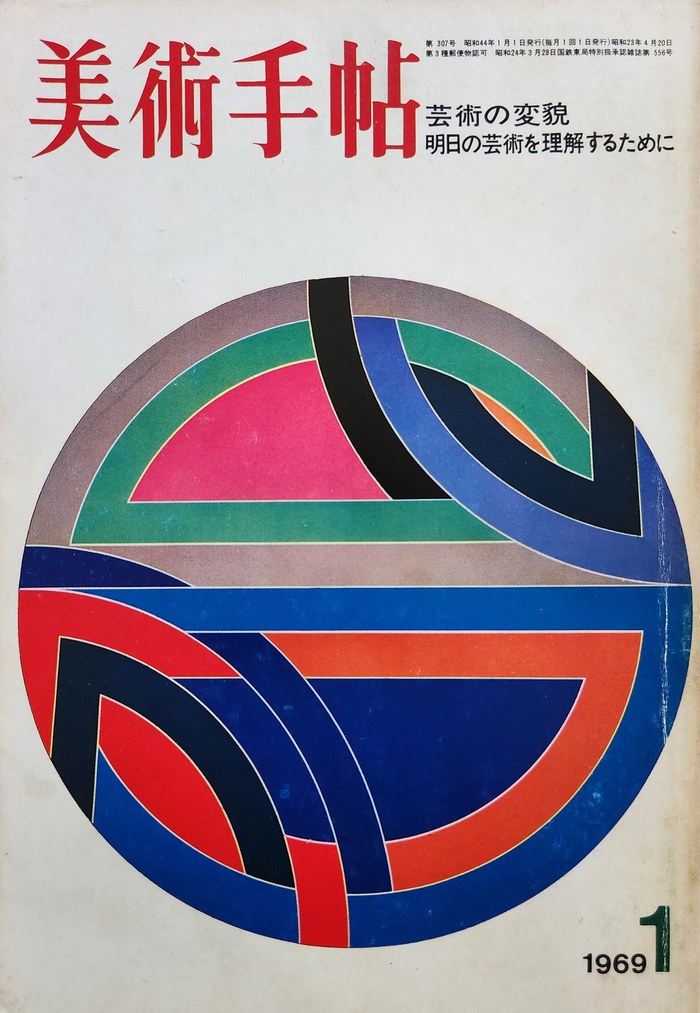
Bijutsu Techō no. 307, January 1969, The Transfiguration of Art issue, Frank Stella cover

Bijutsu Techō 美術手帖, no. 307, “The Transfiguration of Art”

January 1, 1969 · Magazine · Bijutsu Shuppan-sha

Page 88 reproduces Centripetal biological world with the caption “computer urchins that float and drift.”
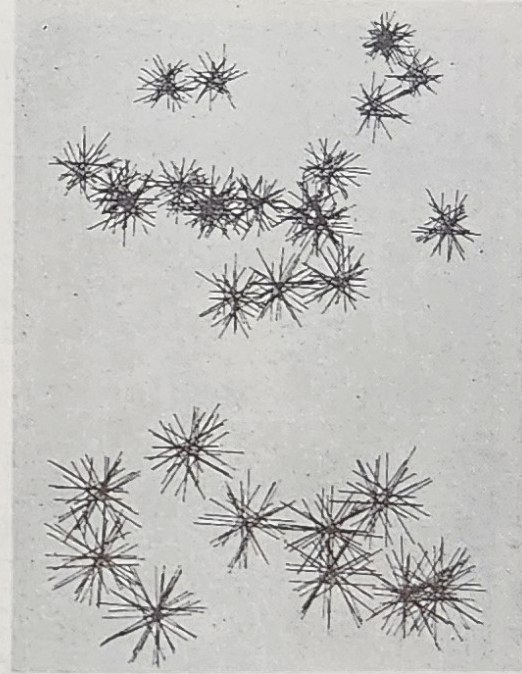
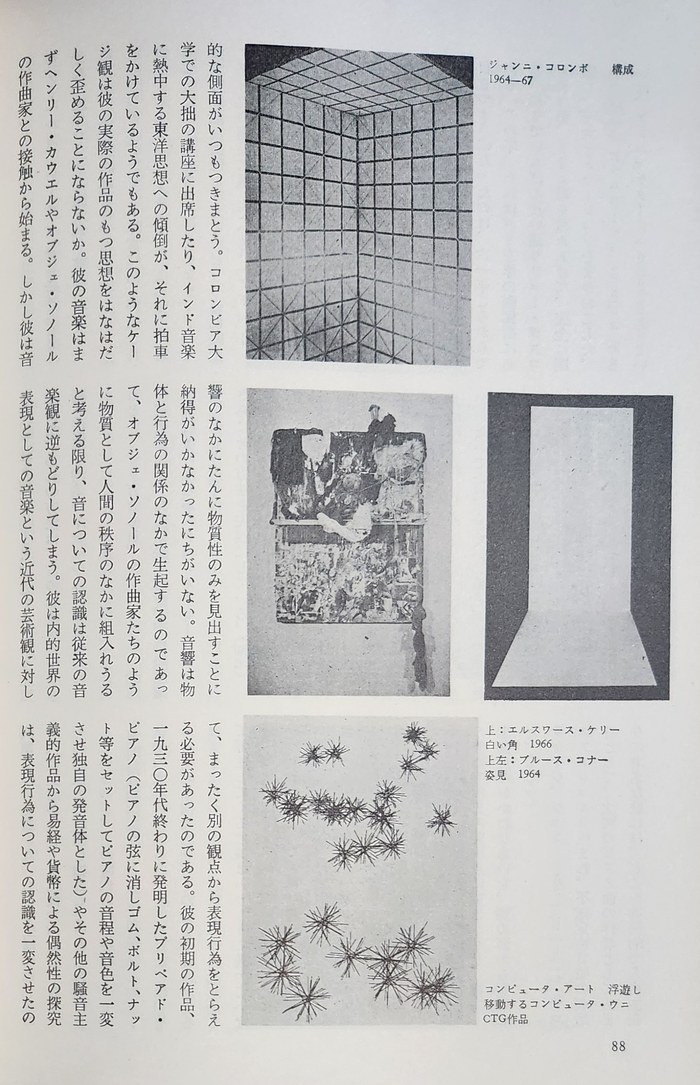
CTG, Centripetal biological world, 1968, printed in Bijutsu Techō no. 307 p. 88 as computer urchins that float and drift Bijutsu Techō no. 307 page 88: CTG urchin plate alongside Ellsworth Kelly and Bruce Conner
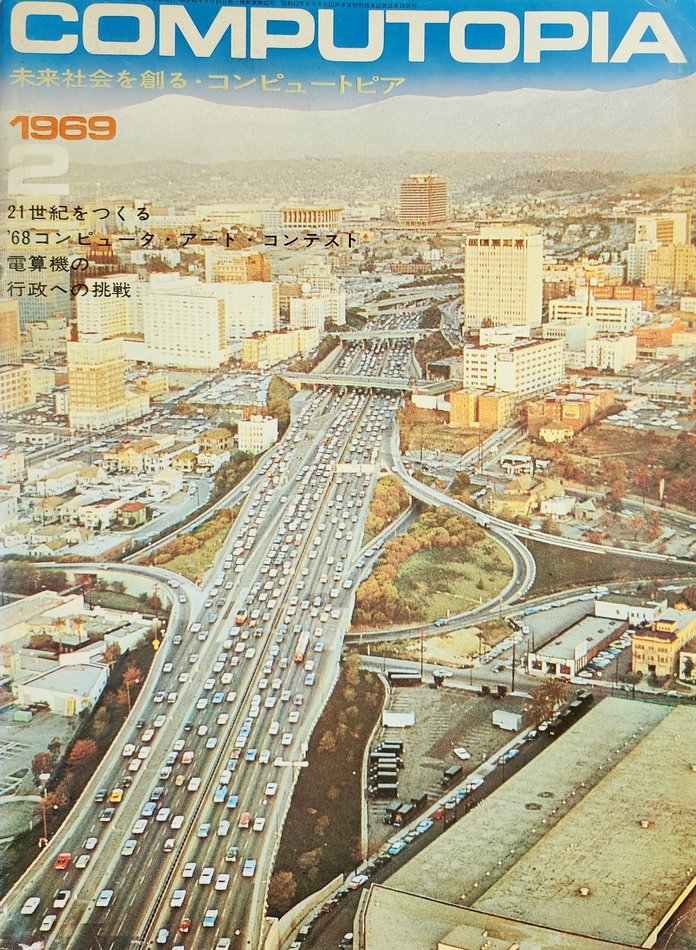
Computopia, February 1969, '68 Computer Art Contest issue, Los Angeles freeway cover

Computopia コンピュートピア, February 1969

February 1, 1969 · Magazine · Computer Age-sha

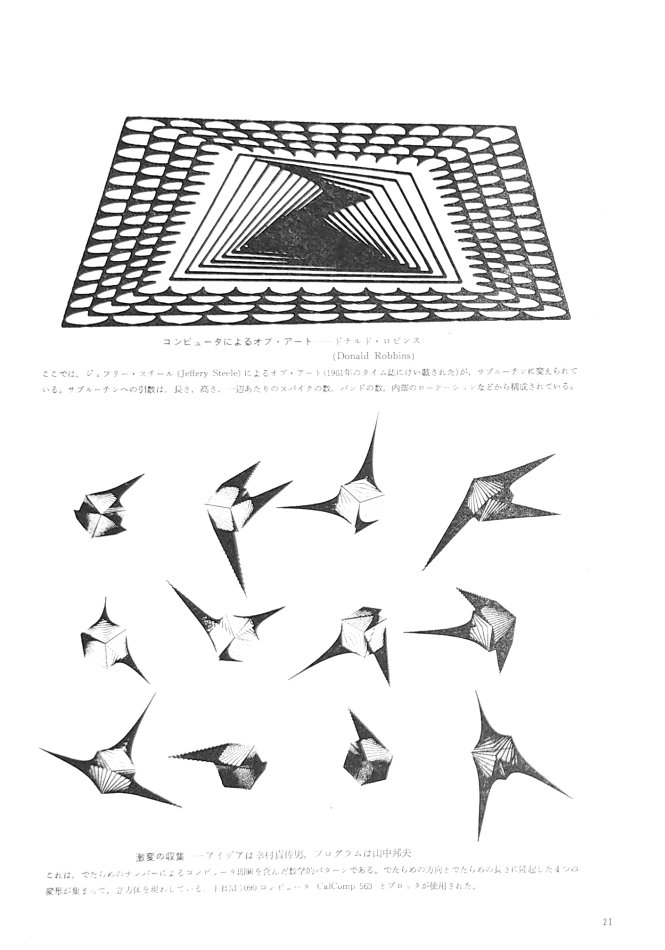
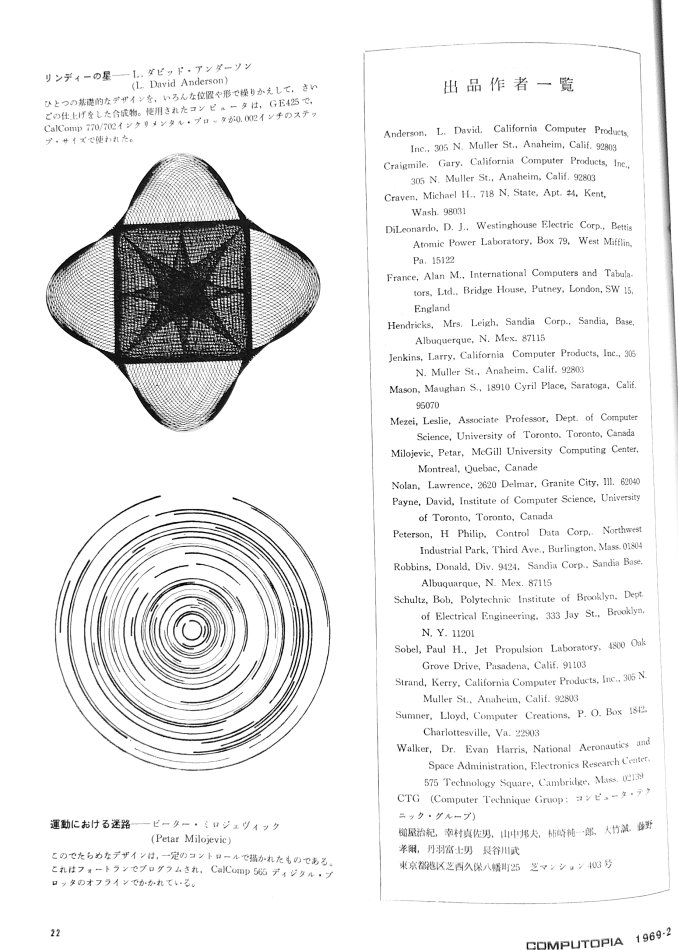
The magazine’s coverage of the Computers and Automation 1968 contest. Four CTG works are shown, Return to a Square, Tragedy of Seven, Deformation of Sharaku and Upheaval Collection.
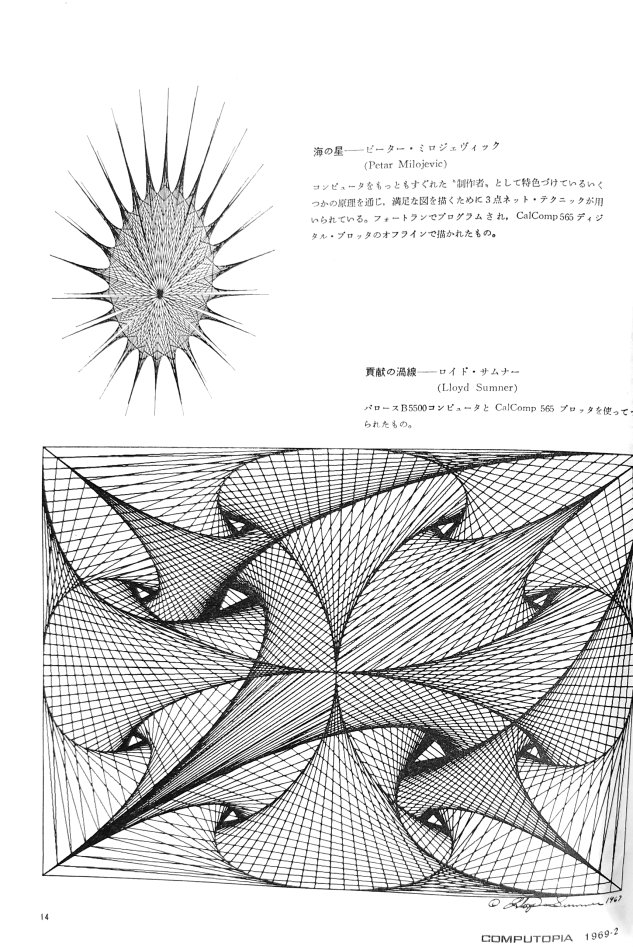
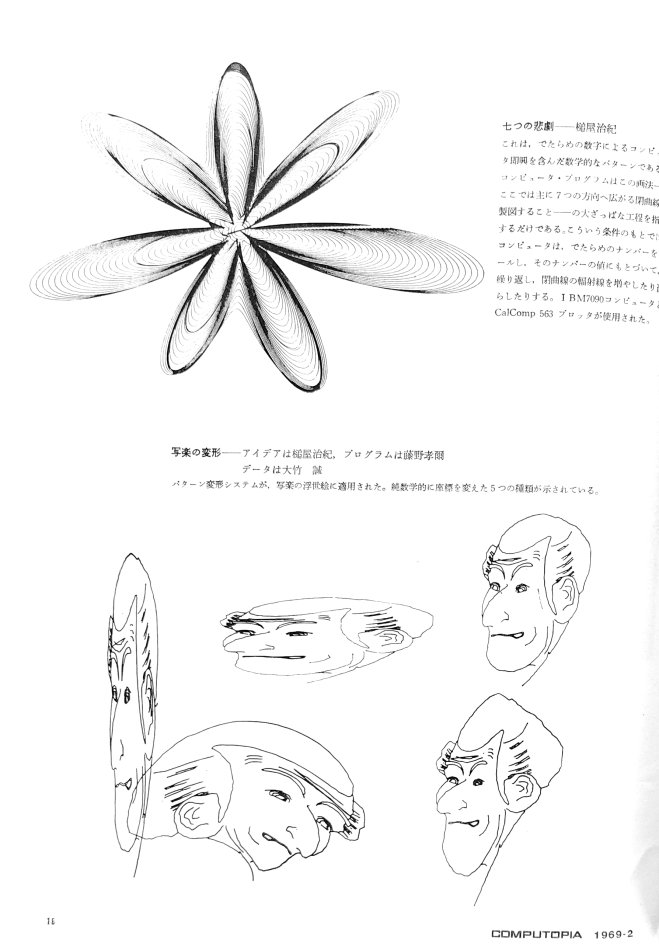
Computopia February 1969 page 15: Return to a Square, design Kohmura, program Yamanaka Computopia February 1969 page 18: Tragedy of Seven, credited to Tsuchiya, above Deformation of Sharaku Computopia February 1969 page 21: Upheaval Collection, idea Kohmura, program Yamanaka, below Donald Robbins' op-art Computopia February 1969 page 22: exhibitor directory printing CTG's eight members and the Shiba-Mansion address
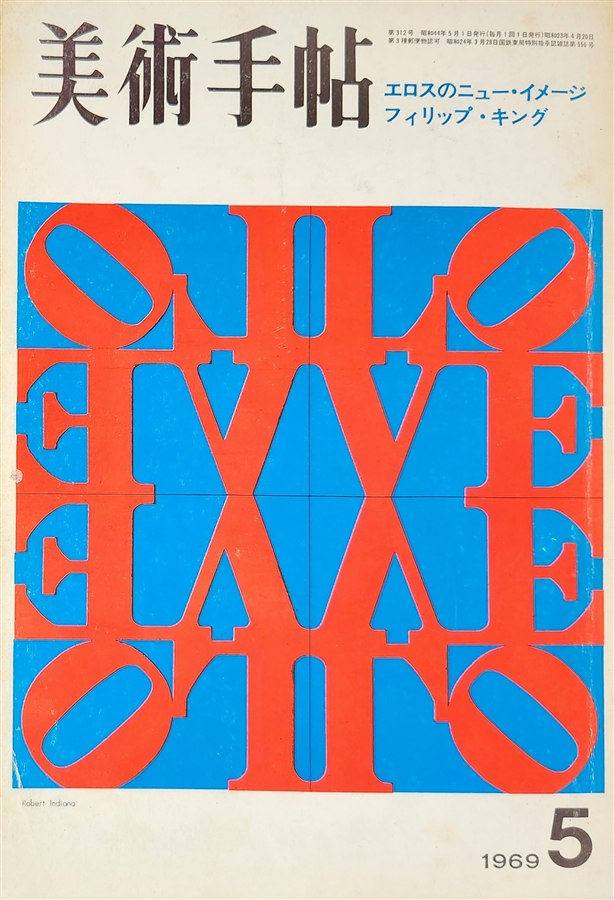
Bijutsu Techō no. 312, May 1969, cover by Robert Indiana

Bijutsu Techō 美術手帖, no. 312

May 1, 1969 · Magazine · Bijutsu Shuppan-sha

Kuniharu Akiyama’s column, “A Connoisseur of Pleasurable Chaos: Cybernetic Music” (pp.168–171), reviews the Cybernetic Serendipity Music LP. Bit Music, “made by Haruki Tsuchiya, a member of Japan’s C.T.G., by recording programmed pulses directly, just as they are, onto the computer’s magnetic tape.”
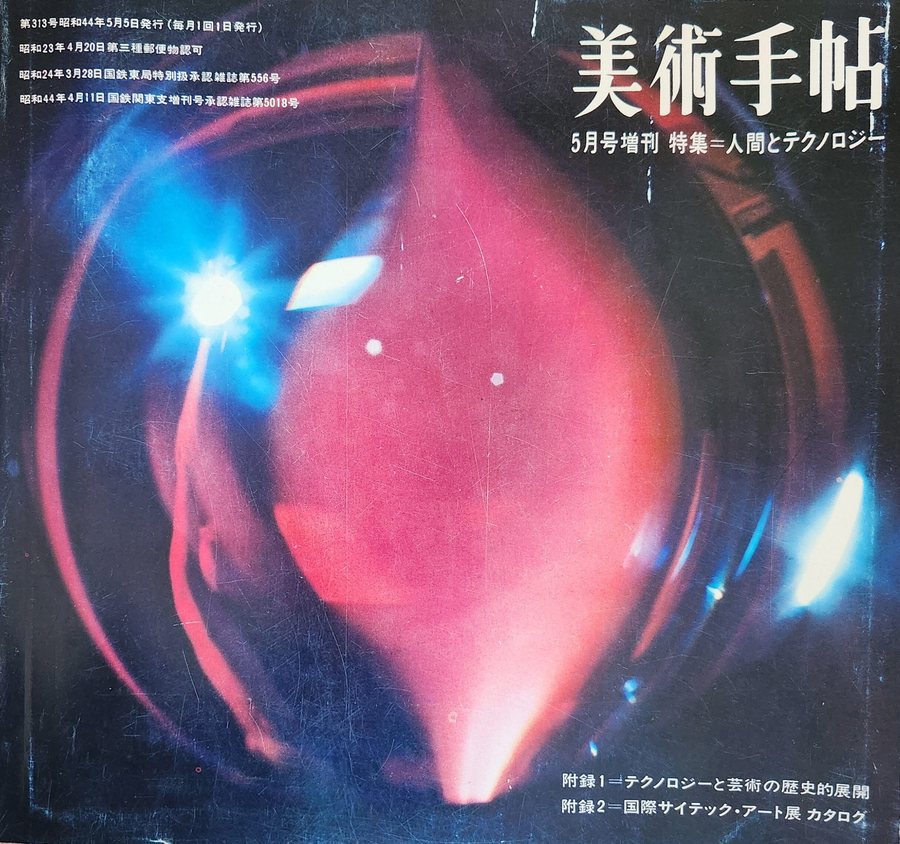
Bijutsu Techō no. 313, May 1969, Man and Technology issue

Bijutsu Techō 美術手帖, no. 313, “Man and Technology”

May 5, 1969 · Magazine with two folding inserts · Bijutsu Shuppan-sha

The special issue on man and technology, published with two appendices: a multi-color poster charting “The Historical Development of Technology and Art,” and the catalog of Electromagica ’69, edited by CTG. The feature showcases CTG’s Automatic Painting Machine No. 1, the group’s interactive spray-painting robot.
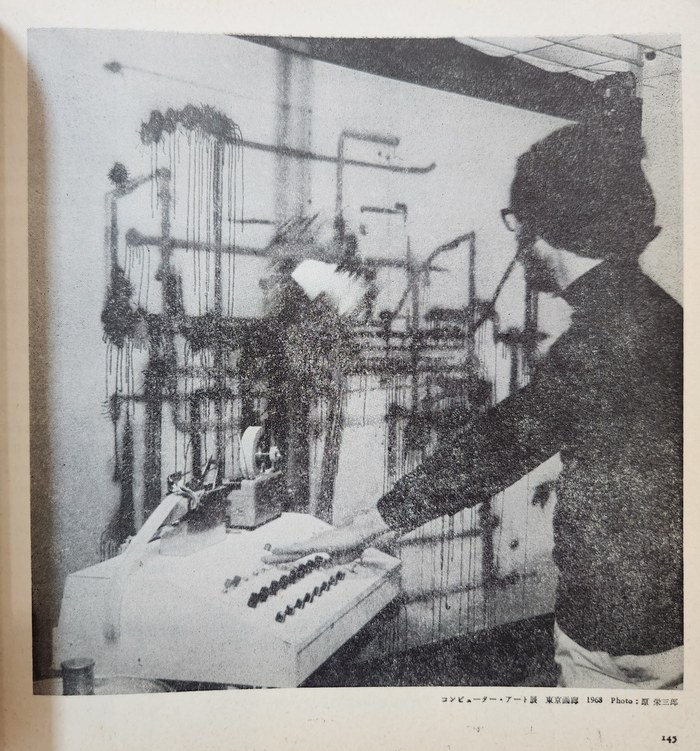
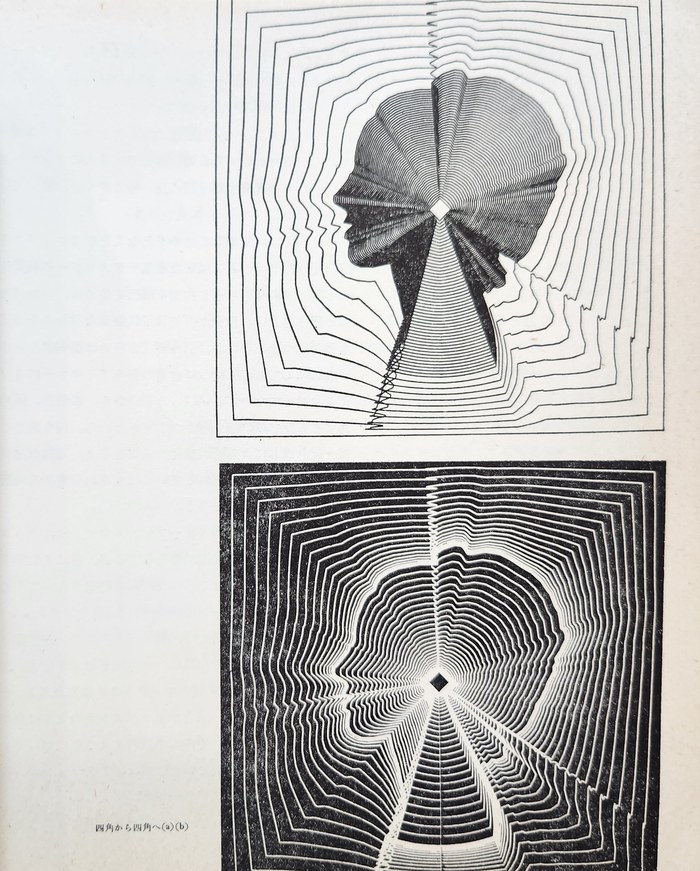
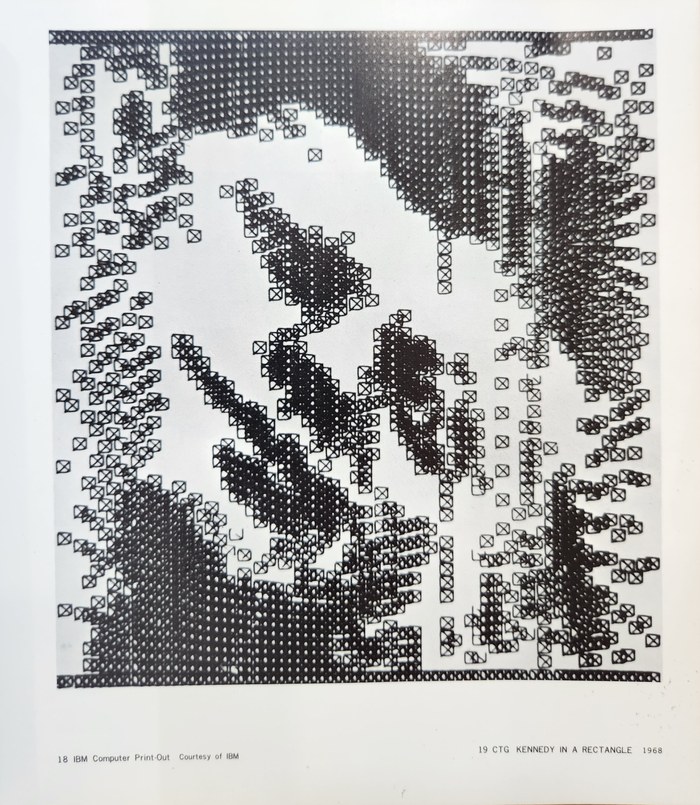
Bijutsu Techō no. 313 p. 145: Kohmura operating APM No. 1 at the Computer Art Exhibition, Tokyo Gallery, 1968. Photo: Eizaburō Hara Bijutsu Techō no. 313: Return to a Square (a) and (b) printed together under the period title From Square to Square Bijutsu Techō no. 313: CTG, Kennedy in a Rectangle, 1968, as plate 19
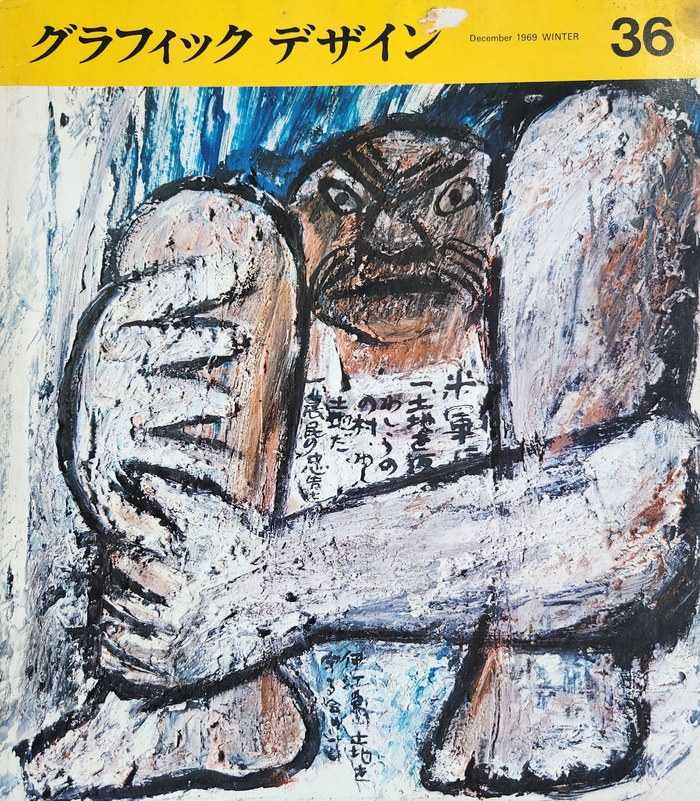
Graphic Design no. 36, December 1969, cover painting by Seizō Tashima

Graphic Design, no. 36

December 20, 1969 · Magazine · Kōdansha

A notice on page 86 reports that CTG had disbanded. It lists the three films the group made—Computer movie No. 1–No. 3. It gives three reasons for stopping: that in three years the group’s work was done; that continuing would turn into mannerism and do harm; and that the members could no longer agree on a common outlook. The magazine says that for a group averaging twenty-six years old, “the way this group has broken itself off is refreshing.”
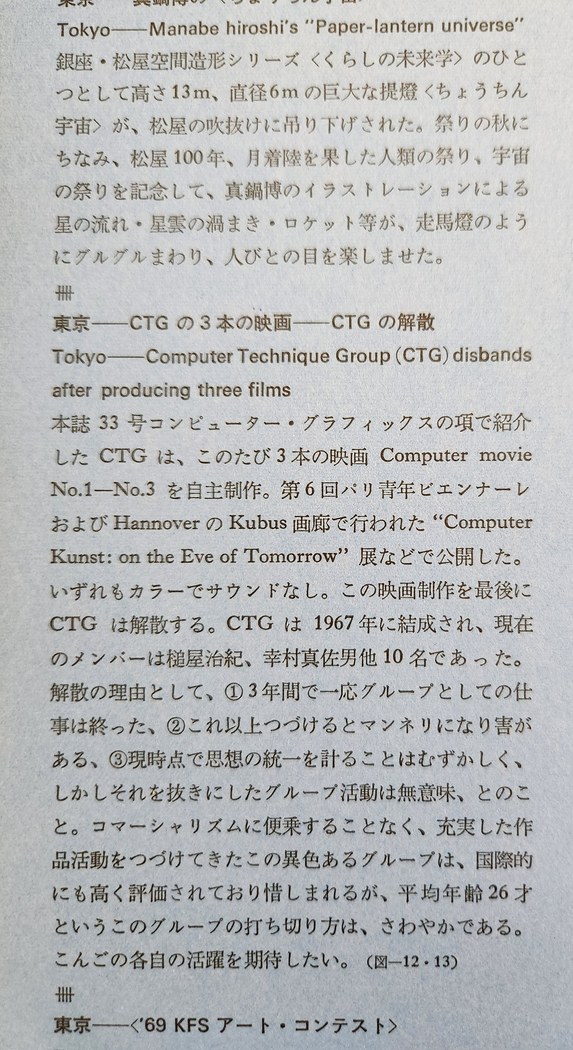
Graphic Design no. 36 page 86: the notice of CTG's dissolution, with two CTG images
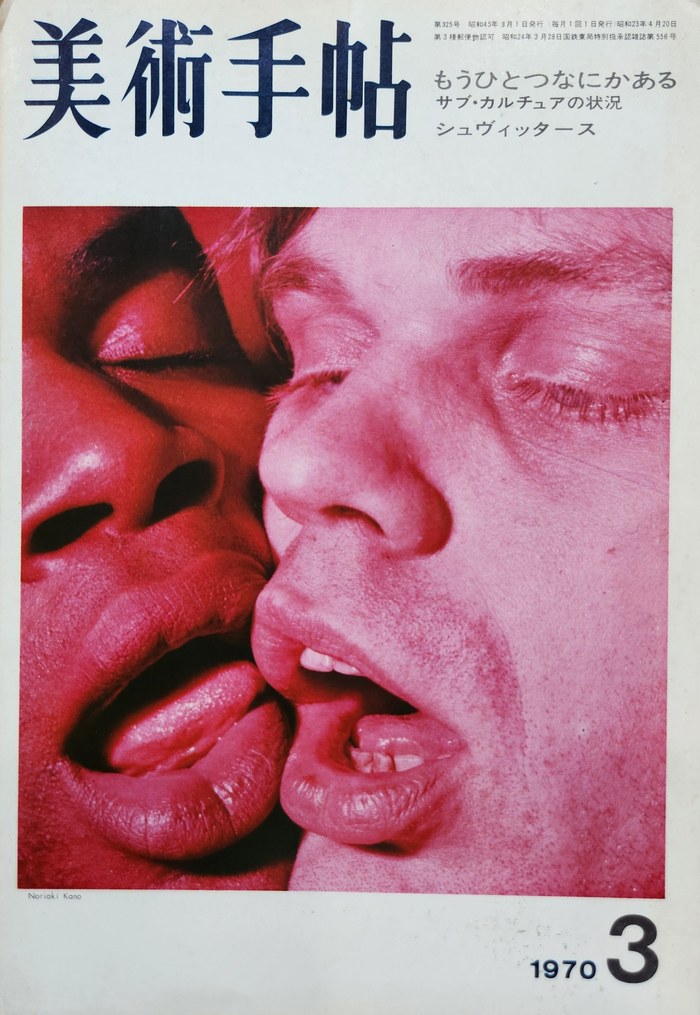
Bijutsu Techō no. 325, March 1970, subculture special issue, cover by Tenmei Kanō

Bijutsu Techō 美術手帖, no. 325, “The Myth of Computer Art Vanishes”

March 1, 1970 · Magazine · Bijutsu Shuppan-sha

The “Wide Angle” column on p.107 reports the January 22, 1970 gathering at Iwanami Hall that was CTG’s dissolution event.
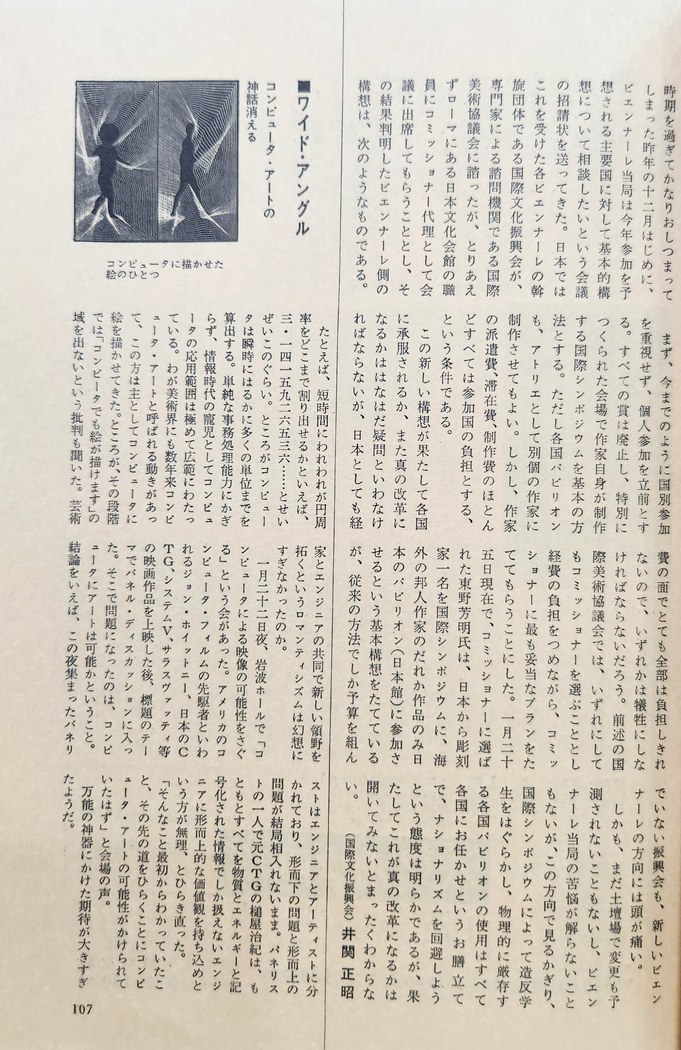
Bijutsu Techō no. 325 page 107: the Wide Angle column “The myth of computer art vanishes,” with the uncredited two-panel topology transformation
IBM-Informatique no. 13, 1975, cover with a quotation from Paul Valéry

IBM-Informatique, no. 13

1975 · Magazine · IBM France

The in-house magazine of IBM France. Includes Collection of Random Windows; Return to a Square in two versions; Shot Kennedy; Individualization.
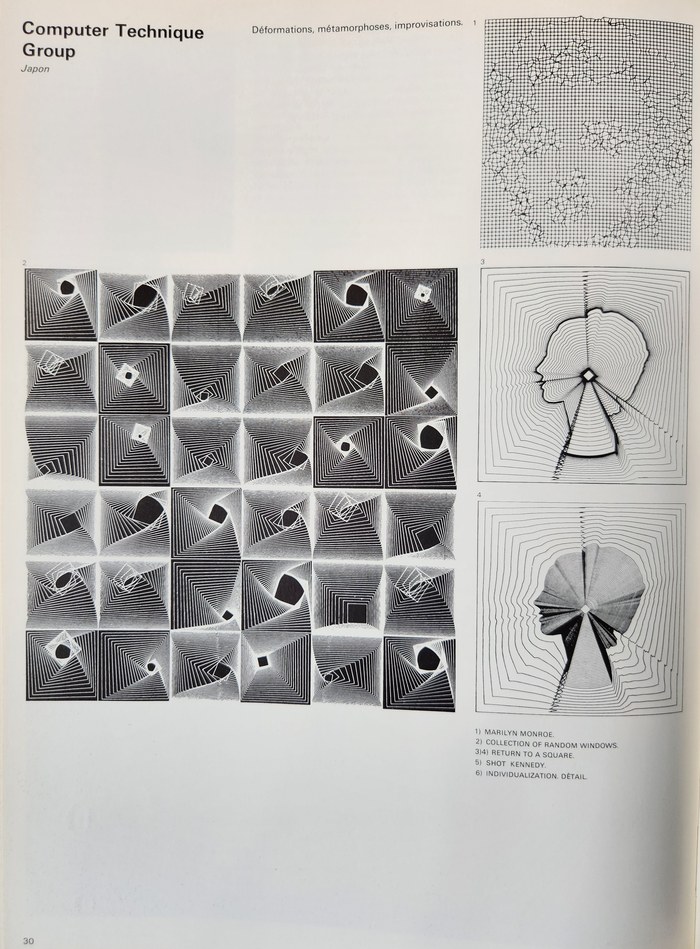
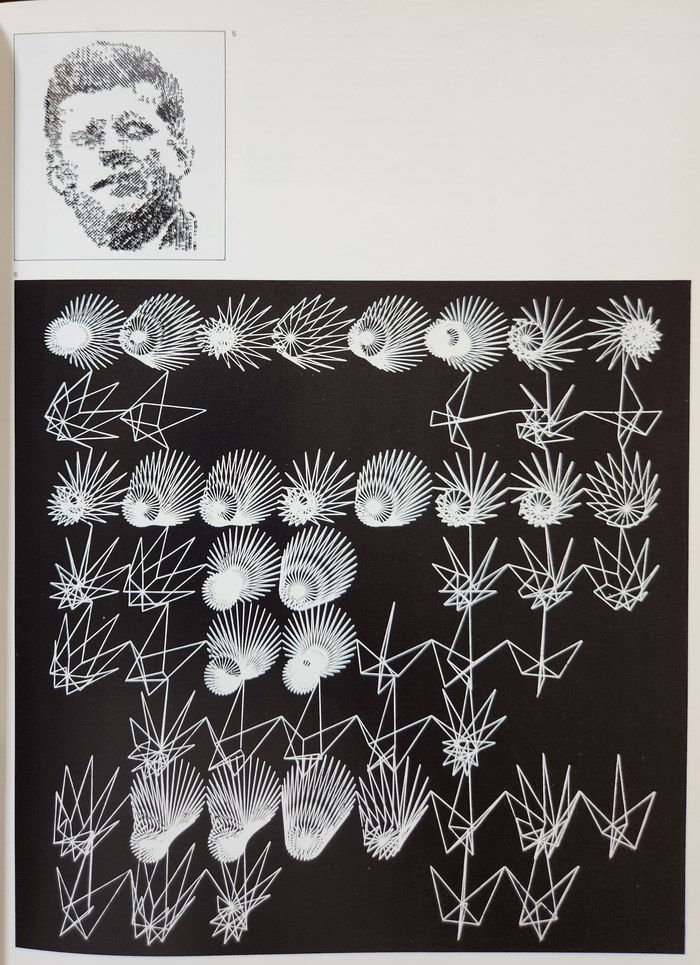
IBM-Informatique no. 13 page 30: the Computer Technique Group section, headed Déformations, métamorphoses, improvisations IBM-Informatique no. 13 page 31: Shot Kennedy and a full-page detail of Individualization
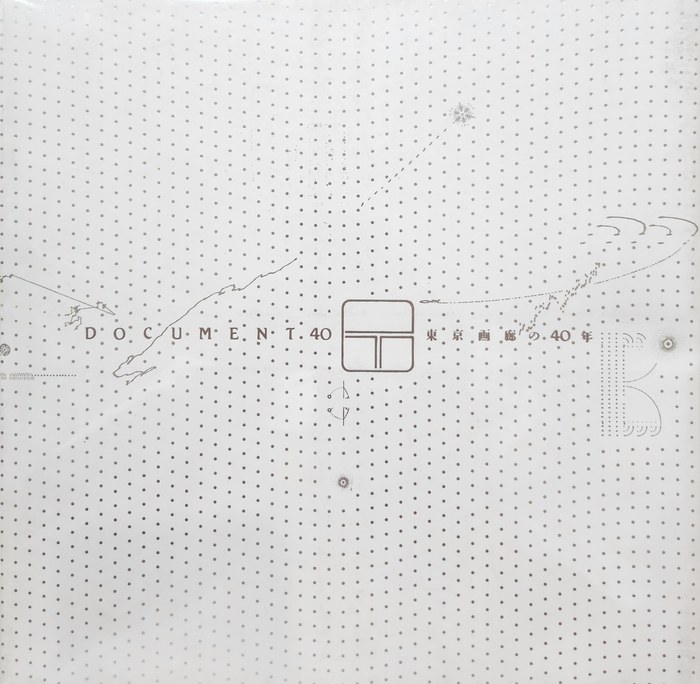
DOCUMENT 40: Forty Years of Tokyo Gallery, 1991, cover

DOCUMENT 40: Forty Years of Tokyo Gallery

1991 · Book · Tokyo Gallery

The record of the gallery’s first four decades, 1950 to 1990, showing the poster for Media Transformation through Electronics, Shot Kennedy No. 2, and APM No. 1.
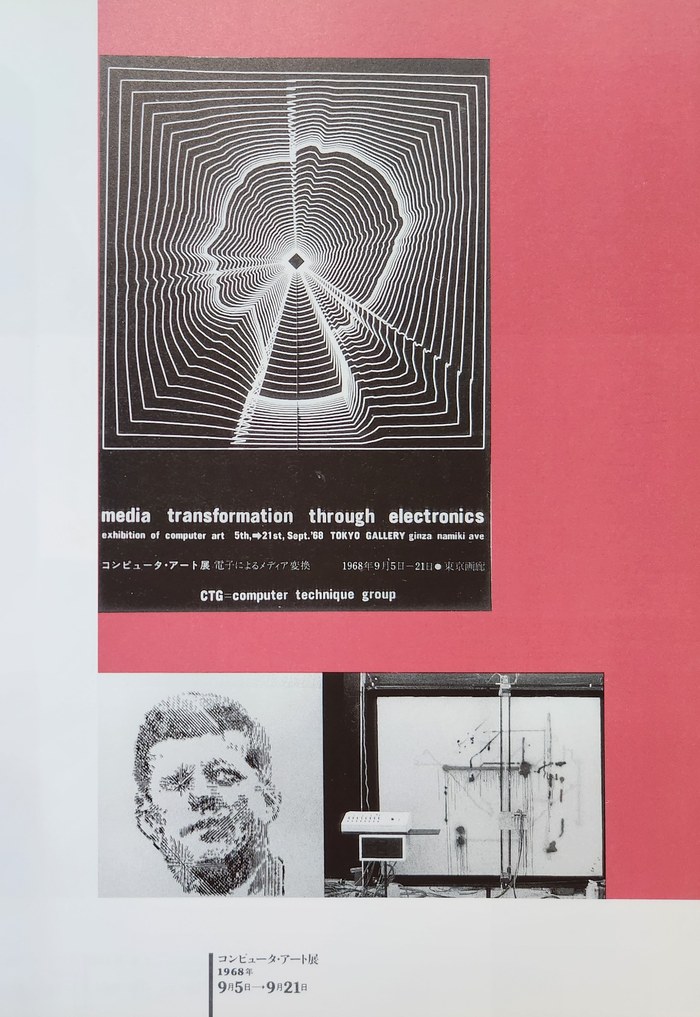

DOCUMENT 40 page 89: the Computer Art Exhibition poster, Shot Kennedy No. 2, and APM No. 1 in the gallery
Sources
VOGUE, January 15, 1964

VOGUE, Jan. 15, 1964

1964 · Magazine · Condé Nast

Includes the William Klein fashion photograph that was the image CTG digitized for Return to a Square.
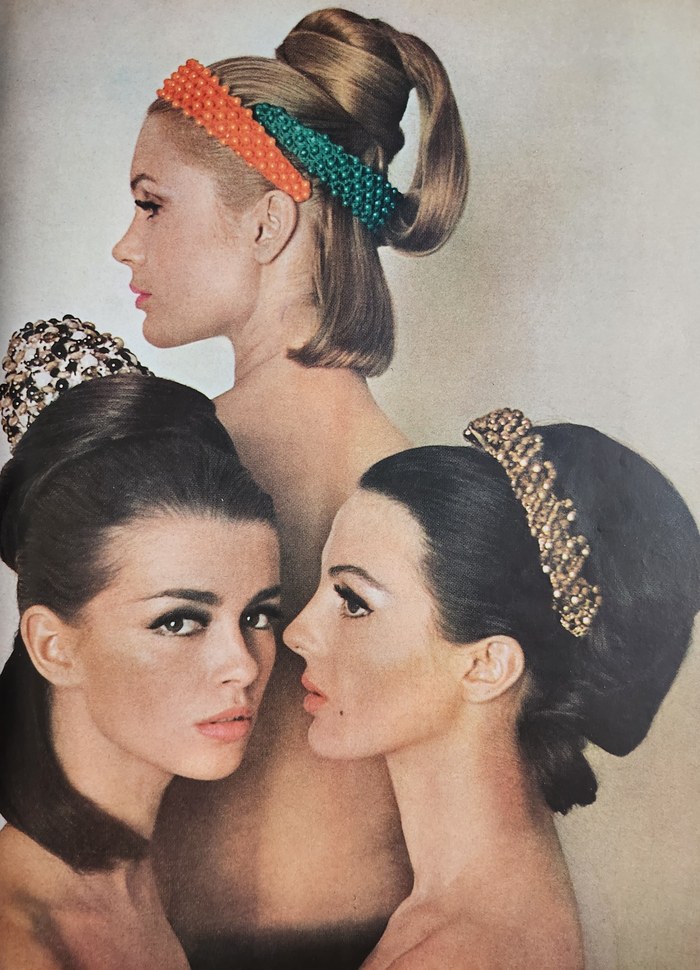
VOGUE, January 15, 1964, p. 71: William Klein photograph of three models; the contour of the woman at right was traced for Return to a Square
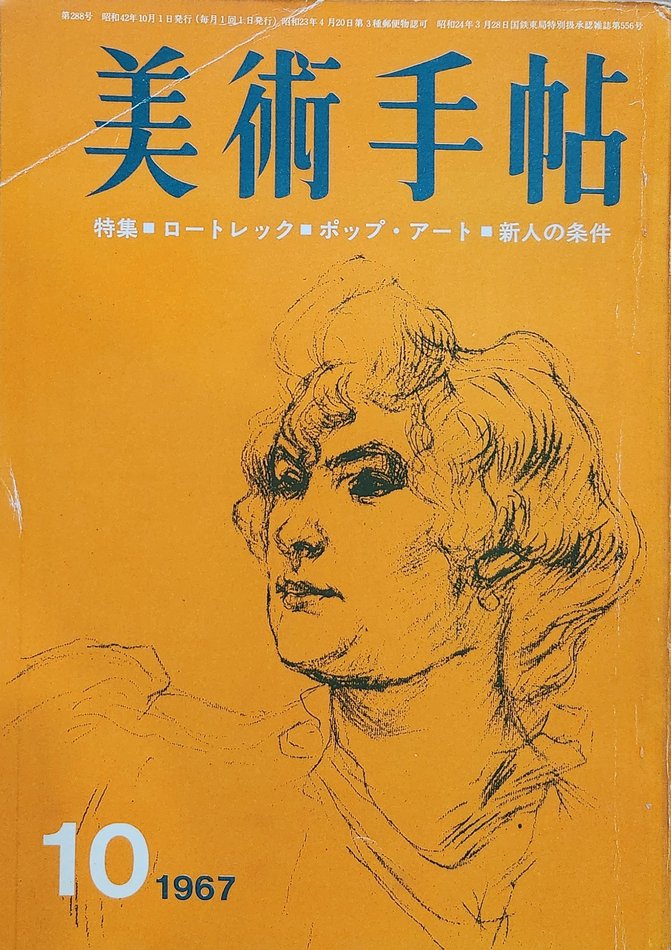
Bijutsu Techō no. 288, October 1967: Toulouse-Lautrec portrait drawing on the cover, with features on Lautrec, Pop Art and the conditions for new artists

Bijutsu Techō 美術手帖, no. 288

October 1, 1967 · Magazine · Bijutsu Shuppan-sha

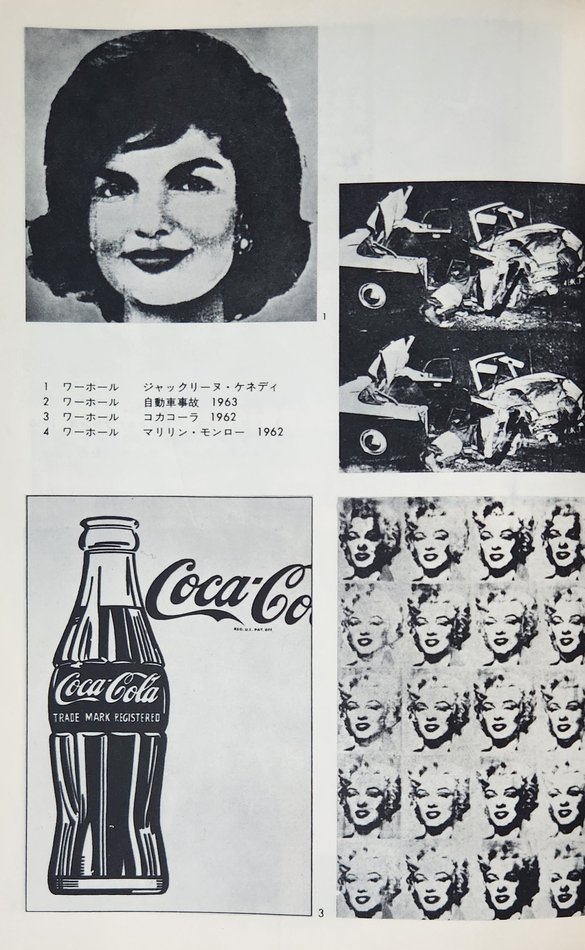
Includes Warhol’s Marilyn Monroe (p. 74), from which CTG took the data for Monroe in the Net. Page 23 shows Kishio Suga’s nested squares drawn on the round seat of a chair, one source of the idea for Return to a Square. On the same page, an announcement for the October 9 symposium The Electronic Computer and Art at Tama Art University.
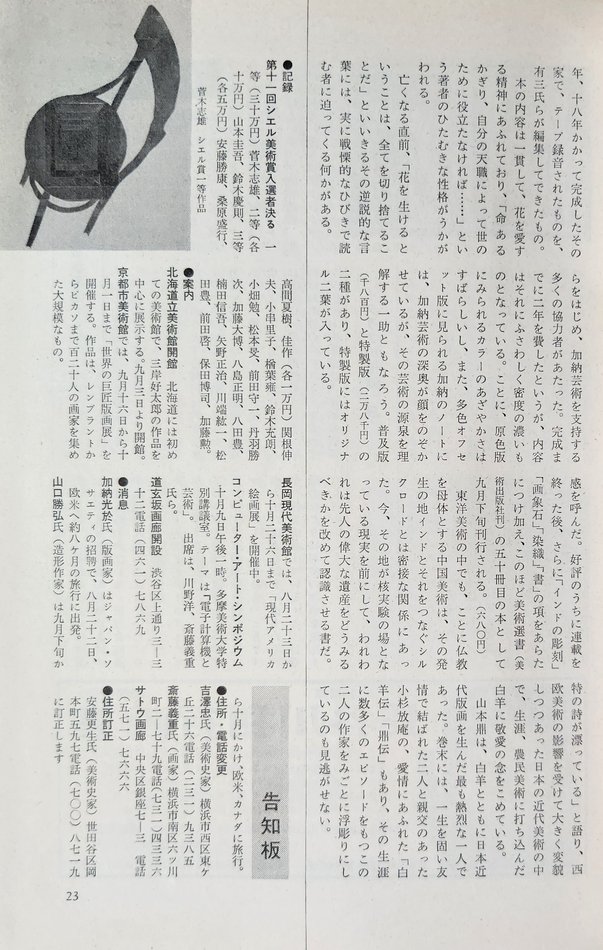
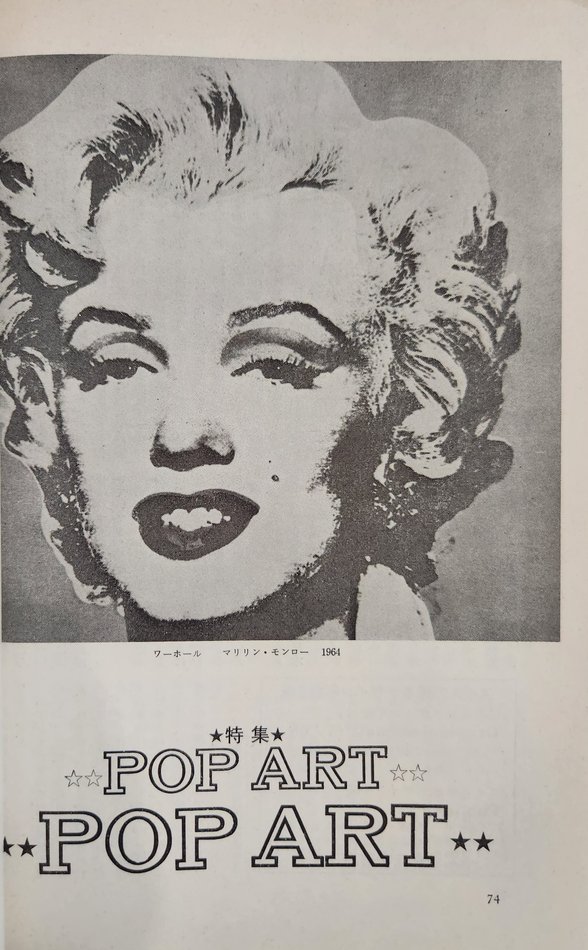
Bijutsu Techō no. 288, p. 23: Kishio Suga's first-prize work at the 11th Shell Art Award, and the notice board announcing the October 9 symposium The Electronic Computer and Art at Tama Art University Bijutsu Techō no. 288, p. 74: Warhol's Marilyn Monroe opening the Pop Art feature, the plate CTG took the data from for Monroe in the Net Bijutsu Techō no. 288, Pop Art feature plates: Warhol's Jacqueline Kennedy, Car Crash (1963), Coca-Cola (1962) and Marilyn Monroe (1962)