ragnar digital collection · 作品展 exhibit of works

computer technique group コンピュータ・テクニック・グループ

tokyo 1966–1969
exemplary works and materials from the pioneering group of computer art
3D walkthrough →

The Collection

works in the Ragnar Digital collection

No. 1

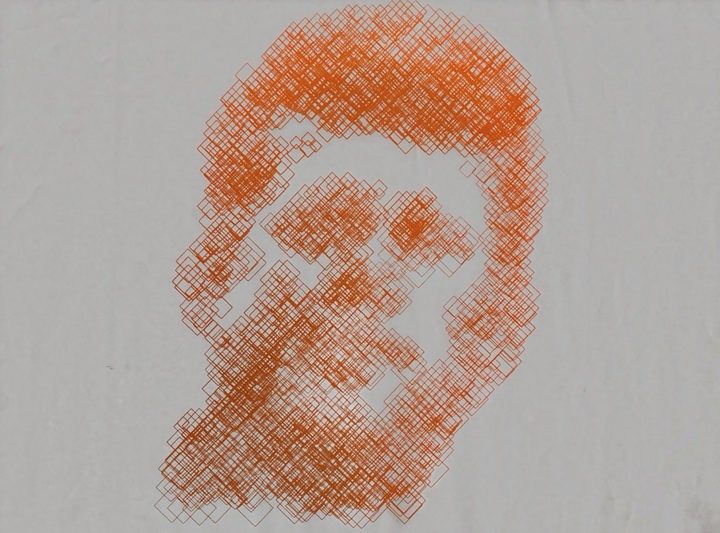
Cube Kennedy 1968

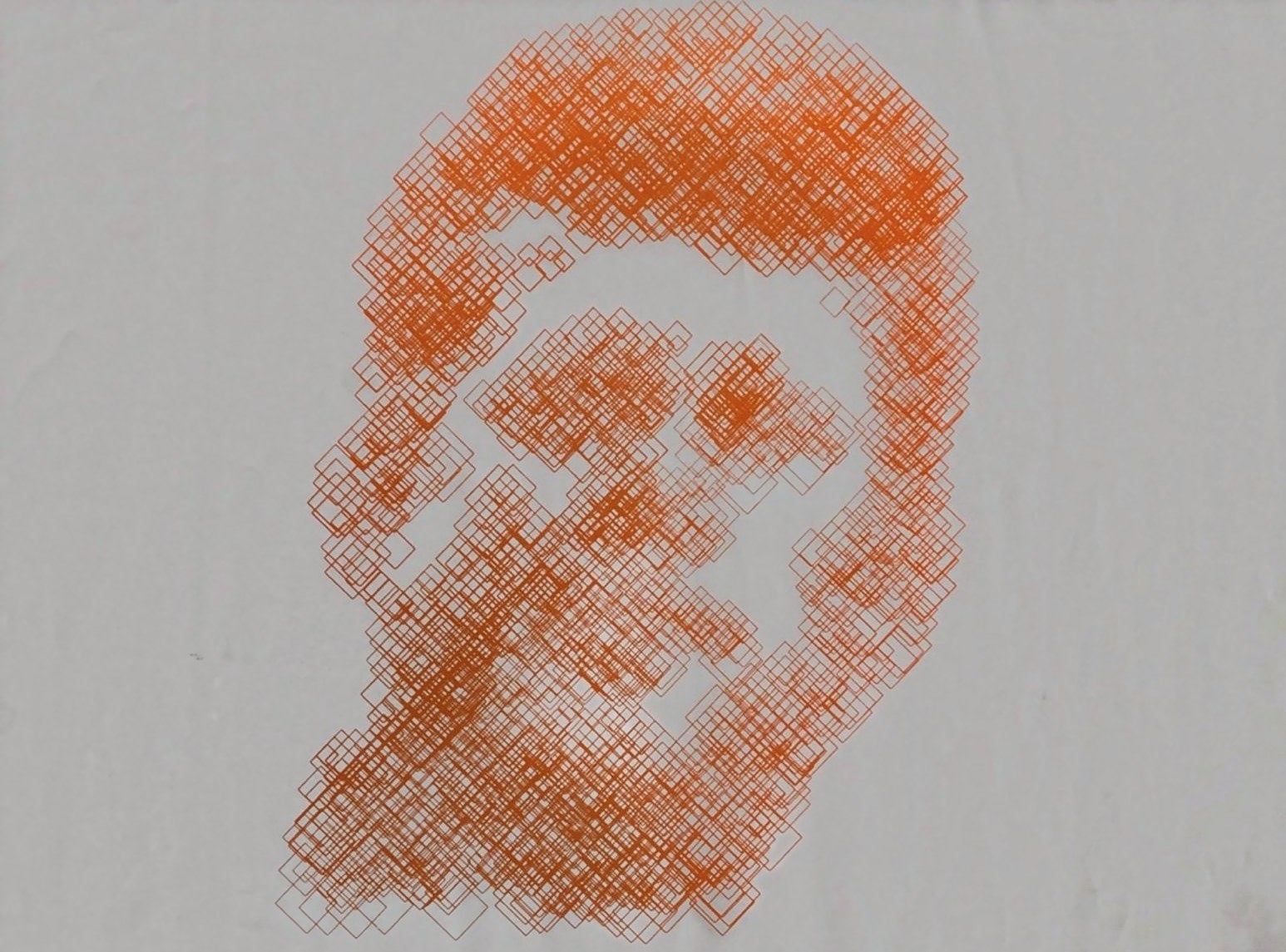
Cube Kennedy—orange overlapping squares forming a portrait of John F. Kennedy on silver-gray ground
Also titled
Cubic Kennedy No. 1
Medium
Silkscreen, orange on silver-gray
Sheet
31.3 × 43.1 in (795 × 1095 mm)
Edition
~20 printed for the 1968 Tokyo Gallery exhibition (per Kohmura)
Only 2 known copies remain: this and the MOT Tokyo copy (yellow on white)
Displayed
This copy: Re: Startline, National Museum of Modern Art, Kyoto, 2023
This work: Tokyo Gallery, 1968; Arte y Cibernética, Buenos Aires, 1969 (as Cube Kennedy Nº 1)

Cube Kennedy is a portrait of John F. Kennedy built from overlapping squares. Each square is centered on a point in a dataset taken from a newspaper photograph, with its size set by a random number. The squares congregate where the photograph is dark and thin out where it is light.

Creating the dataset was labor intensive and more work than writing the program itself. In the summer of 1967 the members laid a 97 × 75 grid over a press photo of Kennedy from the Asahi Journal, judged by eye whether each intersection was black or white, and recorded the black ones as coordinates—2,452 points in all. The program was small—63 lines of FORTRAN—but contained all three of the earliest Kennedy portraits as subroutines: a random trail at each point creates Random Walk Kennedy, a star creates Star Kennedy, a square creates this work.

The plotter original was a small ink drawing. For the group’s autumn 1968 exhibitions, Toppan Printing enlarged the image and silkscreened it at poster scale. Minami Gallery bought most of the group’s 1968 silkscreen stock; the gallery closed in 1979 and the prints have not been seen since.
No. 2

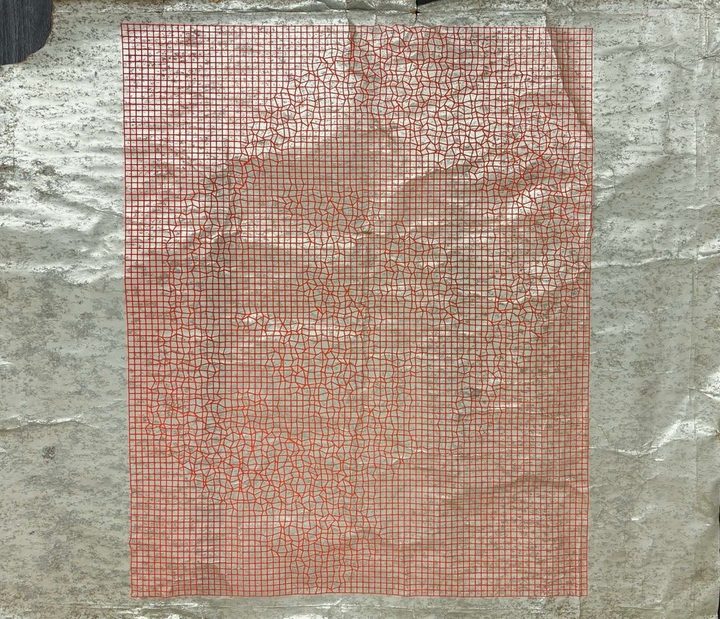
Kennedy in the Net 1968

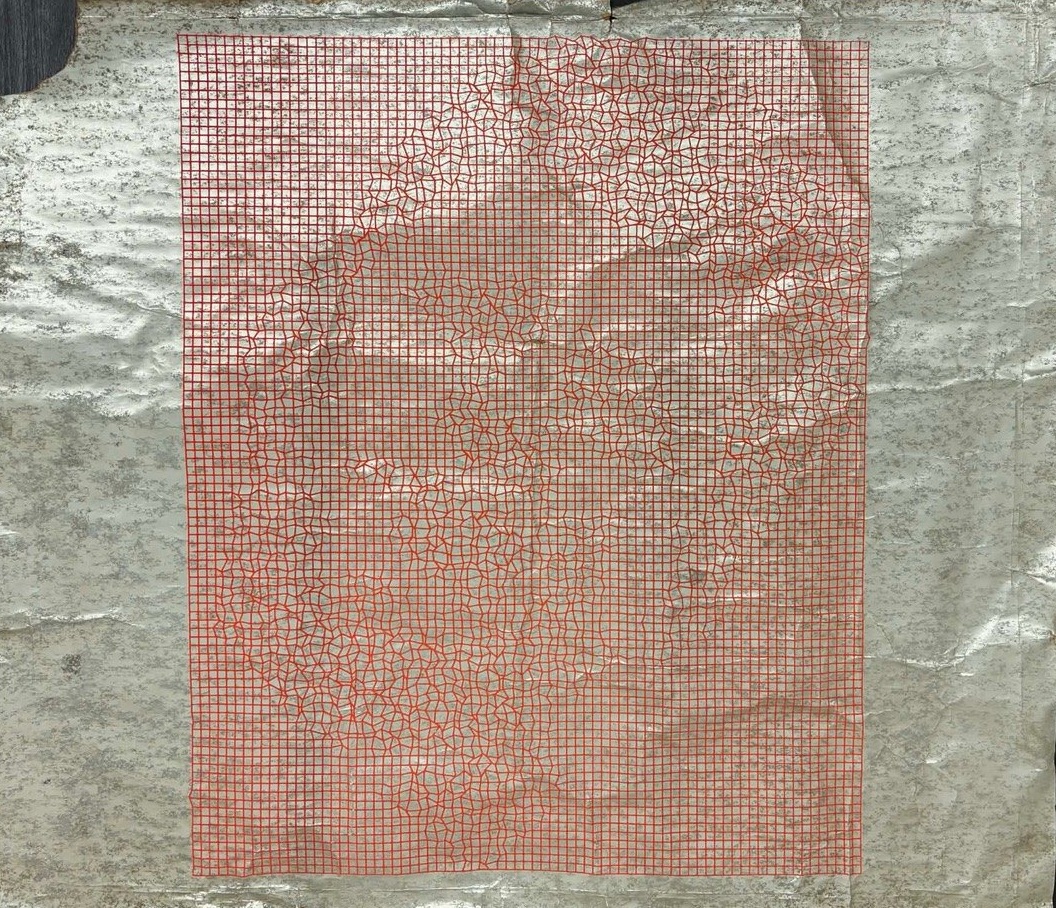
Kennedy in the Net—red-orange grid net deformed into a Kennedy portrait on silver paper
Medium
Silkscreen, red-orange net on silver ground
Sheet
31.3 × 43.1 in (795 × 1095 mm)
Edition
Edition size unrecorded
Believed the last surviving copy
Displayed
This copy (once panel-mounted—fold lines from the mounting remain, along with wrinkles that developed over the years): Tokyo Gallery, 1968; Trends in Contemporary Japanese Art, National Museum of Modern Art, Kyoto, 1968
This work: Cybernetic Serendipity, London, 1968; Arte y Cibernética, Buenos Aires, 1969; Computer-Kunst, Hannover, 1969; Arts on Computer, O Art Museum, Tokyo, 1987 (a 1968 silkscreen—which copy unrecorded)

Kennedy in the Net starts as an evenly spaced grid. A program moves each intersection a random distance in a random direction. The original photograph (the same press photo of Kennedy used across the series) sets limits for the movements: points can travel far when representing dark areas and can barely move when representing light areas. From this manipulation, a face appears, as crumpled, crowded cells turn into shadows. Tsuchiya is credited with both the idea and program. The same process, run against a photograph of Marilyn Monroe, produced the companion piece, Monroe in the Net.

In 2005, while clearing out the Kohmura residence in Tokyo, the sheet was nearly lost and thrown away; Oizumi rescued it and kept it in his university laboratory for some twenty years. Kohmura has stated he does not want the work restored, as the sheet’s survival is part of its history.

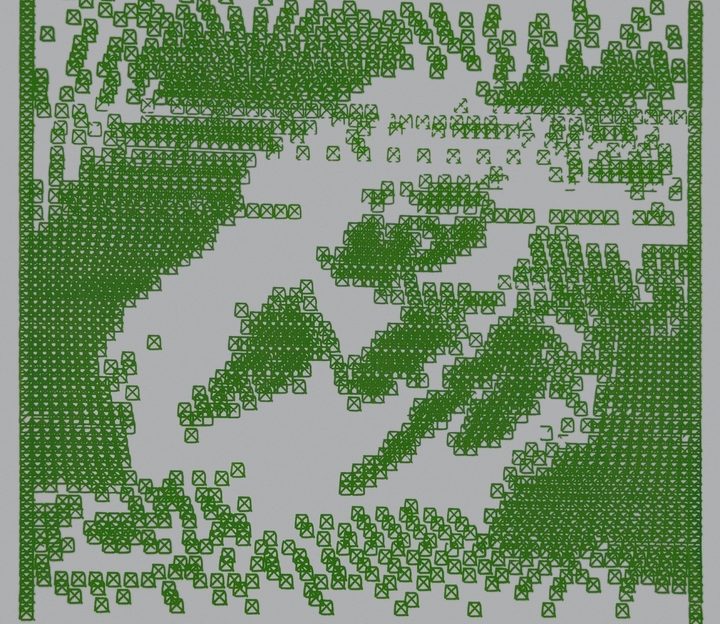
No. 3

Kennedy in a Rectangle 1968

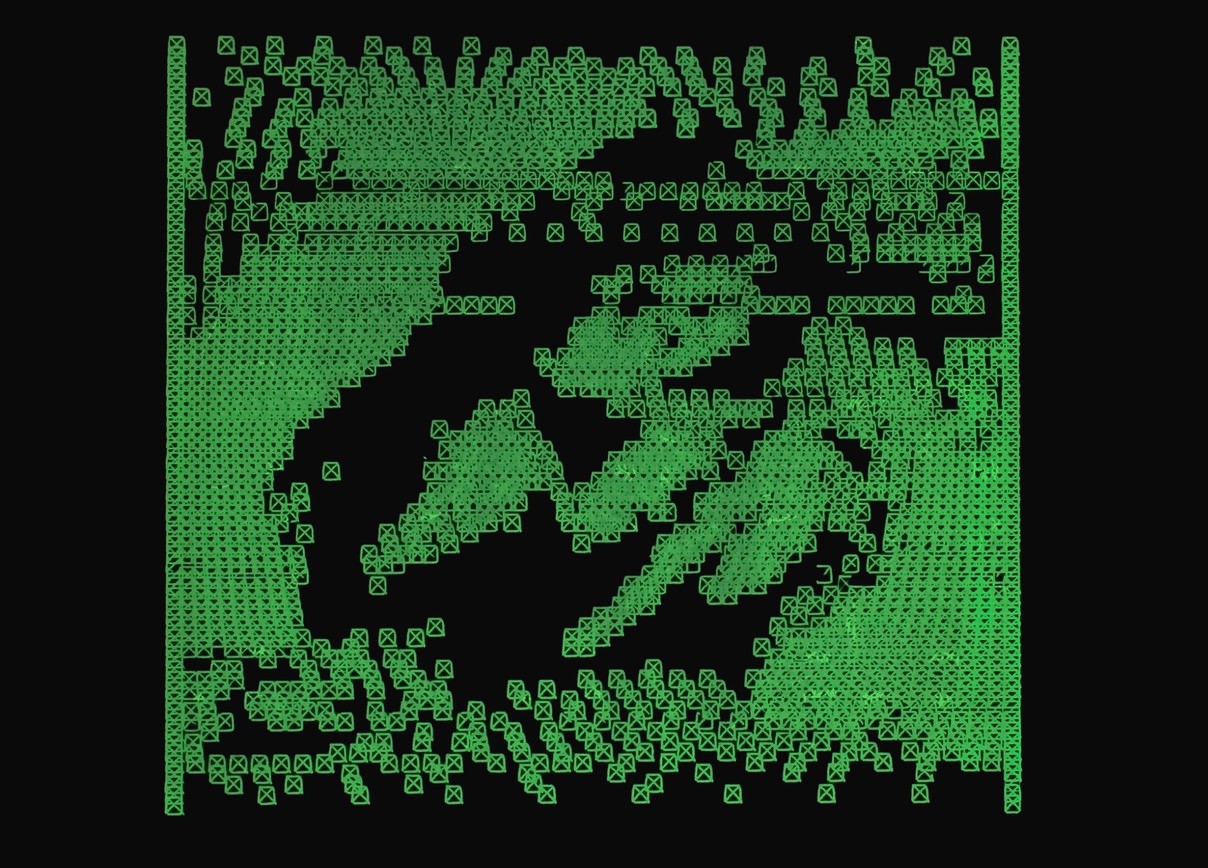
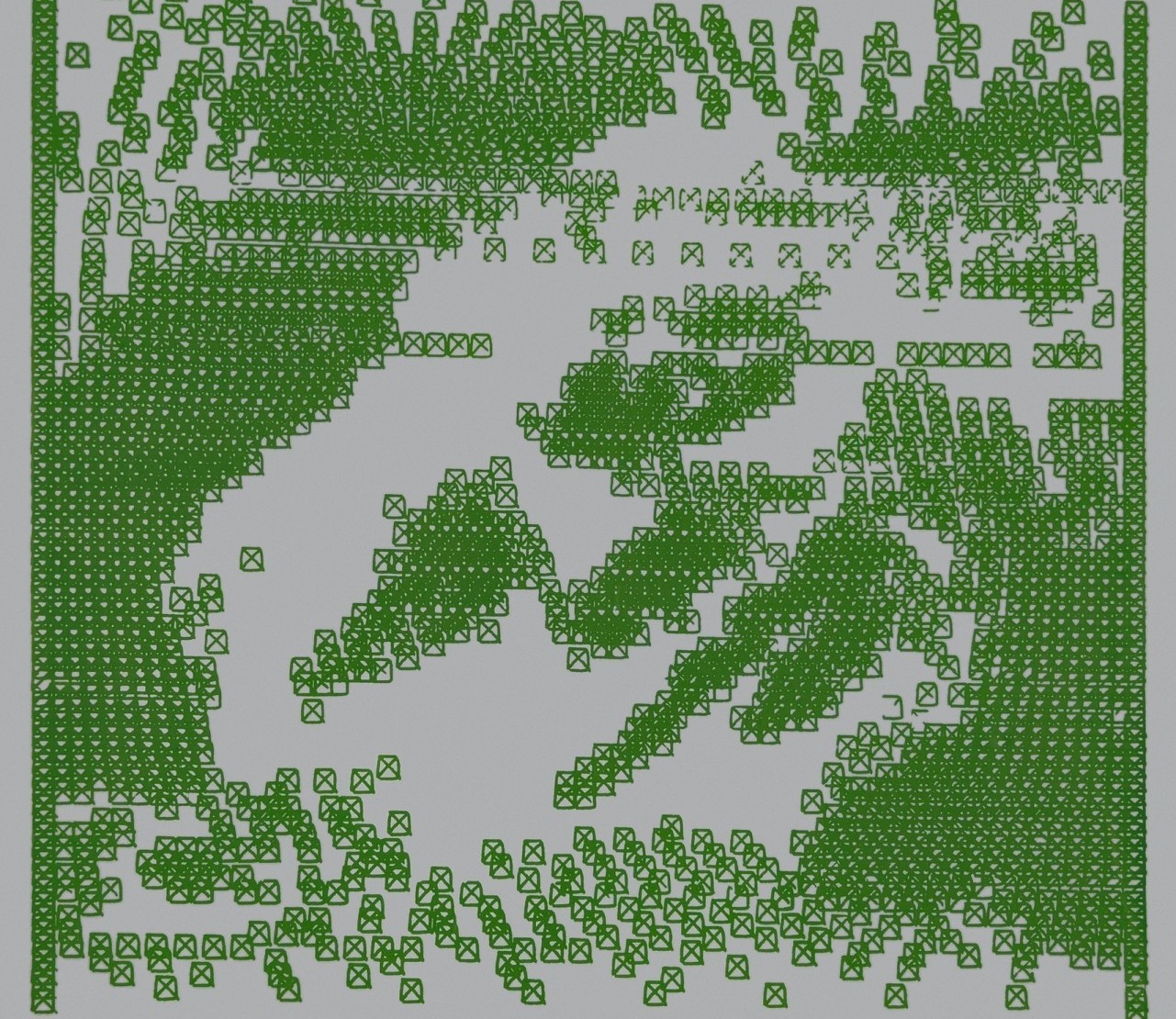
Kennedy in a Rectangle—green crosshatched square cells forming a Kennedy portrait on silver-gray
Medium
Silkscreen, green on silver-gray
Sheet
31.3 × 43.1 in (795 × 1095 mm)
Edition
Unnumbered; edition size unrecorded
Only 2 known copies remain: this and the MOT Tokyo copy
Displayed
This work: Cybernetic Serendipity, 1968; Tokyo Gallery, 1968; Mechanical Design, Toppan Building, 1968; Arte y Cibernética, Buenos Aires, 1969 (as Kennedy in the Rectangular); Computer-Kunst, Hannover, 1969

The program spreads the coordinates of the Kennedy portrait proportionally until they fill a rectangle. As a result, the oval of the head is pulled toward the corners, warping each feature. Each point is drawn as a small crosshatched cell, denser where the photograph is dark. The Cybernetic Serendipity catalog lists this work as idea by Masao Kohmura, program by Fujio Niwa.

Niwa, then a doctoral student in mechanical engineering at the University of Tokyo, wrote the program between late 1967 and March 1968. In the Oizumi monograph’s survey of the works he recalled that the square seemed to evoke a funeral memorial portrait of the late president—“but that too is a later rationalization. At first, the idea of what sorts of ways there were to deform a portrait took precedence. In the end we distributed it proportionally within the rectangle. Since we could not write ‘memorial portrait’ in the title, we wrote ‘rectangle.’”

No. 4

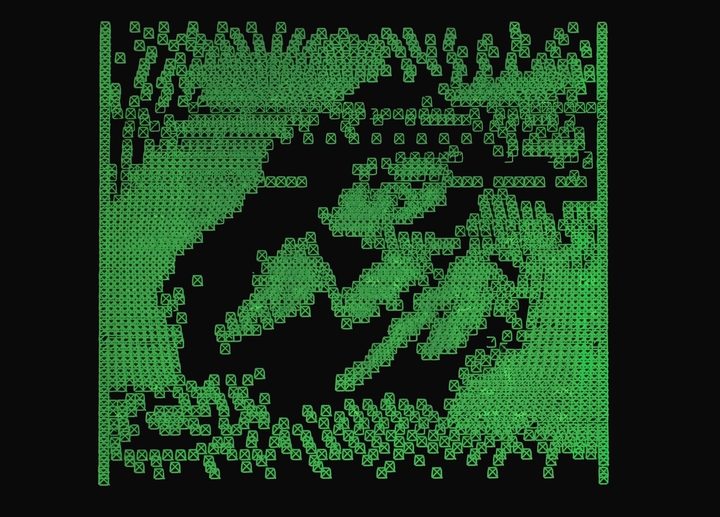
Kennedy in a Rectangle (negative) 1968

Kennedy in a Rectangle (negative)—green cell glyphs on glossy black
Medium
Silkscreen on glossy paper, green on black
Sheet
31.3 × 43.1 in (795 × 1095 mm)
Edition
Unnumbered; the only extant copy known
Displayed
This work (negative version): Tokyo Gallery, 1968; Mechanical Design, Toppan Building, 1968

The same image as No. 3 above with the color values reversed: green cells on glossy black. CTG often pulled variant impressions from plates by changing the color scheme.

No. 5

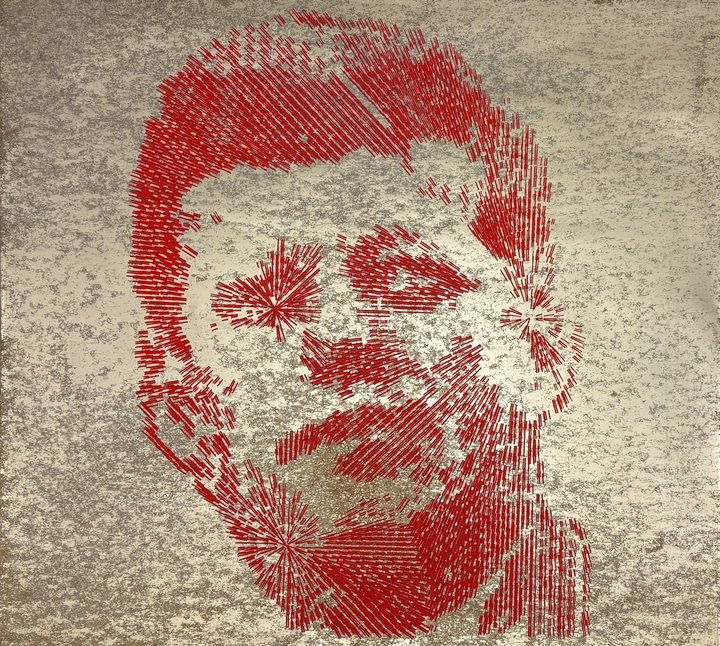
Shot Kennedy No. 2 1968

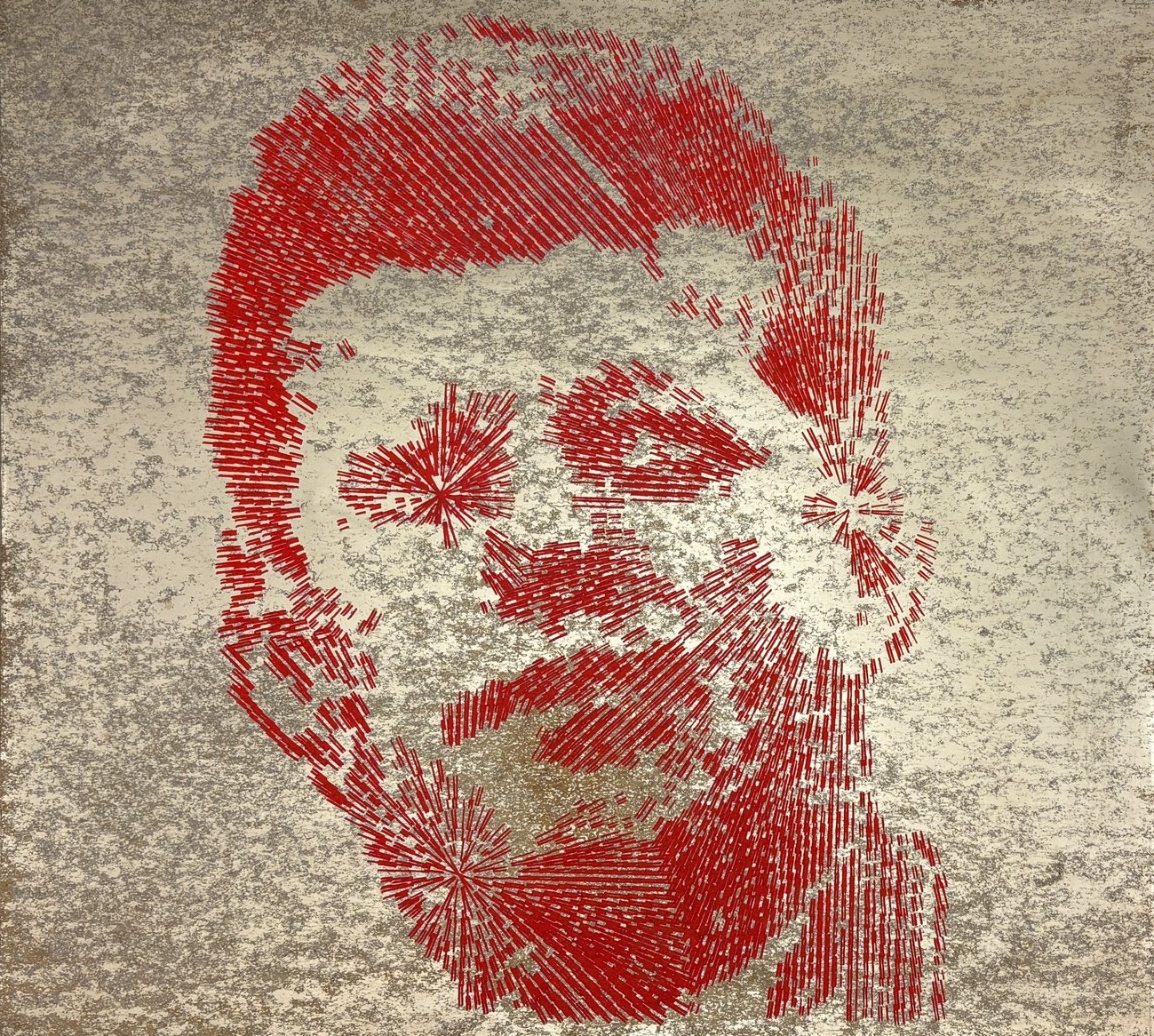
Shot Kennedy No. 2—red dashes radiating from burst points forming a Kennedy portrait on silver
Also titled
Three Shots Kennedy
Medium
Silkscreen, red on silver
Sheet
31.5 × 28.9 in (800 × 735 mm)
Edition
Unnumbered; edition size unrecorded
Only 2 known copies remain: this and the MOT Tokyo copy
Displayed
This copy (panel-mounted): Tokyo Gallery, 1968; Mechanical Design, Toppan Building, 1968; Possible Futures, ICC Tokyo, 2005
This work: Cybernetic Serendipity, 1968; Arte y Cibernética, Buenos Aires, 1969 (as Three Shot Kennedy); Computer-Kunst, Hannover, 1969 (as Three Shot Kennedy)

In this work, every dot of the Kennedy data becomes a dash pointed at one of three set points. The dashes get shorter as they near their point, so each convergence looks like a burst tearing through the face.

At Cybernetic Serendipity it was described as: “Data from a photograph of Kennedy is converted into straight lines converging at one of three points. Idea and programme by Fujio Niwa.” In the Oizumi monograph Niwa explains that each dash’s direction was worked out geometrically using the circle of Apollonius.

Ohtake remembered the idea coming out of a brainstorm, though no one could say later who proposed it: there was an ordinary Kennedy, someone said, it would be fine to shoot it with an arrow, someone else suggested a bullet. In the single-shot version Niwa put the convergence point near the temple; the eyes seemed too direct, and a vital point was meant to shock. Time reviewed the London show in October 1968 and described the photograph as “a series of dashes, all of which converge with sinister impact on the left ear.”

No. 6

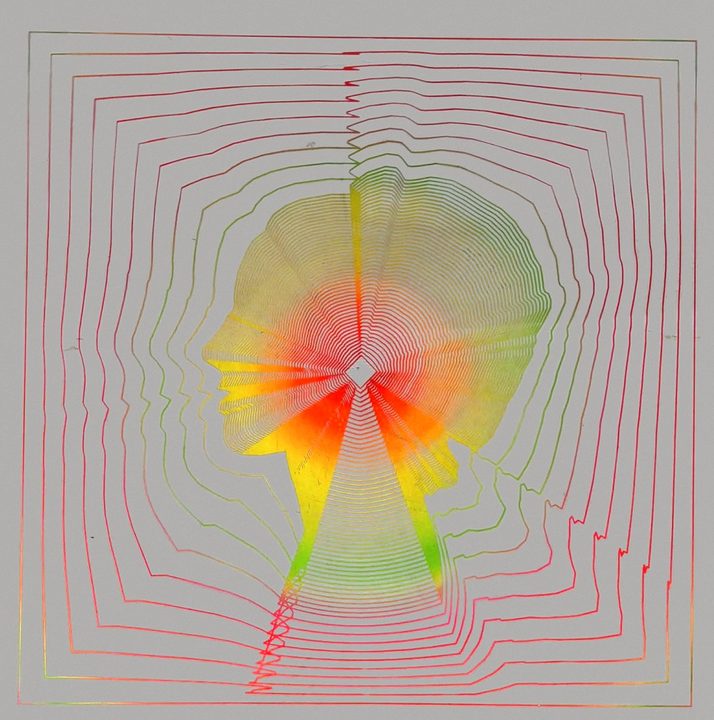
Return to a Square (a), rainbow version 1968

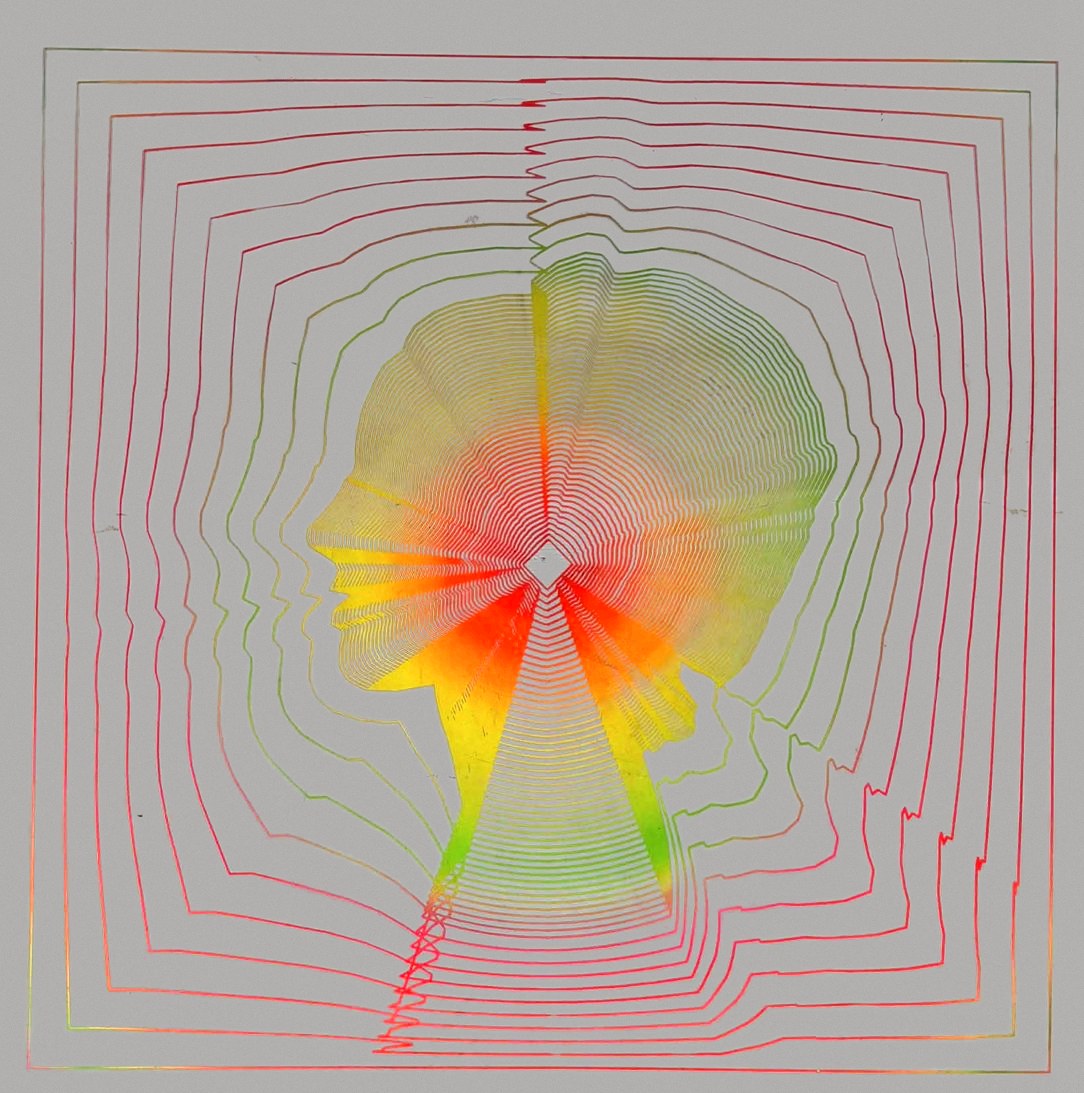
Return to a Square (a)—concentric contours morphing between a woman's profile and a square, sprayed in rainbow color
Medium
Unique impression: silkscreen in graduated color, on Kent paper
Sheet
27.4 × 27.4 in (695 × 695 mm), mounted on panel (edge 1.2 in)
Edition
Unique impression; documented as a test version of color gradation
The only impression made
Displayed
This copy (unique): Possible Futures, ICC Tokyo, 2005
This work (the version-a image): Cybernetic Serendipity, London, 1968; Tokyo Gallery, 1968; Arte y Cibernética, Buenos Aires, 1969

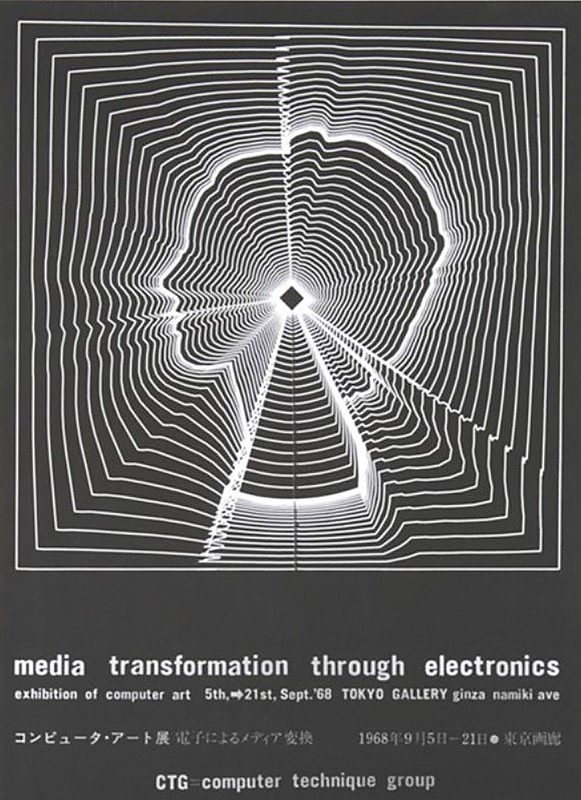
Yamanaka’s program interpolates between a woman’s profile (traced from a William Klein photograph in Vogue) and plain squares set inside and outside it, printing intermediate steps, so the transformation reads as concentric contours. The idea is Kohmura’s.

The algorithm was recreated by Oizumi, who extracted 126 coordinates from the profile and measured the spacing of the printed outlines. Version (a) spaces its outlines at equal intervals: ten outside the profile, fifty inside. Version (b) in contrast compresses the spacing toward the profile following a quadratic rule, with twenty outlines outside the profile and thirty inside, each at a distance proportional to the square of its step count. The gaps start fine against the face and widen steadily toward the square.

One-off colored variants were part of CTG’s practice around the Tokyo Gallery show. A fluorescent Kennedy in a Dog is also recorded.

The work proved to be popular: version (a) was published as a Motif Editions lithograph in London, while version (b) appeared on record jackets including Morton Subotnick’s 1969 Columbia LP Touch and as the poster for the Tokyo Gallery exhibition (No. 13 in this collection).

No. 7

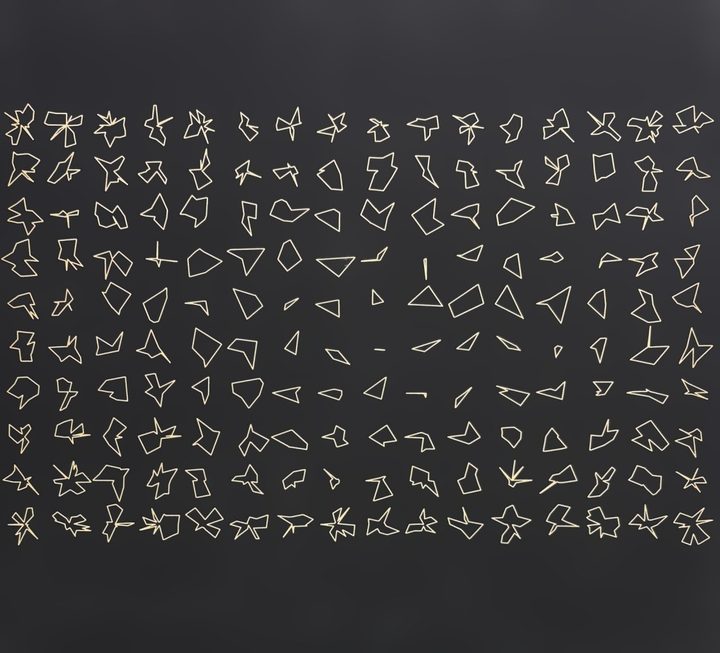
March of Polygons 1968

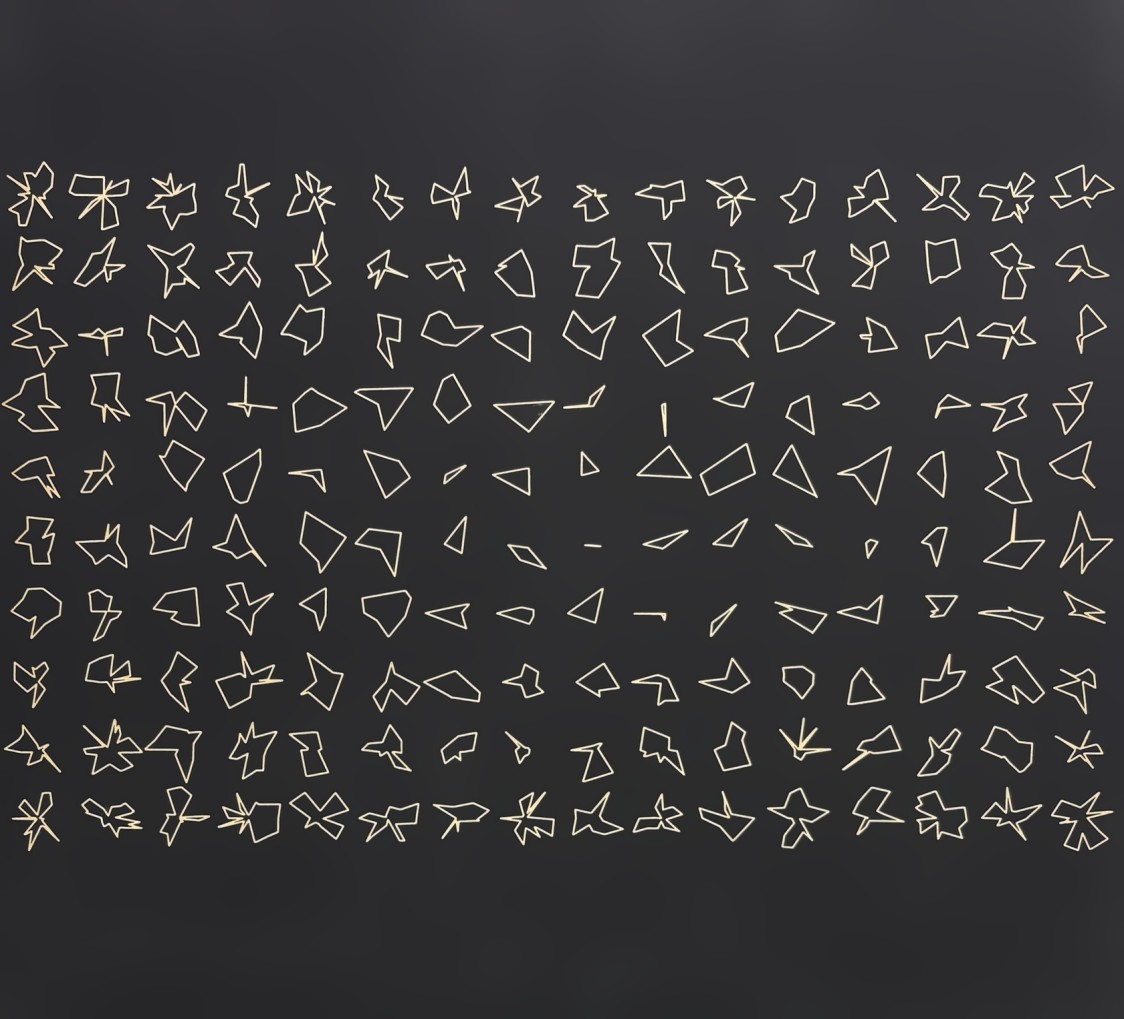
March of Polygons—rows of small random polygon outlines in white on a black panel
Medium
Silkscreen on Kent paper, affixed to wooden panel with paper tape
Sheet
28.7 × 31.5 in (730 × 800 mm)
Marks
CTG stamp on verso
Edition
Unnumbered; edition size unrecorded
The only extant copy known
Displayed
This copy: Tokyo Gallery, 1968; Mechanical Design, Toppan Building, 1968; Possible Futures, ICC Tokyo, 2005
This work: Cybernetic Serendipity, London, 1968; Arte y Cibernética, Buenos Aires, 1969

Rows of small, closed figures cross the field. For each figure, the number of vertices is fixed in advance but their placement is decided by random numbers. In this way, each polygon is alike but different in implementation.

The Cybernetic Serendipity catalog lists this work crediting Tsuchiya with both idea and program. This work is perhaps the purest information-aesthetics of the group’s output, standing closer to works Nake and Nees were plotting in Germany than to the Kennedy series.

No. 8

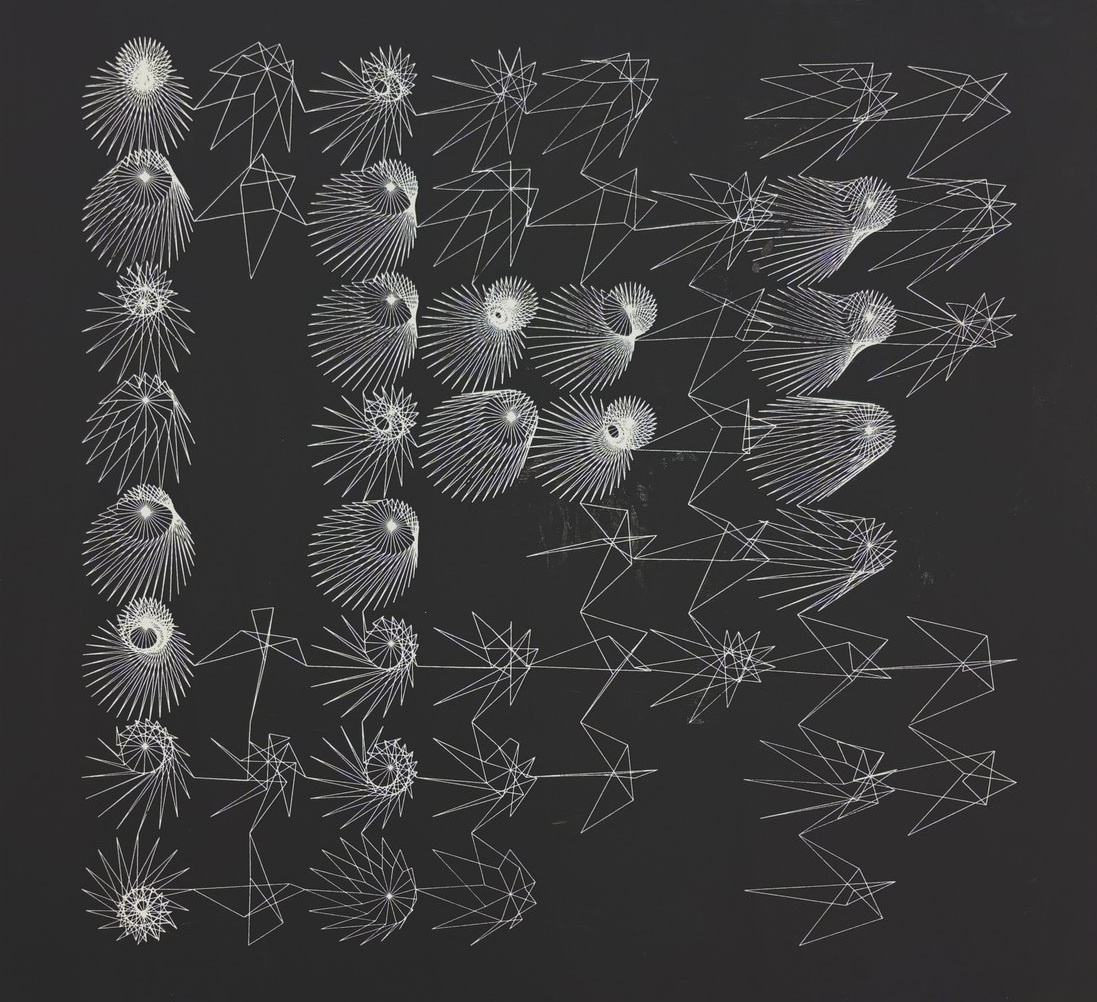
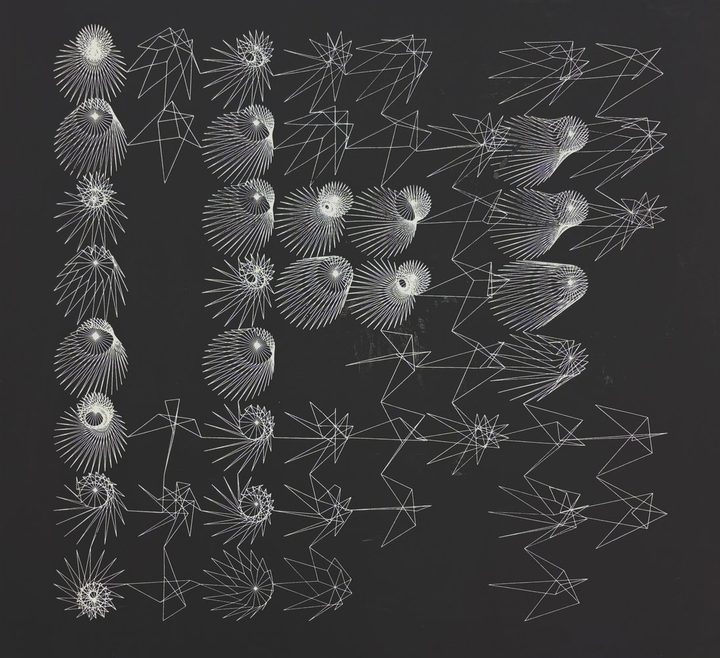
Twisted Circle 1968

Twisted Circle—white radial circle forms progressively twisting into angular zigzag clusters on black
Also titled
Collection of twisted circles (period title, per the 1969 Arte y Cibernética catalog)
Medium
Silkscreen, white on black
Sheet
31.3 × 43.0 in (796 × 1092 mm)
Edition
Unnumbered; edition size unrecorded
The only extant copy known
Displayed
This work: Tokyo Gallery, 1968; Mechanical Design, Toppan Building, 1968; Arte y Cibernética, Buenos Aires, 1969 (as Collection of twisted circles, catalog no. 17); Computer-Kunst, Hannover, 1969 (as Twisted Circles)

Each figure is one continuous plotter line, stepping around a circle and back toward its center. Where the angular step is small the strokes bunch into a dense fan; where it is large the line leaps across the circle and the figure collapses into a zigzag star. The step changes from cell to cell, so fans and angular figures alternate across the sheet. The pen’s travel between figures joins the whole sheet into a single unbroken line.

No. 9

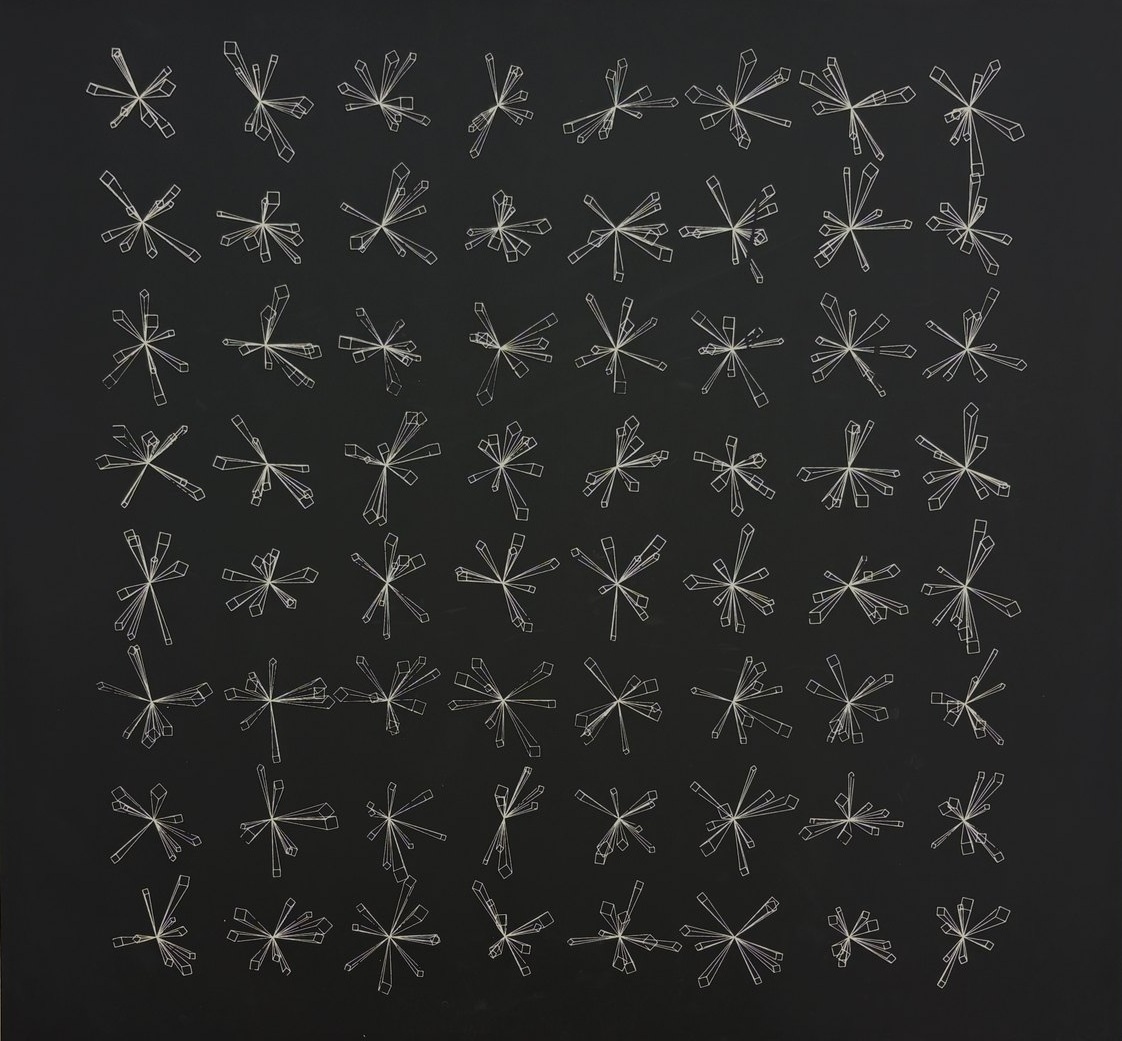
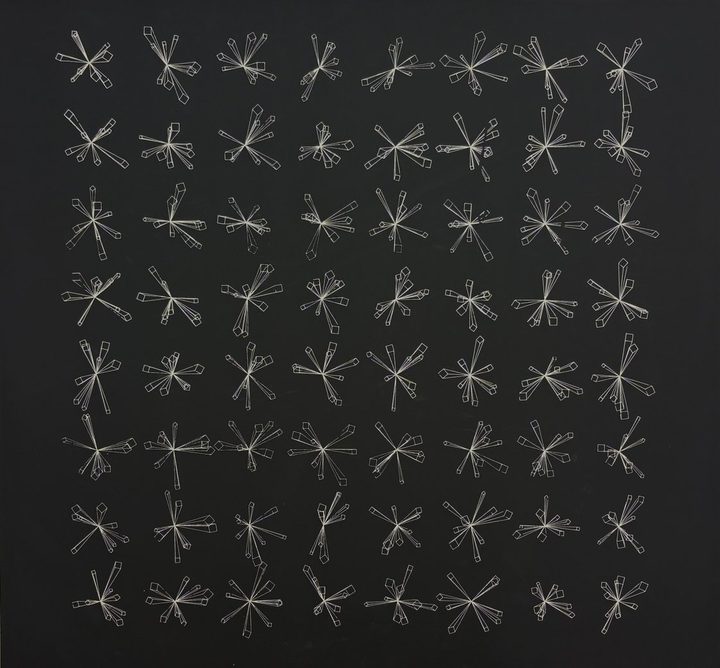
Perspective Pillar Collection 1968

Perspective Pillar Collection—grid of white pillar clusters radiating in perspective on black
Also titled
Random Pillar Collection (period title); Collection of Random Pillars in the 1969 Arte y Cibernética catalog; Perspective Pillar Collection in the 1969 Computer-Kunst catalog
Medium
Silkscreen, white on black
Sheet
31.3 × 43.0 in (796 × 1092 mm)
Edition
1 of 2 known impressions (both in this collection)
Displayed
This work: Tokyo Gallery, 1968; Mechanical Design, Toppan Building, 1968; Arte y Cibernética, Buenos Aires, 1969 (as Collection of Random Pillars, catalog no. 19); Computer-Kunst, Hannover, 1969 (as Perspective Pillar Collection)

Each cell of the grid is a cluster of rectangular pillars drawn in perspective and bursting outward from a center. This image is repeated with random variation across the sheet.

Unlike most of the collection, the work was not part of the Cybernetic Serendipity submission. It was shown for the first time at the group’s Tokyo Gallery exhibition in September 1968 and went on to the Mechanical Design show at the Toppan Building that October, then to Buenos Aires and Hannover.

No. 10

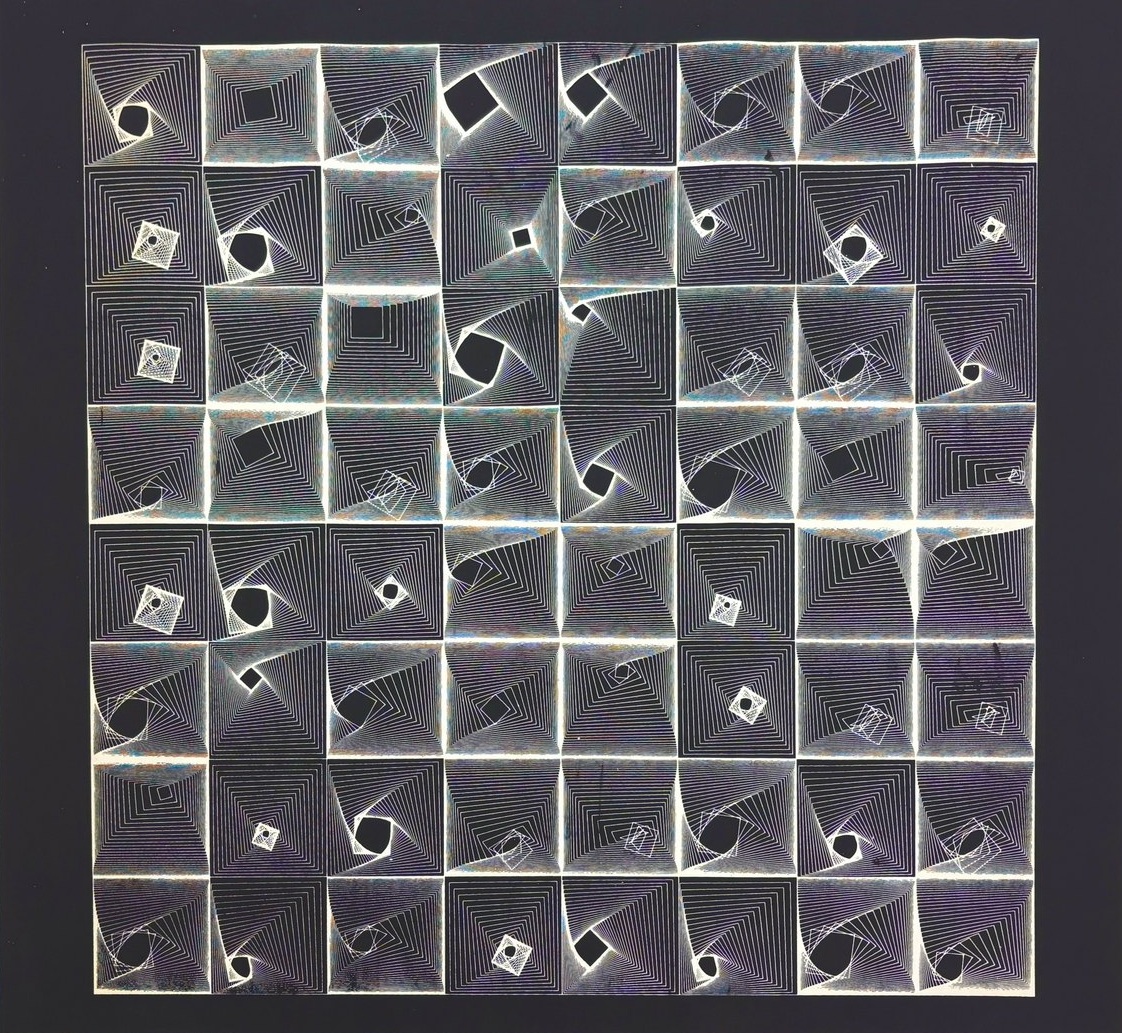
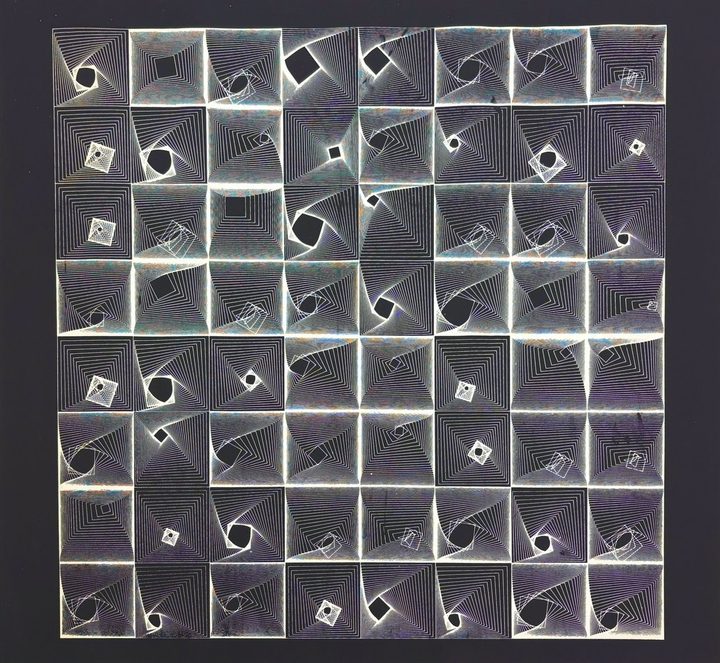
Collection of Random Windows 1968

Collection of Random Windows—grid of concentric-square window cells in white on black
Also titled
Multiple Windows (period title)
Medium
Silkscreen, white on black
Sheet
31.3 × 43.0 in (796 × 1092 mm)
Edition
Unnumbered; edition size unrecorded
The only extant copy known
Displayed
This work: Tokyo Gallery, 1968; Mechanical Design, Toppan Building, 1968; Arte y Cibernética, Buenos Aires, 1969 (catalog no. 20); Computer-Kunst, Hannover, 1969 (as Collection of Random Window)

Every cell of the grid is a window of nested squares spiraling inward toward an aperture whose position changes with random numbers. In the work, the overall layout has been predetermined, but the details are determined by randomness. No member is credited with idea or program.

Like Perspective Pillar Collection, it was not part of the Cybernetic Serendipity submission; it was shown for the first time at the Tokyo Gallery exhibition in September 1968.

No. 11

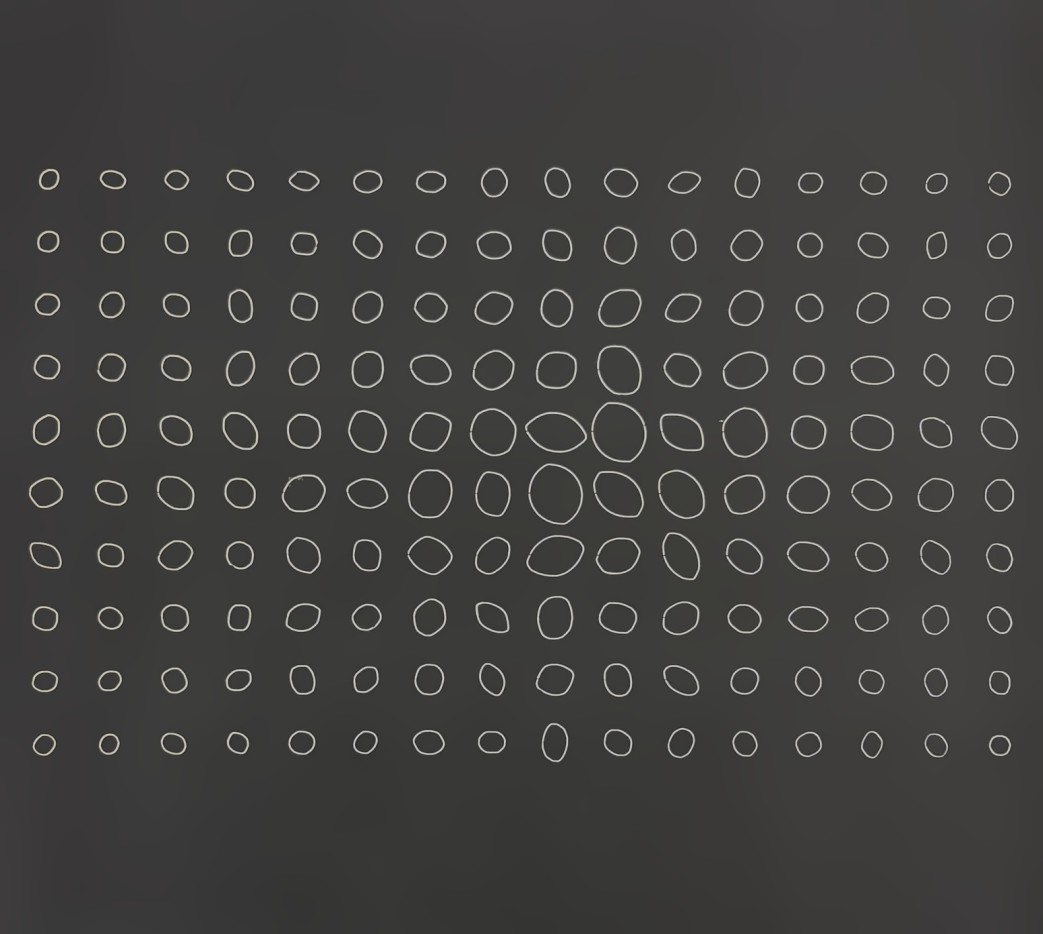
Miracle Stones 1968

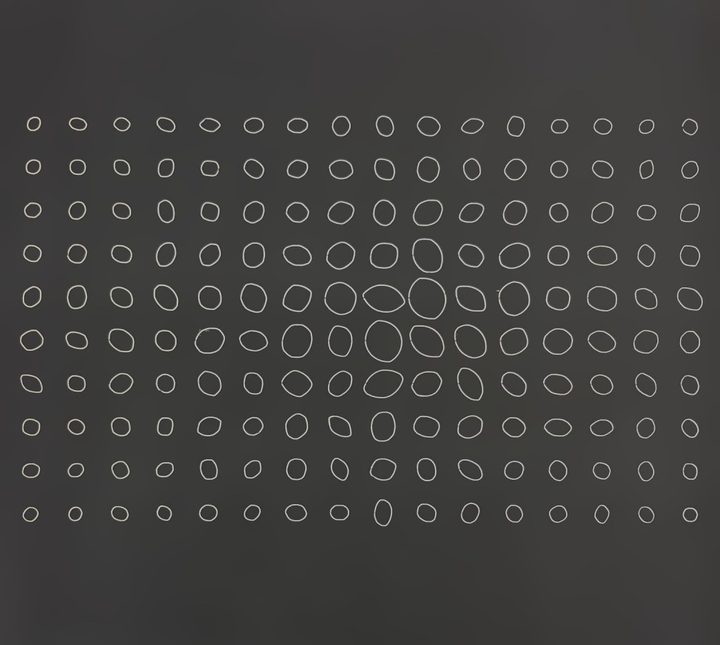
Miracle Stones—rows of small irregular white oval outlines on black
Medium
Silkscreen on Kent paper
Sheet
31.3 × 42.9 in (795 × 1090 mm)
Edition
No edition number
The only known copy of the black version
Displayed
This work: Cybernetic Serendipity, 1968; Tokyo Gallery and Mechanical Design, Toppan Building, 1968 (black version); Arte y Cibernética, Buenos Aires, 1969; Computer-Kunst, Hannover, 1969

Rows of small stone-like ovals. While size and position are predetermined, the shape of each stone is decided by random numbers, with no two exactly the same. Tsuchiya is credited with idea and program.

No. 12

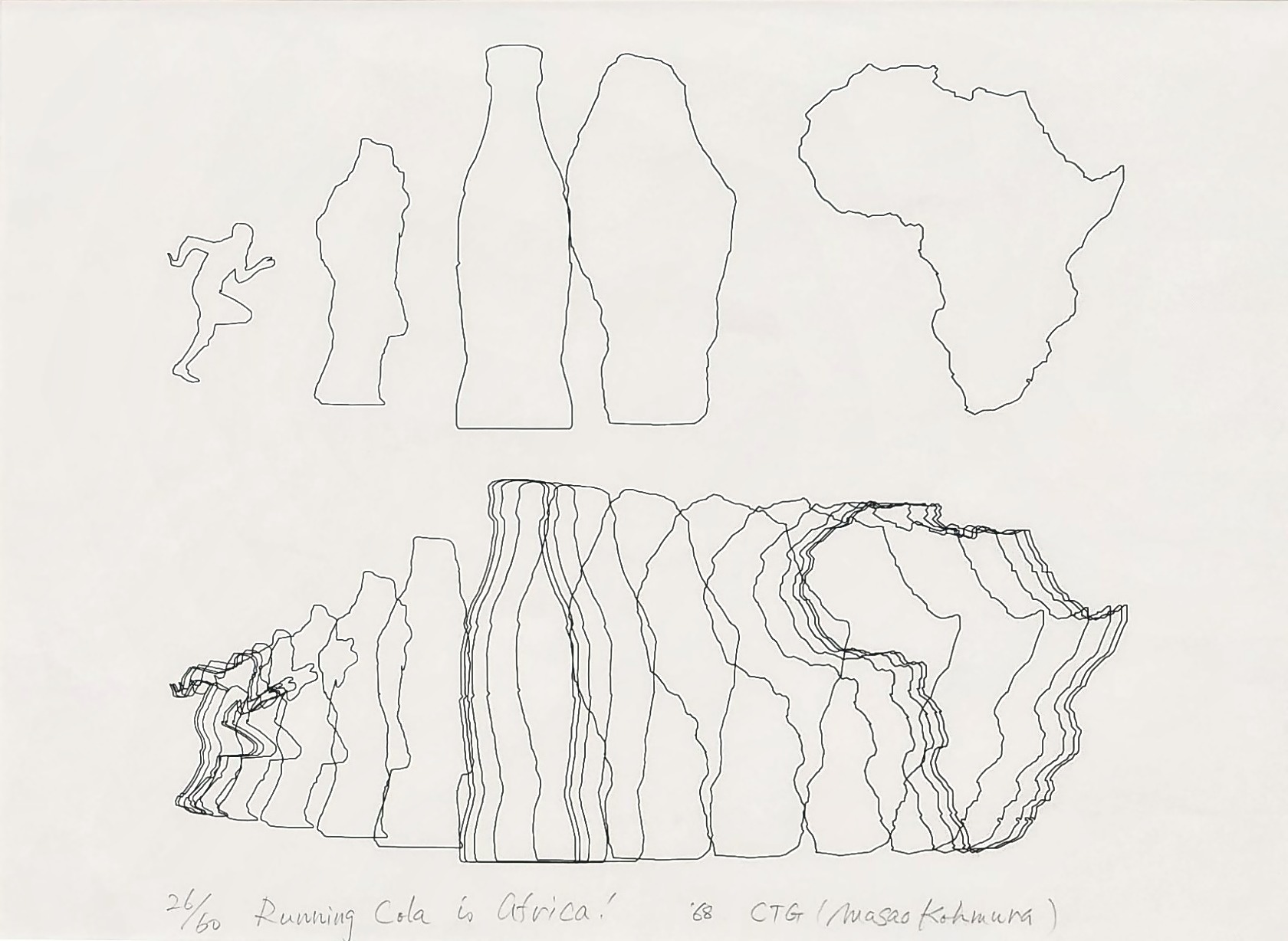
Running Cola is Africa! 1968

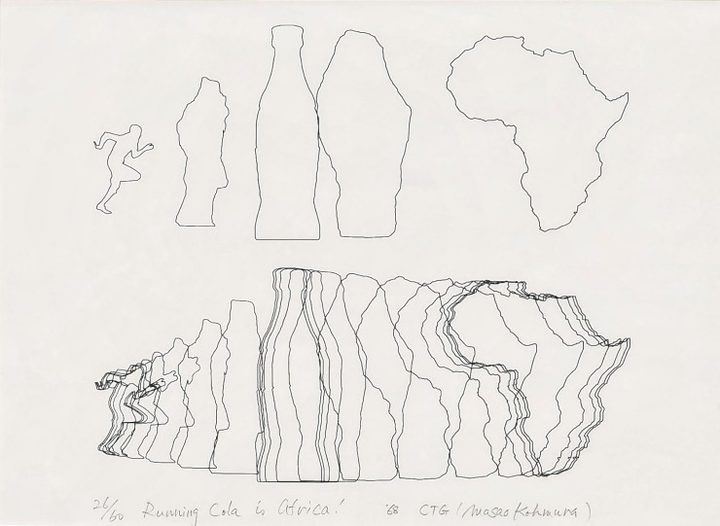
Running Cola is Africa!—line metamorphosis from a running man through a Coca-Cola bottle to the map of Africa
Medium
Silkscreen after the plotter drawing, signed; on ARCHES 88 paper
Sheet
22.4 × 29.9 in (568 × 760 mm)
Edition
26/60, from the signed edition of 60
Located from the edition: this impression, the ICC-shown 56/60, an impression in a private collection, and the V&A artist’s proof; MOT Tokyo also holds a larger 70 × 90 cm silkscreen
Displayed
This work: Cybernetic Serendipity, 1968; Arte y Cibernética, Buenos Aires, 1969 (the Motif Editions lithograph); SIGGRAPH ’86 (signed edition); Arts on Computer, O Art Museum, Tokyo, 1987 (a 1968 silkscreen); ICC Tokyo, 2005 (impression 56/60)

Perhaps the group’s most famous work. A running man becomes a Coca-Cola bottle becomes the map of Africa. The top half shows the three source outlines with two intermediate figures between them; the lower half shows the fuller transformation, the computer interpolating between the images in steps. Three members share the credits: idea by Kohmura, coordinate data by Makoto Ohtake and Kohmura, program by Koji Fujino. The work was computed in late 1967 or early 1968 and is an early landmark of shape-interpolation.

The image exists in at least three print formats: the unsigned Motif Editions lithograph published in London, the signed edition of sixty printed under Kohmura’s own supervision, and a larger 70 × 90 cm silkscreen (the format of the MOT Tokyo copy).

The image ran in the Spring 1969 Whole Earth Catalog and again inside The Last Whole Earth Catalog of 1971. The Computer Arts Society’s bulletin PAGE reviewed the work (1970): “‘Running Cola is Africa’ announces that a System exists and does it in a way far more impressive than words.”

No. 13

Media Transformation through Electronics 1968

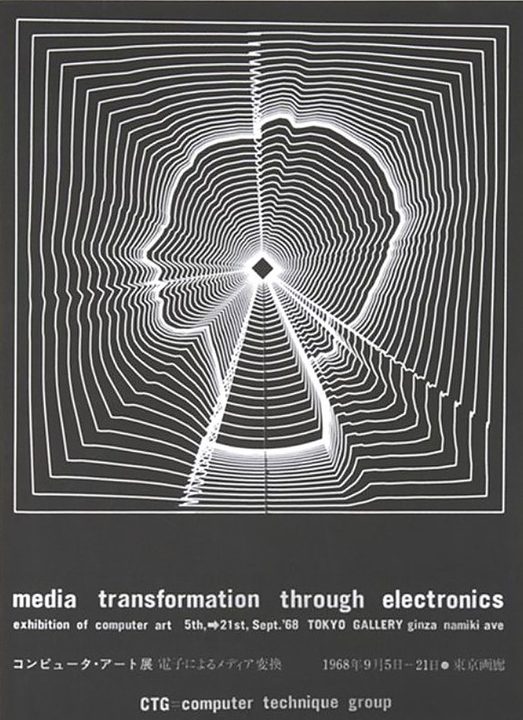
Exhibition poster for Media Transformation through Electronics, Tokyo Gallery 1968, showing Return to a Square (b)
Medium
Exhibition poster, silkscreen
Sheet
27.6 × 23.6 in (700 × 600 mm)
Exhibition
“Exhibition of Computer Art: Media Transformation through Electronics,” Tokyo Gallery, Ginza, September 5–21, 1968
Depicts
Return to a Square (b)
Edition
Poster edition, size unrecorded
One other copy located (MOT Tokyo)
Displayed
This work: its own exhibition at Tokyo Gallery, 1968; Mechanical Design, Toppan Building, 1968; Possible Futures, ICC Tokyo, 2005
The Return to a Square (b) image (as a 1968 silkscreen): Arts on Computer, O Art Museum, Tokyo, 1987

The poster for CTG’s only solo exhibition, held at Tokyo Gallery in Ginza for two and a half weeks in September 1968. It reproduces Return to a Square (b). Most of the works in this collection hung in that exhibit. The exhibition also introduced APM No. 1, an interactive painting machine with light and sound sensors that painted with four color spray guns on an X-Y carriage. What the members wanted was full-color computer output, then out of reach, so they built it from spray guns. A year later CEAC reproduced the same image on its poster for Arte y Cibernética in Buenos Aires (see the Ephemera tab).

Sources for these entries

The primary source throughout is Kazufumi Oizumi, The Genesis of Computer Art: The Trajectory and Thought of CTG 1966–1969 (NTT Publishing, 2015)—production and printing detail, period titles, and the works and exhibition records of its appendices. The algorithm accounts in these entries—the Kennedy dataset and program, and the line spacings of Return to a Square and Running Cola is Africa!—follow the monograph’s fourth chapter, Oizumi’s program-level study and reconstruction of works whose original code and data do not survive; those findings are his. Facts particular to these sheets—the Toppan printing, which copies hung where, the rescue of Kennedy in the Net—rest on correspondence with Oizumi and with Megumi Matsuo of VOICE GALLERY (July and September 2026), cited in place. Exhibition and edition claims were checked against the Cybernetic Serendipity catalog (1968), the checklist of Arte y Cibernética (Galería Bonino, Buenos Aires, 1969; this collection’s copy), the works list of Arts on Computer (O Art Museum, Tokyo, 1987; this collection’s copy), and the collection records of the Museum of Contemporary Art Tokyo, the V&A, the ICC, and the National Museum of Modern Art, Kyoto. Period press supplied particulars: Time (October 1968), Asahi Journal, Bijutsu Techō no. 303 (October 1968), and the Computer Arts Society’s bulletin PAGE (1970), digitized for this research.