Resources 関連資料
Ragnar Digital Collection
This catalog is part of the Ragnar Digital Collection, a collection of historical computer art from the 1950s to today, spanning the movement’s pioneers across specialized collections of South American computer art, Japanese computer art, oscilloscope art, and the field’s female pioneers. Ragnar Digital is dedicated to the preservation, curation, and advocacy of computer art: stewarding the works, championing the artists, and telling the stories. The collection was founded by Michael Bogan, a historian and advisor on historical computer art. All original research and writing in this catalog is his.
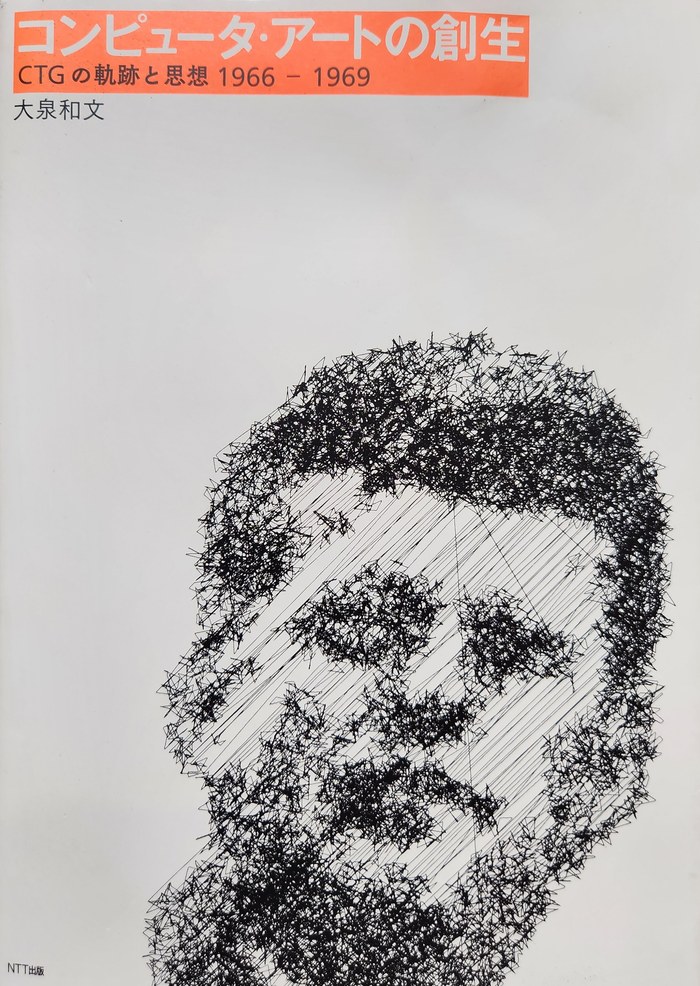
The Genesis of Computer Art: The Trajectory and Thought of CTG, 1966–1969
The definitive monograph on CTG and the authoritative source behind much of this site. Built from the group’s primary documents and interviews with the members, it records the complete works, the exhibition history, and the engineering. In 2016, the ten members admitted Oizumi to CTG as the 11th member.
Cybernetic Serendipity at the ICA—period television footage (1968)
A walkthrough shot inside the ICA while the exhibition was open, introduced by its curator, Jasia Reichardt. From 2:31 the camera shows CTG’s Kennedy transformations as hung on the gallery wall.
Arte y Cibernética—period film, Buenos Aires (c. 1970)
Period footage of the Arte y Cibernética exhibition at Galería Bonino (the film’s titles: August 1970), with Shot Kennedy No. 1 and Kennedy in a Dog on the walls. Apart from the Cybernetic Serendipity documentary, it is the only known film of CTG works as they hung in an exhibition.
Kelemen to the members—the Tendencije 4 invitations (1969)
Dr. Boris Kelemen’s invitation to CTG for “Computers and Visual Research,” Zagreb, works due April 20—with “the flow diagram, programme, datas about the computer used” requested alongside the art. Seven identical letters, one typed for each member at the group’s Kitasuna address. Kohmura’s is the one shown on the Timeline.
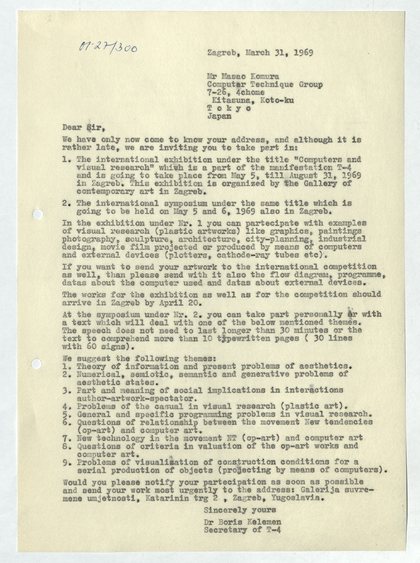
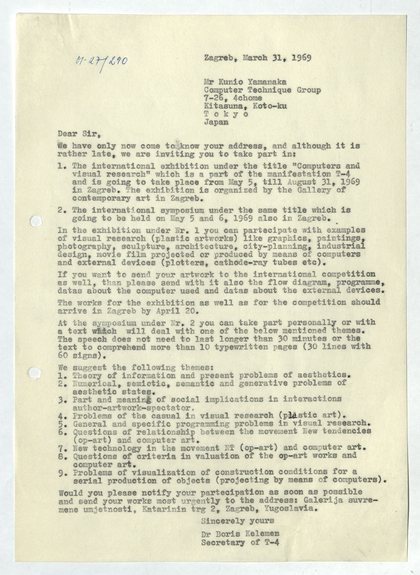

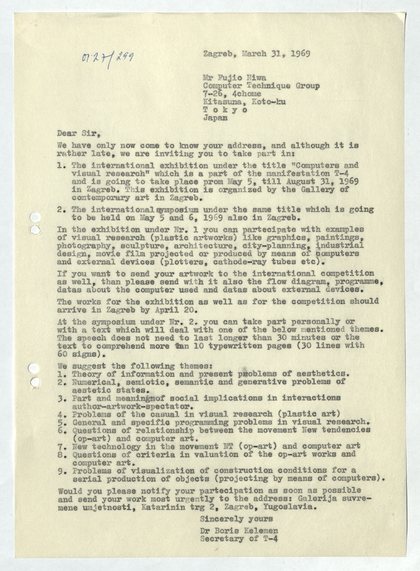
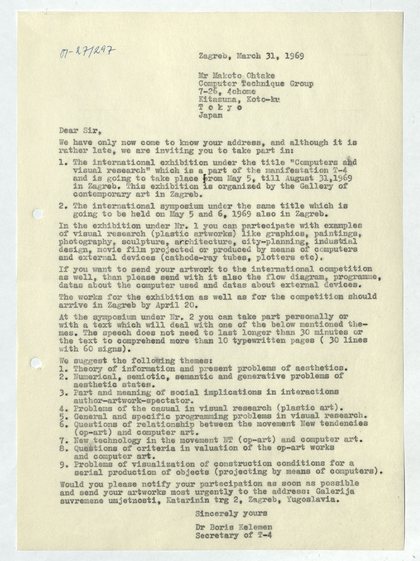
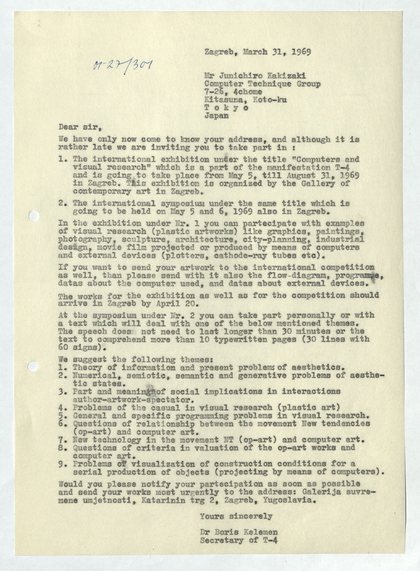
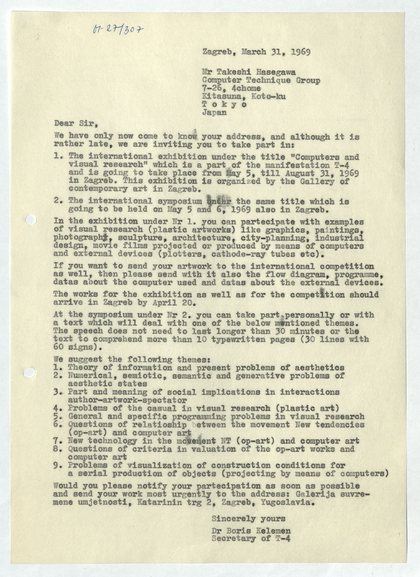
In the Zagreb archive: Kohmura · Yamanaka · Fujino · Niwa · Ohtake · Kakizaki · Hasegawa
- Computers and Automation, August 1968—the Sixth Annual Computer Art Contest issue, seven CTG works; scan at bitsavers.
- Whole Earth Catalog, Spring 1969—Running Cola is Africa! heading the Cybernetic Serendipity review, p. 63; scan at the Internet Archive.
- Computer Art, National Gallery of Modern Art, New Delhi, 1972—the tour’s farthest stop, CTG at cat. 116–134; scan at Monoskop.
- Kohmura’s Flickr archive, “CTG 1966~1969”—the artist’s own photographs of the group’s posters, prints, punch cards and documents.
- Tsuchiya’s CTG page—with Oizumi’s history of the group, the Asahi Journal article of January 1969 and Reichardt’s inscribed book.
Museum of Contemporary Art Tokyo (MOT)
The largest confirmed institutional CTG holding anywhere: twelve works donated in 2019 by Kazufumi Oizumi, author of the standard monograph. Includes Computer Design Series Nos. 2 and 3; the Kennedy deformations Random Walk Kennedy, Star Kennedy, Cube Kennedy, Shot Kennedy No. 2, Kennedy in a Rectangle and Kennedy in a Dog; Return to a Square (b) and its poster version; a larger-format Running Cola is Africa! silkscreen; and the 16mm film Computer Movie No. 2 / Computer + Something.
Victoria and Albert Museum
The signed artist’s proof of Running Cola is Africa!, ex-collection of the historian Patric Prince (gift, 2008), and a four-lithograph Return to a Square (a) mounted as one work on silver paper, possibly period CTG production. The museum also holds the seven-print Motif Editions portfolio, bought from the exhibition in 1969.
Sprengel Museum Hannover
Käthe Clarissa Schröder’s Sammlung Clarissa passed to the City of Hannover and was inventoried by the Sprengel Museum in 1996–99. The museum’s collection records list nineteen CTG objects, none original silkscreens: the Motif Editions Running Cola is Africa! and Return to a Square (a), plus sixteen photographic enlargements.
Reconsidering Japan’s Early Computer Art (series, 2024–2026)
A serial history of Japan’s first computer artists by the artist and researcher hasaqui. The third installment is on CTG; the others place the group among its contemporaries, from Kawano’s first images to the computer-controlled pavilions of Expo ’70.
- 1. Early Computer Art and 1968 (June 2024)
- 2. Hiroshi Kawano’s Computer Art and His View of the Program (June 2024)
- 3. Artists and Engineers: around CTG and Mutsuko Sasaki (September 2024)
- 4. Eiichi Izuhara’s Trees and Graphic Language (February 2025)
- 5. Computer Art and Poetry (September 2025)
- 6. Computers and Their Control at Expo ’70: the Work of Manabu Yamada and Yoshio Tsukio (April 2026)
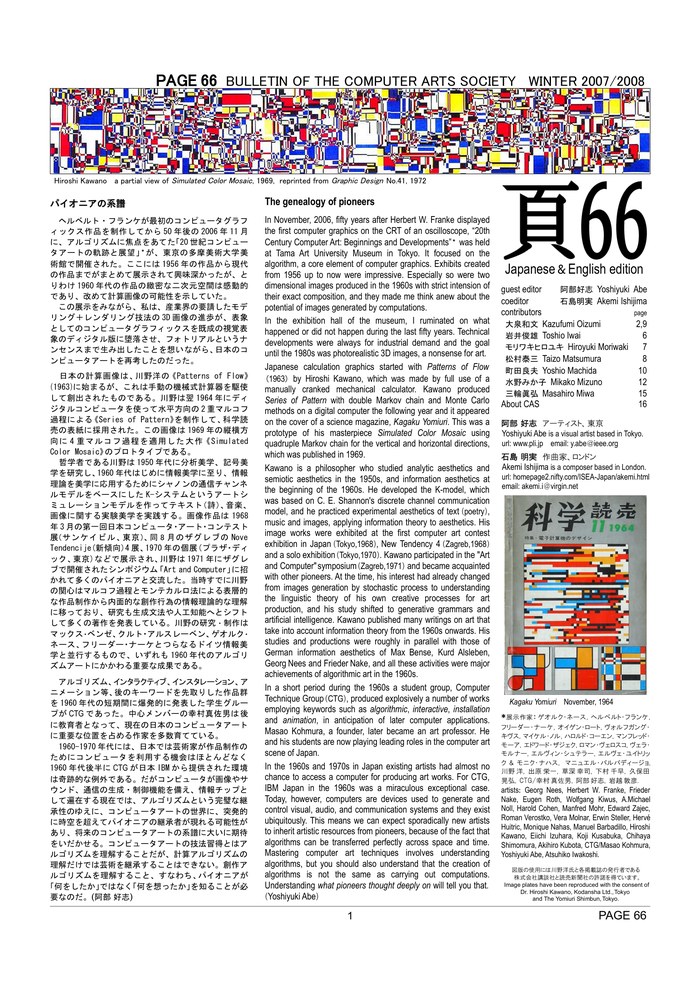
PAGE 66: Bulletin of the Computer Arts Society, Japan special issue
A bilingual special issue on Japanese computer art, opening with Kazufumi Oizumi’s essay on CTG: the manifesto in English, the group’s history and dissolution (with Tsuchiya’s “Good-bye, Computer art!” statement).
“Good-bye, Computer art!”—the Tsuchiya interview さようなら、コンピュータアート
A long interview with Tsuchiya, from the Tōdai mainframe years and the IBM arrangement to the dissolution and his turn to energy research.
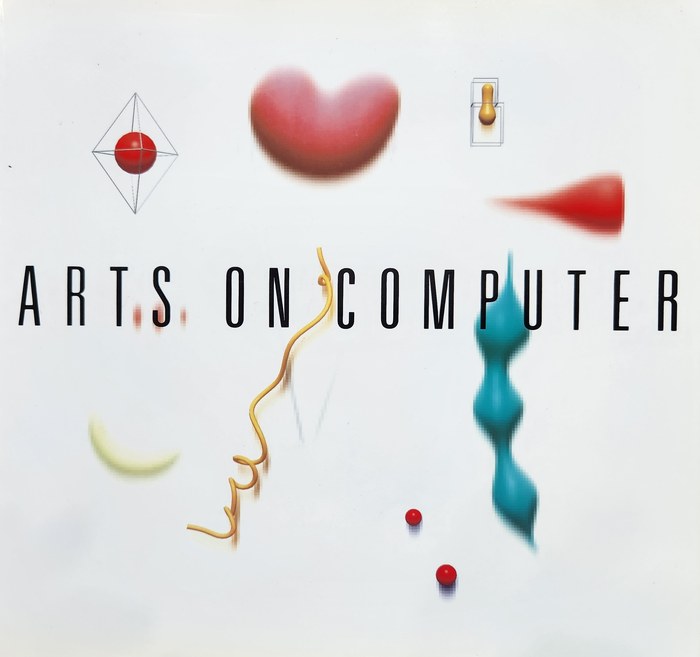
Arts on Computer: Japanese C·G Art
The catalog of the O Art Museum’s inaugural exhibition (June 26 – July 29, 1987), a twenty-artist survey of Japanese computer graphics whose Pioneers section placed Kohmura beside Hiroshi Kawano, Tsukio/Yamada and Eiichi Izuhara.
Findings of this collection’s research, 2026
The Buenos Aires tour (July 2026). Institutional deliveries obtained by this research—the Museo de Antioquia’s Medellín catalog, the MNAV’s digitization of the Montevideo catalog, press clippings and a thesis from MAC Lima, and photographs from Fundación Espigas—establish the arc of the twenty Buenos Aires works: twenty at Bonino (opening August 18, 1969), twenty still together in Santa Fe that November, twelve at Medellín by June 1970, two at Lima in October 1971.
The 1971 catalog, read in full (August 2026). The complete loose-sheet catalog of Arte y Cibernética: San Francisco – Londres – Buenos Aires (April 1971) was located in the Jean Brown Papers at the Getty Research Institute: its roster—the Buenos Aires group, Charles Mattox, and eleven Computer Arts Society artists—contains no Japanese works, establishing that CAyC’s international relaunch of the program proceeded without the CTG corpus. Glusberg’s introductory essay preserves a period statement by the group otherwise absent from the record: “Computer art … has something to say about time, space and existence. An object is transformed via a magnetic tape into a set of information units, transferred through two simple affirmations: 1 or 0.”
The Washington cancellation, documented (August 2026). The files of Frank A. Taylor, the Smithsonian’s Director General of Museums, obtained from the Smithsonian Institution Archives, establish that Cybernetic Serendipity was never shown at the Smithsonian: the exhibition reached Washington in December 1968 so badly damaged—graphics scuffed, torn and warped in their crates, machines beyond economic repair—that the Institution canceled both its own presentation and the booked national tour, and Jasia Reichardt personally arranged the Corcoran Gallery showing as a salvage, with roughly two-thirds of the London material.
The American showings, documented (September 2026). The Corcoran Gallery of Art records at George Washington University’s Special Collections Research Center show the ICA’s packing list for the Smithsonian shipment. It itemizes the Computer Technique Group as ten photographic enlargements with one caption, plus a single enlargement of the poetry sheet, and confirms that the originals did not travel from London.
Arts on Computer, 1987 (August 2026). The catalog of the O Art Museum’s inaugural exhibition, acquired for the collection, documents three 1968 CTG silkscreens eighteen years before the ICC together with Kohmura’s written statements of 1987 and the 1973 Kohmura–Ishioka–Tsuchiya Mao portrait.
Sōgetsu screening, 1970 (August 2026). Japan’s national Media Arts Database preserves the program of the New Film & New Rock festival at Sōgetsu Kaikan, November 18, 1970—Computer Movie No. 2.
Zagreb letters (August 2026). Seven letters of March 31, 1969, from Dr. Boris Kelemen to seven CTG members, inviting the group into Tendencije 4 with three weeks’ notice, were located in the Museum of Contemporary Art Zagreb’s digitized archive; scans are held in the collection’s research archive.
Goethe-Institut tour (August 2026). The tour’s Italian catalog (Computer e arte, 1971; this collection), the Otto Beckmann family archive’s transcription of Käthe Schröder’s own itinerary, the Computer Arts Society’s PAGE bulletins, and German library records together document some thirty stations across ten countries, 1970–73—including a 58,000-visitor showing at the City of Liverpool Museum—while confirming that the tour traveled largely with photographic reproductions. The Sammlung Clarissa sheets now at the Sprengel Museum are themselves cataloged as photographs (see Sprengel Museum Hannover, above); whether an original silkscreen set ever came to Germany is unresolved. Herbert Franke’s Wege zur Computerkunst, which toured in the same years, was a separate exhibition with its own itinerary and published roster; no CTG originals are recorded as reaching the Kunsthalle Bremen with the Franke collection.
ARTRIP series (August 2026). The Tobunken exhibition index dates Cybernetic ARTRIP ’73 to October 7–21, 1973; the Hayama Kōmei archive at Nagano University and Computopia document a 1974 edition, and identify the series’ organizer as the Computer Art Center (founded 1972).
Kohmura in the seventies (August 2026). The Tobunken gallery records place his 1975 solo show at Tamura Gallery; Fujiko Nakaya’s first-person history documents his co-organization of Video Week at the American Center Tokyo (October 1972); the 1987 catalog records his 1972 State Department–invited study tour of American research institutions.
Period reception (August 2026). The complete run of the Computer Arts Society’s PAGE (1969–75) has been digitized, yielding the 1970 review of the Motif prints and the contemporaneous Venice notice quoted in these pages, and establishing that no CAS exhibition of those years is recorded showing a CTG work.
Period-publication record (July–August 2026). The twenty-eight-issue cover series of the NHK Symphony Orchestra’s Philharmony (1969–71) and its two CTG articles, including Tsuchiya’s September 1969 reflection quoted in the introduction; the two-page CTG section and six plates in IBM-Informatique no. 13 (IBM France, 1975); and Eiko Ishioka’s 1973 bindings for the Ningen no Seiki series, carrying the Return to a Square construction.
The group’s writings (August 2026). The Writings tab carries the group’s own texts in Japanese and English—the two manifestos, the essays and columns of 1967–1997, and Tsuchiya’s farewell statement from the dissolution event. Two of them were recovered by searching under member names rather than the group’s: Tsuchiya’s “On the Creative Power of Machines” (Computopia, March 1969), and Kohmura’s “Computer Art Apocalypse,” found in the collection’s copy of the May 1969 “Man and Technology” special.
Japanese Culture showing (August 2026). The catalog of Japanese Culture: The Fifty Postwar Years (1995) records Sine Curve Kennedy touring four museums that year as Deformation of Kennedy, lent from Kohmura’s keeping.
Tokyo Gallery show (August 2026). Bijutsu Techō no. 302 (September 1968) prints the show’s preview in its exhibition calendar—“the group’s first works exhibition,” with a halftone of Kennedy in a Dog—and carries Tragedy of Seven as the issue’s frontispiece. Kagaku Asahi of October 1968 prints three further works and a third period source for the group’s Cybernetic Serendipity entry: 24 pictures, 2 pieces of music, 10 poems.
Kohmura at the 1974 Tokyo Biennale (August 2026). The catalog of the 11th Japan International Art Exhibition confirms the appearance and names the work: Object Collection ’74—This, Too, Is Hyperrealism, a video.
Copyright, reproduction and attribution
Copyright in the artworks themselves remains with the members of CTG.
Photographs are credited wherever their authorship is known. Several period magazine photographs are uncredited in the original, among them the group portrait of CTG and the portrait of Kunio Yamanaka in Bijutsu Techō no. 304.
Translations from the Japanese are this collection’s own, except where a period English printing is used and identified—the 1969 English of the art-Duchamp system essay. The texts on the Writings tab are transcribed from the collection’s copies and from Oizumi’s corrected transcriptions; the rights in them remain with their authors, and they are presented for study.